组成图示
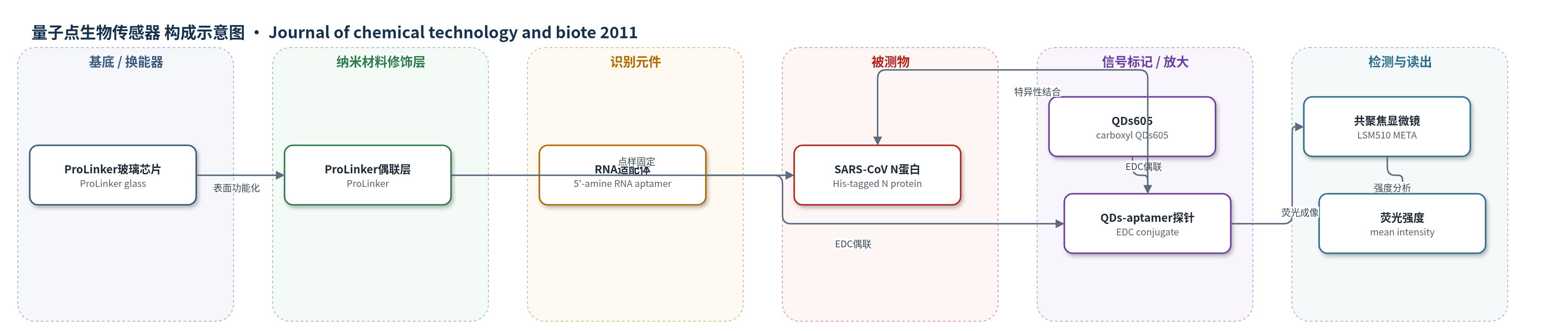
点击图片查看大图 · 依据论文自动绘制
传感器类型
量子点生物传感器
检测对象
SARS冠状病毒核衣壳蛋白(SARS-CoV N protein / Nucleocapsid protein);样品基质为重组蛋白点样缓冲液/蛋白芯片点样液
检测原理
将His-tagged SARS-CoV N蛋白点样固定于ProLinker功能化玻璃芯片;5'端氨基RNA适配体经EDC与羧基化QDs605形成酰胺键,制备QDs-aptamer探针。探针与芯片上N蛋白特异性结合,未结合探针经磷酸盐缓冲液洗去。结合位点处QDs605在激光激发下发射605 nm荧光,N蛋白浓度越高,结合探针越多,局部荧光强度越大。共聚焦激光扫描显微镜采集图像并计算平均强度,实现定量检测。
检测灵敏度
LOD: 0.1 pg mL−1
效应效果
该芯片对SARS-CoV N蛋白具有良好选择性,BSA蛋白芯片未检测到明显荧光,信号接近背景,表明非特异结合低。检测限0.1 pg mL−1,较文献适配体化学发光免疫分析提高至少10倍;整个检测可在1 h内完成,适合快速筛查。作者认为该方法具有高灵敏度、良好特异性、操作简便、可单点监测等优点,可避免ELISA等抗体方法在早期感染、假阳性/假阴性及二次抗体偶联方面的限制,可作为SARS-CoV N蛋白诊断原型芯片,并拓展至多种疾病检测。
传感器的构成
- 基底/换能器:ProLinker功能化玻璃芯片(ProLinker-terminated glass slides, ProteoChip),提供双功能偶联表面用于固定蛋白。
- 捕获/靶标固定层:重组SARS-CoV N蛋白(His-tagged N protein),点样固定于芯片表面,作为适配体结合靶标。
- 识别元件:RNA适配体(5'-gggagagcggaagcgugcugggccugucgguucgcugucuugcuacguuacguuacacgguuggcauaacccagaggucgauggaucccccc-3'),特异性识别N蛋白。
- 信号标记物:QDs605(Invitrogen quantum dots, 605 nm emission),偶联于适配体,提供荧光信号。
- 偶联修饰:EDC(N-(3-dimethylaminopropyl)-N'-ethylcarbodiimide hydrochloride),激活QDs表面羧基与适配体5'端氨基形成酰胺键。
- 洗涤层:磷酸盐缓冲液(phosphate buffer, pH 7.2),洗涤去除未结合QDs-aptamer探针。
- 信号读出:共聚焦激光扫描显微镜(LSM510 META),采集荧光图像并计算平均强度。
中文摘要
严重急性呼吸综合征冠状病毒(SARS-CoV)核衣壳蛋白(N蛋白)是SARS早期诊断的重要抗原。现有ELISA主要检测抗SARS抗体,存在早期感染无法检出、假阳性或假阴性以及抗体反应条件限制等问题。本文提出一种量子点(QDs)偶联RNA适配体芯片,用于快速、高灵敏检测SARS-CoV N蛋白。通过EDC将5'端氨基修饰RNA适配体共价偶联到羧基化QDs605表面,制备QDs-aptamer探针;将重组SARS-CoV N蛋白点样固定于ProLinker功能化玻璃芯片,加入QDs-aptamer探针孵育,洗涤后利用共聚焦激光扫描显微镜读取荧光强度。结果表明,该探针可特异性识别固定化N蛋白,BSA无荧光信号,检测限达0.1 pg/mL,较适配体化学发光免疫分析提高至少10倍,1 h内完成检测,可作为SARS-CoV N蛋白诊断原型芯片。
英文摘要
BACKGROUND: Globally, severe acute respiratory syndrome coronavirus (SARS-CoV) is a newly emerging virus that causes SARS with high mortality rate in infected people. The nucleocapsid (N) protein of the severe acute respiratory syndrome (SARS)-associated coronavirus (SARS-CoV) is an important antigen for the early diagnosis of SARS and the detection of diseases. Here, a new quantum dots (QDs)-conjugated RNA aptamer with high sensitivity and rapidity is proposed for the detection of SARS-CoV N protein using an on chip system. RESULTS: A QDs-conjugated RNA aptamer can specifically hybridize on the immobilized SARS-CoV N protein on the surface of a glass chip. Detection is based on the optical signal variation of a QDs-supported RNA aptamer interacting on an immobilized protein chip. Using an optical QDs-based RNA aptamer chip, SARS N protein was detected at concentrations as low as 0.1 pg mL-1. CONCLUSIONS: It was demonstrated that the QDs-conjugated RNA aptamer could interact on a designed chip specifically and sensitively. This device could form a QDs-conjugated biosensor prototype chip for SARS-CoV N protein diagnosis. The proposed visual SARS-CoV N protein detection technique may avoid the limitations of other reported methods because of its high sensitivity, good specificity, ease of use, and the ability to perform one-spot monitoring. Copyright © 2011 Society of Chemical Industry.