组成图示
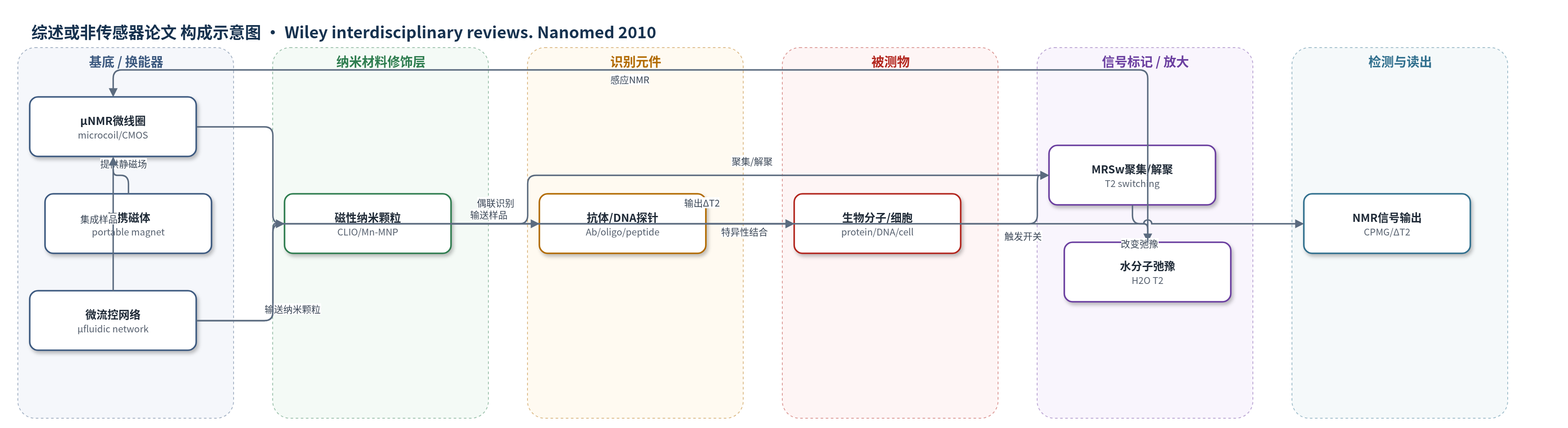
点击图片查看大图 · 依据论文自动绘制
传感器类型
综述或非传感器论文
检测对象
DNA/mRNA(寡核苷酸)、蛋白质(GFP、HCG-β、CA-125、VEGF、α-fetoprotein/AFP)、酶(caspase-3、telomerase/hTERT、MPO、BamH1、trypsin、renin、MMP-2)、小分子(glucose、folate、HA peptide、Ca2+、药物对映体)、病原体(HSV-1、Adenovirus-5/Ad5、MAP、S. aureus、BCG/MTB)、肿瘤细胞(Her2/neu、EGFR、EpCAM/CD326);样品基质包括缓冲液、血清、血液、细胞裂解液、痰液、牛奶、细针穿刺液。
检测原理
DMR 将超顺磁纳米颗粒作为邻近磁弛豫传感器。颗粒在外部磁场中磁化,产生局部磁场梯度,使邻近水质子去相位,缩短纵向/横向弛豫时间,通常用 T2 或 R2=1/T2 读出。识别元件(抗体、DNA/RNA 探针、肽或小分子)偶联在 CLIO、Mn-MNP 或 Cannonballs 表面。正向 MRSw 中,目标分子作为桥联使两群纳米颗粒聚集,有效截面积增大,横向弛豫率增加,T2 缩短;反向 MRSw 中,酶切或竞争结合使预聚集体解聚,T2 增加。细胞/细菌标记模式中,抗体标记目标后洗涤去除未结合颗粒,结合颗粒数量决定磁矩,T2 随细胞/细菌数量下降。信号经 MRI、NMR relaxometer 或 µNMR 的 CPMG 自旋回波序列测量,ΔT2/ΔR2 随目标浓度变化,放大来自单个颗粒影响大量水分子。
检测灵敏度
LOD/检测阈值: HSV-1/Ad5 5 viral particles/10 µl;MAP ~100 CFU;S. aureus 10 CFU/10 µl;BCG/MTB CLIO ~100 CFU/1 µl、Cannonballs ~6 CFU/1 µl、1 ml sputum 20 CFU;肿瘤细胞 1000 cells/10 µl、CLIO 200 cells/1 µl、Mn-MNP ~2 cells/1 µl;线性范围: 0.5–2.7 fmol(寡核苷酸);R^2 > 99%(细胞计数-ΔR2)、R^2 > 98%(DMR 与流式/Western 对比)。
效应效果
DMR 选择性良好:错乱寡核苷酸不引起 T2 变化,单个碱基错配可检测;BSA 对 GFP 传感器无干扰;细胞检测用对照颗粒估计非特异性吞噬。小分子 MRSw 可逆,可多次加样/去除循环。实际样品中,病毒可在血清中检测,MAP 可在牛奶和血液中检测,BCG/MTB 可在痰液中检测,CA-125、VEGF、AFP 可在血液中并行检测,细针穿刺液可分析 Her2/neu、EGFR、EpCAM。与 AFB 涂片相比,TB 检测阈值显著更高,且与培养法相当但仅需数分钟而非数周。DMR 所需细胞数比流式(10^4–10^5)和 Western blot(10^5–10^6)低数个数量级(10–100),并与二者相关。作者认为其适合高通量、低成本、即时检测。
传感器的构成
- 换能器/检测基底:µNMR 芯片中的平面或螺线管微线圈(microcoil)、CMOS NMR 电子与便携磁体,用于射频激发和检测水质子 NMR 信号;也可用临床 MRI 或台式 NMR relaxometer。
- 磁性纳米颗粒:超顺磁 CLIO(MION 核心 Fe3O4/γFe2O3,葡聚糖交联氨基化)或 Mn-MNP(锰掺杂铁氧化物,DMSA 包覆)或 Cannonballs(Fe 核/铁氧体壳,DMSA),作为邻近磁弛豫传感器。
- 识别元件:抗体(anti-GFP、anti-HCG、anti-CA-125、anti-VEGF、anti-Her2、anti-EGFR、anti-EpCAM、anti-BCG 等)、寡核苷酸探针、肽/小分子(biotin-GDEVDG、folate、glucose、HA peptide、vancomycin)或亲和对(avidin-biotin),用于特异性结合目标。
- 信号放大:磁弛豫开关(MRSw),目标桥接使纳米颗粒聚集或酶切/竞争使预聚集体解聚,改变邻近水分子 T2 弛豫时间。
- 样品处理层:µNMR 微流控网络与膜过滤器(~100 nm)用于混合、浓缩细胞/细菌并去除未结合纳米颗粒;植入式装置使用半透聚碳酸酯膜。
- 读出介质:样品中水分子(H2O)作为 NMR 信号源,其 T2 变化经 CPMG 自旋回波序列读出。
中文摘要
快速、准确检测生物样品中的蛋白生物标志物、细胞和病原体是医学诊断的重要挑战。许多新型诊断平台已出现,但生物样品通常磁化率可忽略,因此磁性纳米颗粒被用于生物传感、磁分离和热消融治疗。本综述聚焦于基于磁共振效应、利用磁性纳米颗粒检测生物分子和细胞的诊断磁共振(DMR)技术。DMR 包含多种检测构型和传感原理,目前已用于检测 DNA/mRNA、蛋白质、酶、药物、病原体和肿瘤细胞等。其核心原理是将磁性纳米颗粒作为邻近传感器,调节邻近水分子的自旋-自旋弛豫时间,并可用临床 MRI 或台式 NMR 弛豫仪定量。近年来,微型化芯片 NMR(µNMR)检测系统显著提升了 DMR 能力,可在微升级样品体积中进行高灵敏、多路检测。结合未来进展,DMR 有望成为高通量、低成本、便携的大规模分子与细胞筛查平台,适用于临床和即时检测场景。
英文摘要
One of the major challenges in medicine is the rapid and accurate measurement of protein biomarkers, cells, and pathogens in biological samples. A number of new diagnostic platforms have recently been developed to measure biomolecules and cells with high sensitivity that could enable early disease detection or provide valuable insights into biology at the systems level. Most biological samples exhibit negligible magnetic susceptibility; therefore, magnetic nanoparticles have been used for diverse applications including biosensing, magnetic separation, and thermal ablation therapy. This review focuses on the use of magnetic nanoparticles for detection of biomolecules and cells based on magnetic resonance effects using a general detection platform termed diagnostic magnetic resonance (DMR). DMR technology encompasses numerous assay configurations and sensing principles, and to date magnetic nanoparticle biosensors have been designed to detect a wide range of targets including DNA/mRNA, proteins, enzymes, drugs, pathogens, and tumor cells. The core principle behind DMR is the use of magnetic nanoparticles as proximity sensors that modulate the spin-spin relaxation time of neighboring water molecules, which can be quantified using clinical MRI scanners or benchtop nuclear magnetic resonance (NMR) relaxometers. Recently, the capabilities of DMR technology were advanced considerably with the development of miniaturized, chip-based NMR (microNMR) detector systems that are capable of performing highly sensitive measurements on microliter sample volumes and in multiplexed format. With these and future advances in mind, DMR biosensor technology holds considerable promise to provide a high-throughput, low-cost, and portable platform for large scale molecular and cellular screening in clinical and point-of-care settings.