组成图示
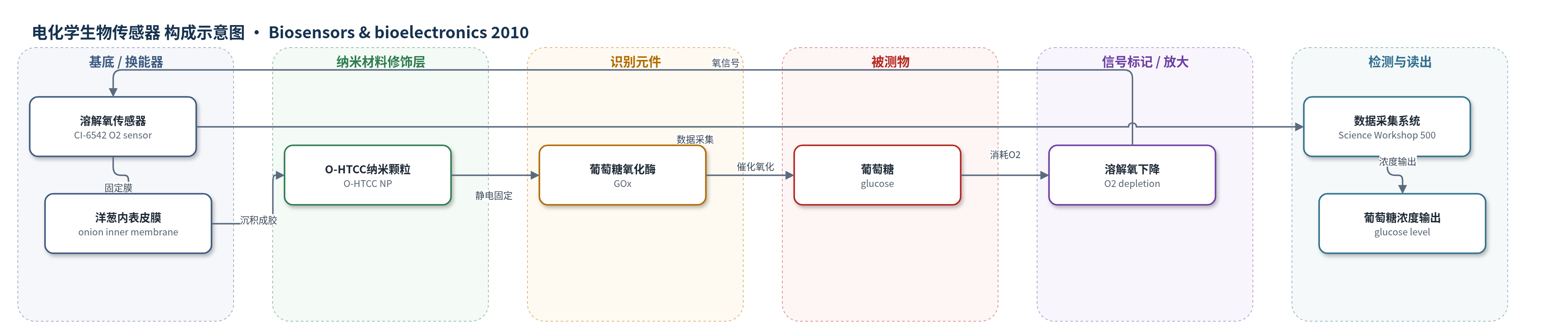
点击图片查看大图 · 依据论文自动绘制
传感器类型
电化学生物传感器
检测对象
葡萄糖(glucose);样品基质:磷酸盐缓冲液、橙汁、红酒、茶饮料
检测原理
该传感器以洋葱内表皮膜为生物相容性固定化平台,O-HTCC NP作为阳离子纳米凝胶剂,通过静电作用将GOx固定于膜表面。样品中的葡萄糖扩散进入膜内,被GOx识别并催化氧化:β-D-葡萄糖在O2存在下生成葡萄糖酸和H2O2,同时消耗溶解氧。由于酶促反应速率与葡萄糖浓度相关,溶液中溶解氧水平随葡萄糖浓度增加而下降。覆盖在酶膜上的O2传感器将溶解氧浓度变化转换为电信号,经数据采集系统记录。O2下降量与葡萄糖浓度呈线性关系,从而实现葡萄糖定量。该体系未使用额外化学放大,主要依靠酶催化和氧消耗信号。
检测灵敏度
LOD: 50 μM (S/N = 3);线性范围: 0.0–0.60 mM;灵敏度斜率: 12.15 mg/L per mM;R^2 = 0.9920
效应效果
该传感器响应时间70 s,重复性RSD 3.2%(n=10),4 ℃储存3周保持90%初始灵敏度,100次重复使用仍保持90%活性。与壳聚糖、戊二醛相比,O-HTCC NP传感器灵敏度更高,响应70–90 s,优于戊二醛>100 s;戊二醛膜7天保留60%活性,O-HTCC膜3周保留90%。乙酸、乳酸、丙酸、丁酸、叶酸、甲醇、甘氨酸、dl-丙氨酸、dl-半胱氨酸不显著干扰;抗坏血酸干扰较大,可空气饱和2 h降低。橙汁、红酒、茶饮料稀释100–200倍后测定,与分光光度法无显著差异,回收率97–110%,RSD 0.98–2.03%。作者认为其低成本、简单、易操作,适用于食品葡萄糖检测。
传感器的构成
- 换能器:Pasco CI-6542 溶解氧传感器(O2 sensor),检测溶解氧浓度变化
- 固定化膜基底:洋葱内表皮膜(onion inner epidermis membrane),提供气体/水通透性和生物相容性
- 纳米材料修饰层:O-(2-羟基)丙基-3-三甲基铵壳聚盐酸纳米颗粒(O-HTCC NP),阳离子壳聚糖衍生物,成胶并静电固定酶
- 识别元件:葡萄糖氧化酶(GOx),催化葡萄糖氧化并消耗O2
- 缓冲介质:200 mM 磷酸盐缓冲液(pH 7.4),维持酶活性和离子环境
- 固定件:O-ring,将酶固定化膜稳定固定在O2传感器表面
- 读出系统:Science Workshop 500 接口及控制软件,采集并处理O2信号
中文摘要
本文报道了一种基于葡萄糖氧化酶(GOx)/O-(2-羟基)丙基-3-三甲基铵壳聚盐酸纳米颗粒(O-HTCC NP)固定化洋葱内表皮和溶解氧(O2)传感器的葡萄糖生物传感器。该传感器利用GOx催化葡萄糖氧化并消耗溶解氧,通过监测O2水平下降来定量葡萄糖。传感器对葡萄糖在0.0–0.60 mM范围内呈线性响应,检出限为50 μM(S/N=3)。系统研究了O-HTCC NP用量、酶负载量、pH、温度和磷酸盐缓冲液浓度对灵敏度的影响。该传感器响应时间为70 s,重复性为3.2%(n=10),4 ℃储存3周后仍保持90%初始灵敏度。乙酸、乳酸、丙酸、丁酸、叶酸、甲醇、甘氨酸、dl-丙氨酸和dl-半胱氨酸等常见干扰物不产生显著干扰。方法成功用于橙汁、红酒和茶饮料中葡萄糖测定,结果与分光光度法一致,加标回收率良好,表明其准确、精确且适用于实际样品分析。
英文摘要
A glucose biosensor comprising a glucose oxidase/O-(2-hydroxyl)propyl-3-trimethylammonium chitosan chloride nanoparticle (O-HTCC NP)-immobilized onion inner membrane and a dissolved oxygen (O(2)) sensor has been successfully developed. The detection scheme is based on the depletion of dissolved O(2) content upon exposure to glucose. The decrease in O(2) level was monitored and related to the glucose concentration. The biosensor shows linear response to glucose from 0.0 to 0.60 mM with a detection limit of 50 microM (S/N=3). The effect of O-HTCC NP and enzyme loading, pH, temperature, and phosphate buffer concentration on the sensitivity of the biosensor was studied in detail. The biosensor exhibits fast response time (70s), good repeatability (3.2%, n=10) and storage stability (90% of initial sensitivity after 3-week storage). Common interferents including acetic acid, lactic acid, propionic acid, butyric acid, folic acid, methanol, glycine, DL-alpha-alanine and DL-cysteine do not cause significant interferences on the biosensor. The proposed biosensor method was successfully applied to determine the glucose content in real samples such as orange juice, red wine and tea drink and the results were comparable to that obtained from a spectrophotometric method. The glucose recovery test demonstrates that the proposed glucose biosensor offers an excellent, accurate and precise method for the determination of glucose in real samples.