组成图示
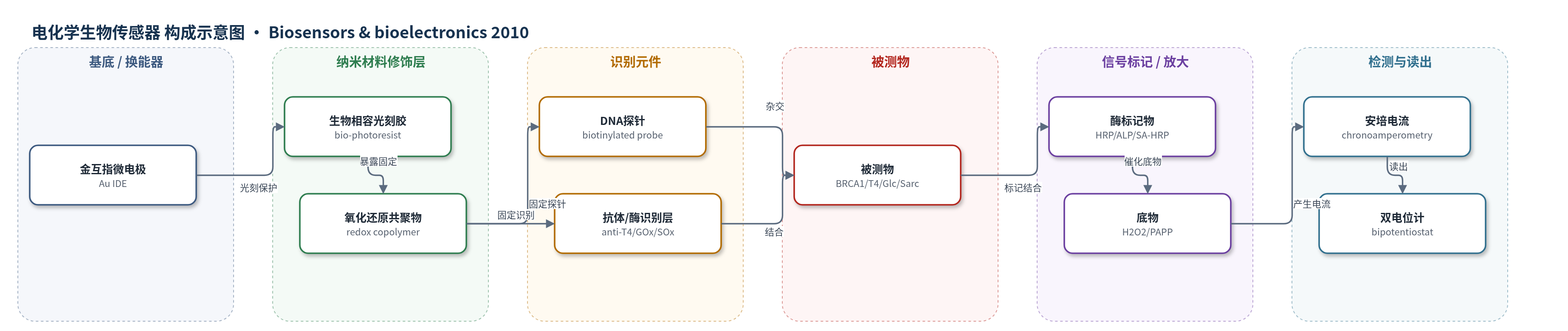
点击图片查看大图 · 依据论文自动绘制
传感器类型
电化学生物传感器
检测对象
BRCA1基因突变寡核苷酸(BRCA1 mutant oligonucleotide,HEPES缓冲液)、甲状腺素T4(thyroxine/T4,无T4人血清)、肌氨酸(sarcosine,PBS缓冲液)、葡萄糖(glucose,PBS缓冲液)
检测原理
该微阵列以金互指电极为工作电极,生物相容光刻胶选择性暴露不同电极。识别元件(DNA探针、抗体/抗原偶联物、GOx/SOx)经氧化还原共聚物、PEG和SA等固定。DNA检测中,生物素化靶标与互补探针杂交后结合SA-HRP,HRP催化H2O2在电极上发生氧化还原,产生安培电流;ALP标记则催化p-氨基苯磷酸盐生成p-氨基苯酚并在+300 mV氧化。酶检测中,GOx/SOx分别催化葡萄糖/肌氨酸生成H2O2,氧化还原共聚物介导电子传递,+500 mV下电流随底物浓度升高。T4竞争免疫检测中,样品T4与固定bIgG-T4竞争结合抗T4抗体,再结合抗兔-HRP,H2O2底物下电流随T4浓度升高而降低。信号由双电位计安培读出。
检测灵敏度
—
效应效果
阵列选择性与抗串扰良好。双酶DNA图案化HRP电极RSD=0.006、ALP电极RSD=0.04,交换底物与电位无交叉响应。BRCA1检测互补探针电流1.8 μA,非互补0.05 μA,无靶标对照0.4 μA,RSD为0.5、0.08、0.1。GOx/SOx阵列葡萄糖与肌氨酸信号独立,RSD=0.01和0.005;葡萄糖最大约3.23 μA cm−2(60 mM)或3.8 μA cm−2(40 mM),肌氨酸约1.5 μA cm−2(10 mM),PSS/PVP消除串扰但GOx信号降约50%。T4竞争法零标准110 nA,含104 ng/mL T4为20 nA;结论称零标准70 nA、含分析物约1/7。作者认为方法通用且可竞争现有技术。
传感器的构成
- 基底/换能器电极:金互指微电极阵列(Au IDE),工作电极;Ag/AgCl参考电极与Pt对电极用于电化学测量
- 图案化保护层:生物相容甲基丙烯酸酯光刻胶(bio-photoresist),选择性暴露两组电极
- 电子介体/固定层:氧化还原共聚物(redox copolymer,含osmium copolymer)、PEG与链霉亲和素(SA),介导电子传递并固定生物素化探针
- 识别元件:生物素化DNA探针(biotinylated probe)、抗T4抗体/牛IgG-T4偶联物(anti-T4/bIgG-T4)、葡萄糖氧化酶(GOx)或肌氨酸氧化酶(SOx)
- 信号标记物:辣根过氧化物酶(HRP)、碱性磷酸酶(ALP)、链霉亲和素-HRP(SA-HRP)或抗兔HRP抗体
- 封闭/阻隔层:巯基乙醇(mercaptoethanol)、生物素(biotin)、BSA封闭;聚电解质多层(PSS/PVP)阻隔第二酶非特异吸附
- 底物/电子供体:H2O2、p-氨基苯磷酸盐(p-aminophenyl phosphate)、葡萄糖(glucose)、肌氨酸(sarcosine)
中文摘要
微加工使密集电极阵列可集成于微系统和小型诊断装置,但任意形状电极与不同生物分子的选择性功能化仍是难题。本文采用生物分子友好光刻工艺,在间距20 μm的互指微电极阵列上依次选择性固定不同生物分子,以解决多分析物传感器阵列的制备问题。研究以乳腺癌基因突变寡核苷酸的选择性检测、特异性抗体检测甲状腺素T4,以及特异性酶检测肌氨酸和葡萄糖的双分析物阵列为例,证明该方法兼容DNA、抗体和酶等生物识别分子。阵列采用电化学检测,因其成本低、灵敏度高且易于微型化。尽管阵列仅含两组电极,结果仍表明所提方法具有通用性,可用于更高分辨率电化学多分析物生物传感器的图案化。
英文摘要
Microfabrication permits the incorporation of dense electrode arrays in microsystems and small volume diagnostic devices. However, the specific functionalization of arbitrary shape electrodes with different biomolecules remains a challenging issue. In the present work, the problem of fabricating closely spaced microelectrodes (20 microm sensor diameter and 20 microm-spaced interdigitated electrodes array) that can be modified selectively in order to create multi-analyte sensor arrays is addressed by employing a biomolecule friendly photolithographic procedure for the sequential immobilization of different biomolecules onto separated electrodes of the same array. The concept was demonstrated with selective detection of oligonucleotides for breast cancer gene mutation detection, the hormone T4 detected with specific antibodies and sarcosine and glucose detected with specific enzymes immobilized in two-analyte arrays in order to assure that the method is compatible with all the types of biorecognition molecules used in biosensors. Electrochemical techniques were used in this array, because of the low cost, high sensitivity and easy miniaturization of these transducers. Although the array was composed of only two sets of electrodes, the results demonstrate that the method proposed is generic and could be used for patterning of electrochemical multi-analyte biosensors at even higher resolution.