组成图示
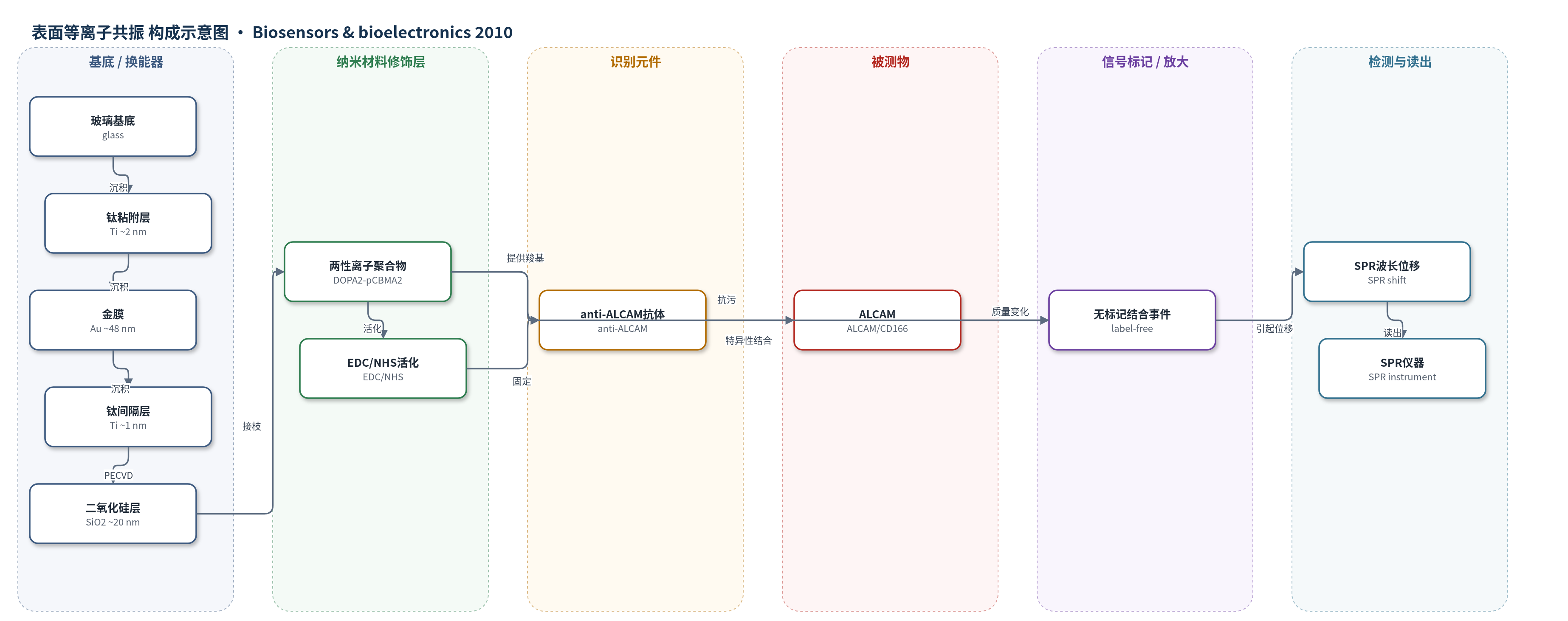
点击图片查看大图 · 依据论文自动绘制
传感器类型
表面等离子共振(SPR)生物传感器
检测对象
激活的白细胞细胞粘附分子 ALCAM(CD166);样品基质:未稀释人血清(100% human serum),另在PBS缓冲液中加标验证
检测原理
DOPA2-pCBMA2通过DOPA与SiO2表面的仿生粘附作用(包括儿茶酚与氧化物表面的配位/氢键及氧化交联)形成致密两性离子涂层。pCBMA链的离子水化层排斥蛋白,降低非特异吸附。聚合物上的羧基经EDC/NHS活化为NHS酯,与anti-ALCAM抗体氨基共价固定。当ALCAM与抗体结合时,传感界面质量增加,改变SPR金膜附近电磁场分布,引起共振波长位移。SPR仪器实时记录波长变化,净响应由加标血清与未加标血清背景扣除得到。由于涂层抗污且无封闭剂,背景低,信号随ALCAM浓度升高而增大,无外源信号放大。
检测灵敏度
LOD: ∼64 ng/mL(未稀释人血清中ALCAM);PBS中最低检测浓度: 26 ng/mL
效应效果
优化涂层对1 mg/mL纤维蛋白原和溶菌酶吸附不可检出,对100%人血浆/血清非特异吸附为6.3±0.9/11.7±3.0 ng/cm2(图2典型5.4/9.5 ng/cm2)。anti-ALCAM固定量55.4±20.0 ng/cm2,anti-Salm对照无ALCAM非特异结合,选择性良好。未加标血清背景约55 ng/cm2。血清ALCAM检出限约64 ng/mL,优于OEG COOH/OH表面>100 ng/mL,与SI-ATRP pCB约10 ng/mL、金表面约30 ng/mL同数量级。SiO2层在pH 1–10及溶剂中稳定,聚合物接洗脱少,适用于植入器械、体内诊断和纳米传感器。
传感器的构成
- 基底/换能器:玻璃基底、钛粘附层(Ti,约2 nm)、金膜(Au,约48 nm)、钛间隔层(Ti,约1 nm)和二氧化硅层(SiO2,约20 nm),构成SPR换能器与模型硅表面
- 接枝聚合物层:DOPA2-pCBMA2聚合物共轭物,DOPA仿生基团粘附于SiO2,pCBMA两性离子链提供抗污和羧基功能化位点
- 识别元件:anti-ALCAM抗体,经EDC/NHS与pCBMA羧基共价固定,特异性识别ALCAM(CD166)
- 封闭剂:无,未使用封闭剂,依赖两性离子涂层抑制非特异吸附
- 读出系统:无标记ALCAM结合引起SPR共振波长位移,由SPR仪器读出
中文摘要
人血浆和血清中非特异性蛋白吸附严重制约癌症生物标志物生物传感器的性能。本文开发了一种简便的20分钟原位“graft to”接枝方案,将含仿生粘附基团3,4-二羟基-L-苯丙氨酸(DOPA)的两性离子羧基甜菜碱甲基丙烯酸酯(CBMA)聚合物共轭物接枝到二氧化硅(SiO2)基底上。利用表面等离子共振(SPR)生物传感器,系统考察了缓冲液、pH、盐浓度和温度对接枝条件的影响,获得致密聚合物膜,同时最大限度降低非特异性蛋白吸附并提高抗体固定量。优化后的涂层对100%人血浆和血清表现出强抗污性。随后在不使用任何封闭剂的情况下,抗体功能化表面可直接从未稀释人血清中特异性检测癌症生物标志物激活的白细胞细胞粘附分子(ALCAM),检出限达64 ng/mL。该两性离子涂层在SiO2表面用于复杂介质检测的成功应用,表明其在植入式医疗器械、体内诊断和纳米生物传感器开发中具有广泛潜力。
英文摘要
Non-specific protein binding from human plasma and serum has severely hindered the full capabilities of biosensors concerned with cancer biomarker detection. Currently, there is a strong desire for developing new materials which allow for the convenient attachment of an ultra-low fouling and functionalizable surface coating which can be used for highly sensitive and label-free detection of target analytes directly from complex media. In this work, a short 20 min in situ "graft to" protocol using Tris pH 8.5 buffer was developed for zwitterionic carboxybetaine methacrylate (CBMA) polymer conjugates containing the adhesive biomimetic moiety, 3,4-dihydroxy-L-phenylalanine (DOPA), on SiO(2) substrates. Using a surface plasmon resonance (SPR) biosensor, different buffers, pH values, salt concentrations, and temperatures were investigated for determining the "graft to" conditions that yield dense polymer films which both minimize non-specific protein adsorption and maximize antibody immobilization. The optimized surface coatings were shown to be highly protein resistant to 100% human blood plasma and serum. Subsequent antibody functionalized surfaces without any blocking agents enabled the specific detection of the cancer biomarker ALCAM directly from undiluted human serum down to 64 ng/mL. The successful use of this zwitterionic surface coating for detection from complex media on SiO(2) surfaces indicates its potential for broad impacts in the development of implantable medical devices, in vivo diagnostics, and nano-scale biosensors.