组成图示
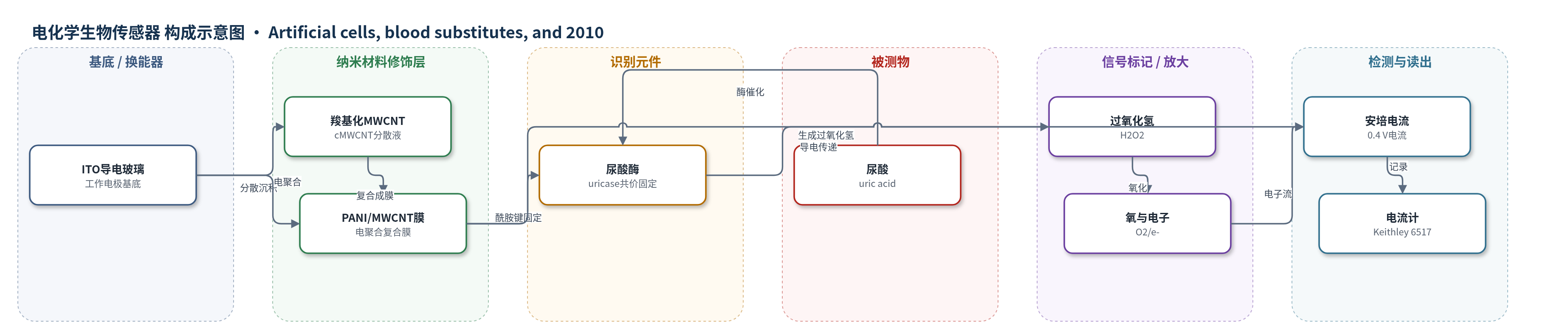
点击图片查看大图 · 依据论文自动绘制
传感器类型
电化学生物传感器
检测对象
尿酸(uric acid, UA);样品基质:血清(serum)
检测原理
尿酸酶(uricase)共价固定于聚苯胺/羧基化多壁碳纳米管(PANI/cMWCNT)复合膜上,作为识别元件。当血清中的尿酸(uric acid, UA)扩散至电极表面时,尿酸酶催化尿酸与水和氧气反应生成尿囊素、二氧化碳和过氧化氢(H2O2)。H2O2在0.4 V工作电位下发生氧化反应,释放电子并生成氧气;电子经PANI/cMWCNT导电网络传递至ITO电极,形成与尿酸浓度成正比的安培电流。MWCNT提供高导电通道和大比表面积,PANI通过酰胺键稳定固定酶并促进电子转移,因此电流响应随尿酸浓度升高而增大。
检测灵敏度
LOD: 5 μM;线性范围: 0.005–0.6 mM
效应效果
该传感器响应时间约8 s,对葡萄糖、尿素、抗坏血酸、丙酮酸、胆红素、胆固醇及常见无机盐等生理浓度干扰物无明显干扰。批内和批间变异系数分别≤2.7%和≤2.3%;血清加标回收率为86%±0.4%(10 mg/L)和81.2%±0.4%(20 mg/L)。与酶法比色试剂盒在60份血清样本中比较,相关系数r=0.98,回归方程y=0.969x+0.046。电极4℃干燥保存3个月内基本无活性损失,可重复使用200次;6个月后活性下降约40%,货架寿命超过180天。作者认为其适用于高尿酸血症、痛风及肾病相关血清尿酸快速定量检测。
传感器的构成
- 基底/换能器电极:ITO导电玻璃(indium tin oxide, ITO),作为工作电极基底并提供导电支撑。
- 纳米材料修饰层:羧基化多壁碳纳米管(cMWCNT)与苯胺(ANI)电聚合形成聚苯胺/多壁碳纳米管复合膜(PANI/MWCNT),提供导电通道、增大表面积并辅助固定酶。
- 识别元件:尿酸酶(uricase, EC 1.7.3.3,Bacillus fastidious uricase),通过cMWCNT羧基与酶表面氨基形成酰胺键共价固定,催化尿酸氧化。
- 信号转换产物:过氧化氢(H2O2),由尿酸酶催化尿酸生成,在0.4 V下氧化产生电流。
- 信号读出:三电极体系(Ag/AgCl参比电极、铂丝对电极)与Keithley 6517 A/E电流计,在0.4 V安培法记录电流。
中文摘要
本文报道了一种高灵敏安培型尿酸生物传感器,用于血清中尿酸水平的检测。该传感器利用碳纳米管独特的物理和导电性能,将尿酸酶通过酰胺键共价固定于电聚合聚苯胺/碳纳米管复合膜上。扫描电镜证实球形尿酸酶成功固定于聚苯胺/碳纳米管复合电极表面。碳纳米管复合电极使传感器具有8 s的快速响应时间、5 μM的最低检测限,并将电极系统货架寿命延长至180天以上,同时酶活性仅轻微损失。作者通过健康个体以及高尿酸血症和痛风患者血清中尿酸的定量测定,验证了该安培型尿酸生物传感器的实际检测效能。
英文摘要
A highly sensitive, amperometric uric acid biosensor possessing unique physical, electro-conductive properties of carbon nanotubes is described for determination of uric acid level in serum. A uric acid biosensor was constructed after immobilization of uricase onto a polyaniline/CNT matrix by carbonamide linkage. The scanning electron micrographs confirmed the immobilization of globular enzyme onto the electroploymerized polyaniline/CNT composite. Employment of carbon nanotubes composite in the present electrode leads to a very quick response time of 8 sec with the minimum detection limit of 5 microM along with an increase in shelf-life of electrode system to >180 days with slight loss of enzyme activity. Efficiency of the present amperometric uric acid biosensor was validated by quantitative estimation of uric acid level in biological serum of healthy individuals and the persons suffering from hyperuricemia and gout.