组成图示
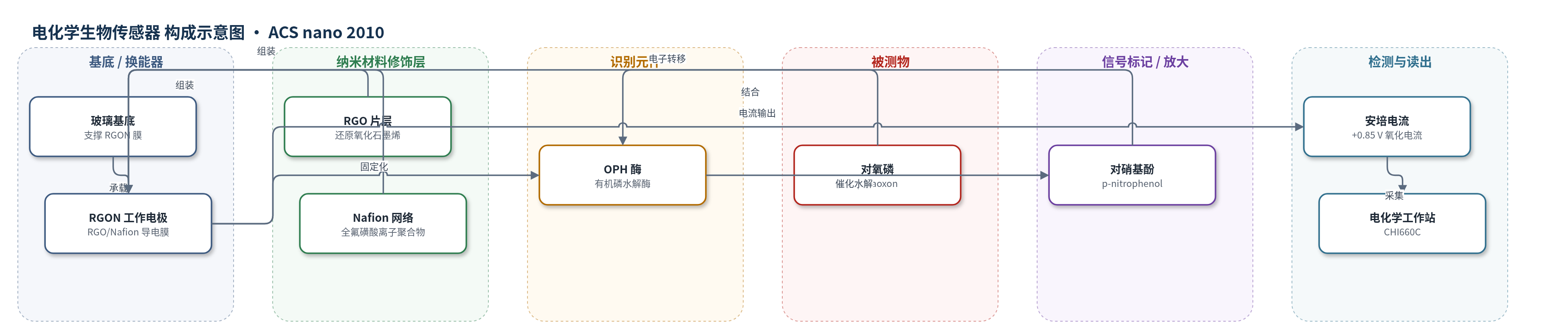
点击图片查看大图 · 依据论文自动绘制
传感器类型
电化学生物传感器
检测对象
对氧磷(paraoxon,有机磷化合物/神经毒剂);样品基质:N2 饱和 PBS 缓冲液
检测原理
RGON 膜由 RGO 与 Nafion 自组装形成:RGO 提供导电网络和大比表面积,Nafion 的磺酸基增强分散并降低界面电阻,互穿网络促进电荷传输。OPH 酶固定化在 RGON 膜表面并保留催化活性。对氧磷进入后,OPH 催化其水解生成对硝基酚(p-NP)。在 +0.85 V 恒电位下,p-NP 在 RGON 工作电极表面发生电化学氧化,电子经 RGO/Nafion 网络快速传递至电极,产生与对氧磷浓度成正比的安培电流。该过程依赖酶催化产物电化学检测,RGON 的高电导率、低界面电阻和快速电子转移使响应快、灵敏度高。
检测灵敏度
LOD: 1.37 × 10^-7 M;灵敏度: 10.7 nA/μM;R^2 = 0.9988;弯曲后 LOD: 3.60 × 10^-7 M,灵敏度: 9.7 nA/μM
效应效果
RGON 生物传感器在 100 次弯曲疲劳测试后仍保持约 90% 以上最大性能,弯曲后灵敏度 9.7 nA/μM、LOD 3.60×10^-7 M、响应时间 <3 s,而 RGO 膜因脆性无法弯曲。与 OPH-RGO 相比,OPH-RGON 灵敏度提高约 2.6 倍(10.7 对 4.1 nA/μM),LOD 降低一个数量级(1.37×10^-7 对 1.39×10^-6 M),响应时间由 >10 s 缩短至 <3 s。与未修饰厚膜和金电极相比,RGON 具有更高灵敏度和更快响应,LOD 相近;与 CNT 修饰电极相比灵敏度较低,作者归因于二维与一维结构差异。论文未报告选择性、抗干扰、RSD 或实际样品回收率,但强调其可作为高灵敏、快速、低 LOD 的柔性电化学生物传感器平台。
传感器的构成
- 基底:玻璃基底(glass substrate),承载 RGON 膜并提供机械支撑
- 工作电极/导电膜:RGON(reduced graphene oxide/Nafion)自由站立柔性导电膜,作为电化学工作电极
- 导电纳米层:RGO(reduced graphene oxide)片层,提供高电导率、大比表面积和快速电子转移
- 聚合物修饰层:Nafion(全氟磺酸离子聚合物),疏水骨架与 RGO 自组装,磺酸基提供分散、界面粘结和低界面电阻
- 识别元件:OPH(organophosphorus hydrolase,有机磷水解酶),固定化于 RGON 膜表面,催化水解对氧磷
- 信号产物:p-nitrophenol(对硝基酚,p-NP),由 OPH 水解对氧磷生成,在 +0.85 V 下电化学氧化产生电流
中文摘要
本文报道通过溶液化学制备自由站立柔性导电还原氧化石墨烯/Nafion(RGON)杂化膜,利用自组装和定向对流组装。Nafion 的疏水骨架通过自组装在微观和宏观尺度形成明确集成结构,其亲水磺酸基团赋予石墨烯高稳定分散性(约0.5 mg/mL)和长期稳定性(2个月)。RGON 的几何互锁形貌赋予杂化膜高机械完整性,互穿网络构建有利电荷传输通路。RGON 的协同电化学特性归因于高电导率(1176 S/m)、促进电子转移和低界面电阻。因此,RGON 膜作为有机磷(OP)检测的电化学生物传感平台,表现出灵敏度 10.7 nA/μM、检测限 1.37×10^-7 M 和响应时间 <3 s。此外,100 次弯曲疲劳测试验证了 RGON 生物传感器的可靠性。该策略从材料角度为石墨烯及杂化纳米材料制备和实际器件生物传感器平台设计提供见解。
英文摘要
We report the preparation of free-standing flexible conductive reduced graphene oxide/Nafion (RGON) hybrid films by a solution chemistry that utilizes self-assembly and directional convective-assembly. The hydrophobic backbone of Nafion provided well-defined integrated structures, on micro- and macroscales, for the construction of hybrid materials through self-assembly, while the hydrophilic sulfonate groups enabled highly stable dispersibility ( approximately 0.5 mg/mL) and long-term stability (2 months) for graphene. The geometrically interlocked morphology of RGON produced a high degree of mechanical integrity in the hybrid films, while the interpenetrating network constructed favorable conduction pathways for charge transport. Importantly, the synergistic electrochemical characteristics of RGON were attributed to high conductivity (1176 S/m), facilitated electron transfer (ET), and low interfacial resistance. Consequently, RGON films obtained the excellent figure of merit as electrochemical biosensing platforms for organophosphate (OP) detection, that is, a sensitivity of 10.7 nA/microM, detection limit of 1.37 x 10(-7) M, and response time of <3 s. In addition, the reliability of RGON biosensors was confirmed by a fatigue test of 100 bending cycles. The strategy described here provides insight into the fabrication of graphene and hybrid nanomaterials from a material perspective, as well as the design of biosensor platforms for practical device applications.