组成图示
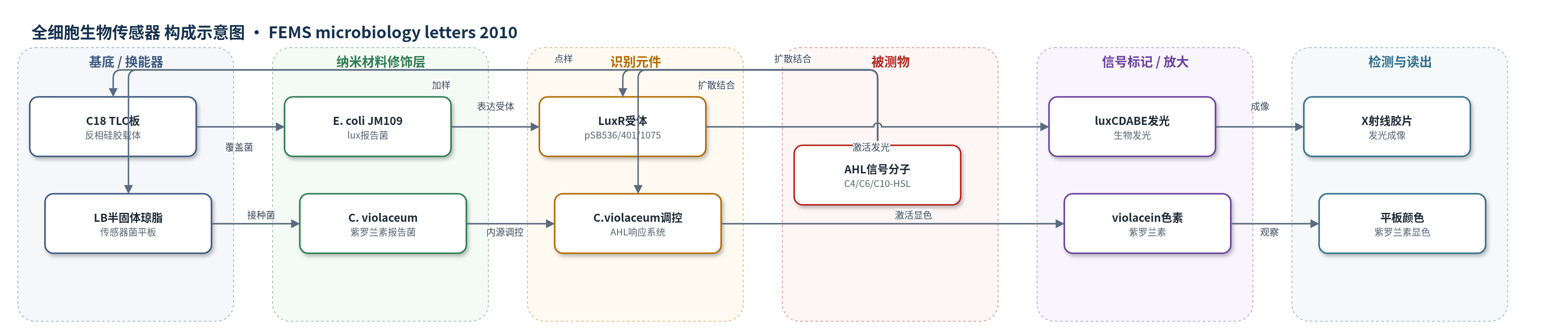
点击图片查看大图 · 依据论文自动绘制
传感器类型
全细胞生物传感器
检测对象
N-酰基高丝氨酸内酯(AHLs,包括 C4-HSL、C6-HSL、C10-HSL);样品基质:Tenacibaculum maritimum 的 FMM/MB 酸化培养液提取物及菌悬液/上清。
检测原理
该检测基于全细胞 AHL 生物传感器。T. maritimum 培养液酸化后经有机溶剂提取,点样于 C18 TLC 板或加入 LB 平板孔中。AHL 扩散进入 E. coli JM109 或 C. violaceum 细胞,与 LuxR 型受体结合,形成 AHL-LuxR 复合物并激活下游报告基因。E. coli 中 luxCDABE 表达产生生物发光,发光强度随 AHL 浓度升高而增强,经 X 射线胶片成像;C. violaceum 中 violacein 合成基因表达产生紫罗兰素,颜色深浅反映 AHL 水平。在降解试验中,T. maritimum 消耗 C10-HSL 后,剩余 AHL 降低,VIR07 紫罗兰素信号减弱。LC-MS 用于化学确认 AHL 种类。
检测灵敏度
未报告 LOD、线性范围、灵敏度斜率或相关系数。
效应效果
9 株 T. maritimum 均被 E. coli JM109 pSB536 检出短链 AHL 活性,但活性峰值时间不同。LC-MS 在 NCIMB2154T 中确认 C4-HSL。C. violaceum 平板试验显示,24 h 后 C10-HSL 被完全降解,HPLC 定量为初始 2 mg mL−1 的约 90% 被降解;C6-HSL 无明显降解。无细胞培养上清中降解不显著,提示活性与细胞相关。酸化不能回收 C10-HSL,排除内酯酶型,提示酰基酶型。作者认为该发现将 AHL 群体感应扩展至 Proteobacteria 之外,并为水产养殖中通过干扰 QS 控制鱼病提供思路。
传感器的构成
- 换能细胞:E. coli JM109 或 C. violaceum CV026/VIR07,作为全细胞生物传感器,响应 AHL 并产生可读信号。
- 识别元件:LuxR 型 AHL 受体(pSB536、pSB401、pSB1075 或 C. violaceum 内源 AHL 响应系统),结合 AHL 启动报告基因表达。
- 报告基因:luxCDABE 生物发光基因簇(E. coli)或 violacein 合成基因(C. violaceum),产生生物发光或紫罗兰素颜色。
- 检测载体:C18 反相硅胶 TLC 板或 LB 半固体琼脂平板,用于点样提取物并覆盖传感器菌。
- 样品基质:酸化培养液经二氯甲烷/乙酸乙酯提取的 AHL 样品,来自 T. maritimum FMM 或 MB 培养液。
- 读出装置:X 射线胶片(生物发光)或平板颜色观察(紫罗兰素),用于判断 AHL 活性。
中文摘要
海洋鱼病病原 Tenacibaculum maritimum(原 Flexibacter maritimus)是 Cytophaga–Flavobacterium–Bacteroides(CFB)群的丝状生物膜形成菌,可引起广泛分布的 tenacibaculosis。作者利用多种基于 lux 的 AHL 生物传感器菌株检测该菌 9 个代表菌株培养液中的 N-酰基高丝氨酸内酯(AHL)群体感应信号,发现所有菌株均存在短链 AHL 活性。液相色谱-质谱(LC-MS)进一步在 T. maritimum NCIMB2154T 中鉴定出 N-丁酰基-L-高丝氨酸内酯(C4-HSL)。随后证明该菌株对长链 AHL C10-HSL 具有降解活性;降解后培养液酸化不能回收 C10-HSL,提示其可能为酰基酶型降解而非内酯酶型。尽管 AHL 介导的群体感应在该菌中调控的生理过程仍需进一步表征,但该发现将 AHL 介导的群体感应信号扩展至 Proteobacteria 之外,并强化了其生态意义。
英文摘要
Tenacibaculum maritimum (formerly Flexibacter maritimus) is a filamentous, biofilm-forming member of the Cytophaga-Flavobacterium-Bacteroides group (or Bacteroidetes), which causes the widely distributed marine fish disease tenacibaculosis. A search for N-acylhomoserine lactones (AHLs) quorum-sensing (QS) signals in the culture media of nine representative strains of this species using different biosensor strains revealed the presence of short-type AHL activity in all of them. N-butyryl-L-homoserine lactone (C4-HSL) was identified in T. maritimum NCIMB2154(T) by LC-MS. A degradation activity for long-acyl AHLs (C10-HSL) was subsequently demonstrated in T. maritimum NCIMB2154(T). The acidification of the culture medium after degradation did not allow the recovery of C10-HSL, which indicates a possible acylase-type degradation activity. Even though the physiological processes under the control of AHL-mediated QS in T. maritimum need to be further characterized, this discovery extends the paradigm of AHL-mediated QS signalling beyond the Proteobacteria and reinforces its ecological significance.