组成图示
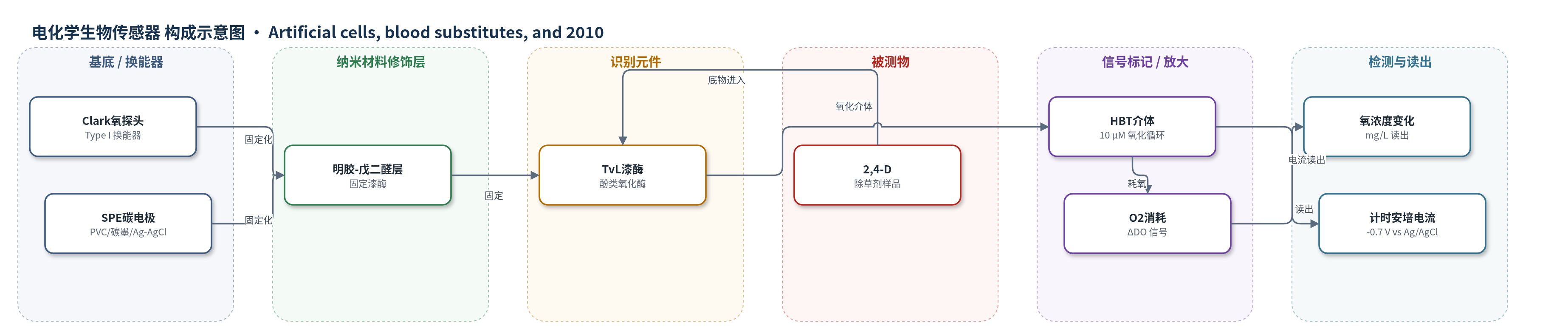
点击图片查看大图 · 依据论文自动绘制
传感器类型
电化学生物传感器
检测对象
2,4-二氯苯氧乙酸(2,4-D, 2,4-dichlorophenoxyacetic acid)、苯酚(phenol)、儿茶酚(catechol)、没食子酸(pyrogallol)、2-氯酚(2-chlorophenol)、4-硝基酚(4-nitrophenol);样品基质:真实除草剂样品及缓冲液标准。
检测原理
两种传感器均以云芝漆酶(TvL)为生物识别/催化元件。2,4-D 等酚类底物进入生物活性层后,被漆酶催化氧化;在 10 μM 羟基苯并三唑(HBT)介体存在下,漆酶-HBT 氧化循环将电子/氧传递耦合起来,底物浓度越高,催化氧化速率越快,氧消耗或电极电流变化越大。Type I 以 Clark 溶解氧探头为换能器,底物氧化导致反应液中溶解氧下降,氧探头记录 ΔDO(mg/L),信号与 2,4-D 浓度呈线性。Type II 以丝网印刷碳电极为工作电极,在 -0.7 V vs Ag/AgCl 下进行计时安培测量,介体氧化还原循环产生电流(mA),电流随底物浓度增加而增大。未使用 HCR/RCA 等核酸放大,主要依靠酶催化和介体循环实现信号转换。
检测灵敏度
Type I:LOD: 5 nM;线性范围: 0.005–0.020 μM;方程: y=20.40x+0.008(x: μM, y: mg/mL);R^2=0.9958(正文另报 0.9948)。Type II:LOD: 500 nM;线性范围: 0.5–2.0 μM;方程: y=0.4846x-0.005(x: μM, y: mA);R^2=0.9893(正文另报 0.9933)。
效应效果
两种传感器对 2,4-D 和苯酚响应最好,对儿茶酚、没食子酸、2-氯酚、4-硝基酚也呈良好线性,Type I 选择性更高。最佳 pH 4.5、温度 35 °C;35 °C 孵育 8 h 后 Type I 活性下降 5%,Type II 下降 10%。重复性:Type I 在 0.01 μM 2,4-D(n=5)CV 2.7%;Type II 在 0.5 μM(n=5)CV 4.66%。真实除草剂加标:Type I 加 0.010 μM 测得 0.013±0.00045 μM,加 0.015 μM 测得 0.015±0.00045 μM;Type II 加 0.5 μM 测得 0.435±0.066 μM,加 1.5 μM 测得 1.542±0.026 μM。作者认为其较 LC/GC 更简单快速,可用于除草剂样品检测。
传感器的构成
- 基底/换能器:Clark 溶解氧探头(Type I)或 PVC 基底上的丝网印刷碳工作电极、Ag/Pd 导电层和 Ag/AgCl 参比电极(Type II),用于氧信号或电流信号转换。
- 生物活性层:Trametes versicolor 漆酶(TvL,4 U)作为识别/催化元件,氧化 2,4-D 等酚类底物。
- 固定化/交联层:明胶(gelatin,Type I 10 mg、Type II 0.2 mg)与戊二醛(glutaraldehyde,2.5% v/v)交联固定漆酶,形成稳定生物膜。
- 介体/信号传递层:工作缓冲液中的羟基苯并三唑(HBT,10 μM)作为漆酶介体,参与氧化循环并传递电子/氧消耗。
- 工作缓冲体系:50 mM 醋酸缓冲液(pH 4.5),维持漆酶活性和反应环境。
- 信号读出:Type I 记录溶解氧浓度变化(ΔDO,mg/L);Type II 在 -0.7 V vs Ag/AgCl 下记录计时安培电流(mA)。
中文摘要
本研究以 Trametes versicolor(云芝)漆酶作为生物识别元件,构建了用于检测 2,4-二氯苯氧乙酸(2,4-D)的安培型生物传感器。漆酶通过明胶和戊二醛固定化于 Clark 溶解氧探头和丝网印刷电极(SPE)表面,分别形成两种传感器,并进行安培和计时安培测量。首先考察了漆酶活性对两种传感器性能的影响,随后测定了最佳 pH、最佳温度及热稳定性。此外,通过标准曲线获得若干酚类化合物的检测范围。重复性研究中计算了两种传感器的变异系数和标准偏差。最后,将所构建的传感器应用于真实除草剂样品中 2,4-D 的测定。结果表明,两种传感器均可检测 2,4-D 及部分酚类化合物,其中基于溶解氧探头的传感器在灵敏度和选择性方面表现更优,而基于 SPE 的传感器因酶和固定材料用量少而更具经济性。
英文摘要
Amperometric biosensors using laccase from Trametes versicolor as a bioelement were developed for 2,4-dichloro phenoxy acetic acid (2,4-D). Laccase enzyme was immobilized by gelatin and glutaraldehyde onto a Clark oxygen probe and screen printed electrodes (SPEs). Amperometric and chronoamperometric measurements were carried out with the biosensors. First, the effect of laccase activity on the biosensor performances was investigated for both biosensors, and then optimum pH and temperature and also thermal stability of the biosensors were tested. In addition, the detection ranges of some phenolic compounds were obtained by the help of calibration graphs of them. In repeatability studies, variation coefficients and standard deviations for both biosensors were also calculated by the studies done for this purposes. Finally, the biosensors were applied to the determination of 2,4-D in a real herbicide sample.