组成图示
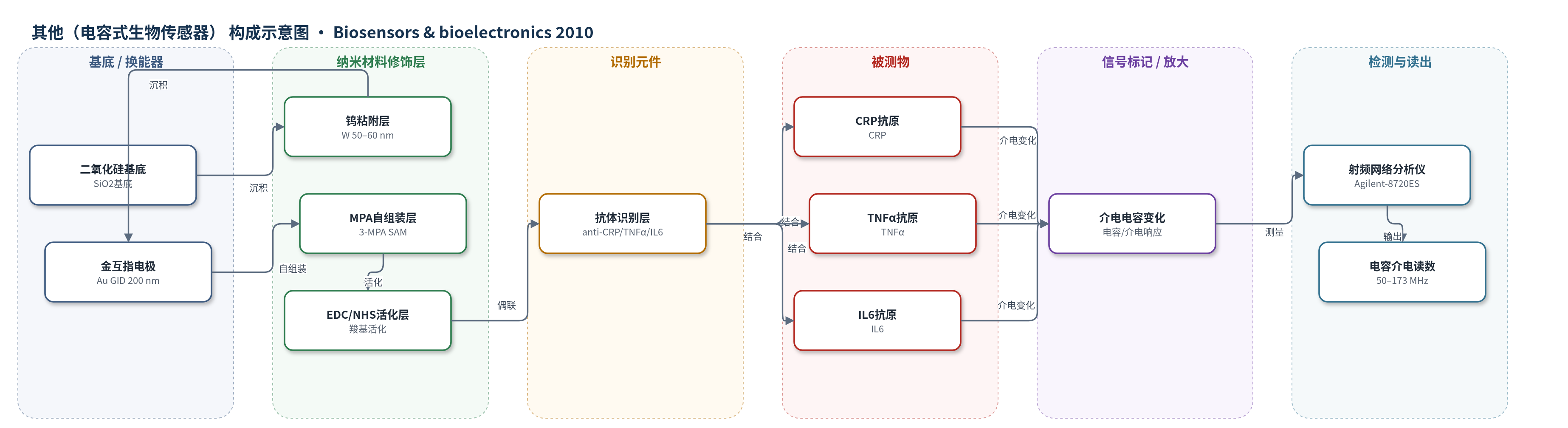
点击图片查看大图 · 依据论文自动绘制
传感器类型
其他(电容式生物传感器)
检测对象
C-反应蛋白(CRP)、肿瘤坏死因子α(TNFα)、白细胞介素6(IL6);样品基质:PBS 缓冲液(文中拟用于血清/疑似血清样品)
检测原理
该传感器采用无标记电容免疫检测原理。金互指电极(GID)电容器阵列表面通过3-巯基丙酸(MPA)自组装单分子层和EDC/NHS活化共价固定anti-CRP、anti-TNFα或anti-IL6抗体。当样品中的CRP、TNFα或IL6与对应抗体结合后,电极表面形成抗体–抗原复合物,使电极间介电层中的分子尺寸、偶极矩、电荷分布和介电常数发生变化。根据电容公式 C=2nεε0A/d,介电常数 ε 的变化引起电容/阻抗变化。射频网络分析仪在50 MHz–1 GHz(有效50–173 MHz)下测量该变化,信号随抗原浓度增加而增强。格式I用纯抗体阵列分别检测,格式II用等摩尔混合抗体顺序孵育,实现多标志物检测;未使用酶、荧光或纳米标记放大。
检测灵敏度
格式I:CRP 与 IL6 检测限 25 pg/ml,动态范围至 25 ng/ml;TNFα 检测范围 25 pg/ml–1 ng/ml。格式II:LOD: 32 pg/ml;线性范围: 25 pg/ml–25 ng/ml(173 MHz,CRP、IL6、TNFα)。
效应效果
选择性方面,以牛血清白蛋白(BSA)作为非特异蛋白阴性对照,未观察到明显非特异响应,表明抗体识别具有较好特异性。重现性方面,批内和批间相对标准偏差(RSD)均在14%以内。格式I中CRP和IL6在25 pg/ml–25 ng/ml范围内响应,TNFα仅至1 ng/ml;格式II通过等摩尔混合抗体和顺序孵育将TNFα动态范围扩展至25 pg/ml–25 ng/ml,LOD为32 pg/ml。论文未报告实际血清样品加标回收率,也未与ELISA、HPLC或qPCR进行定量对比。作者认为该无标记电容传感器速度快、操作简便、成本低、可微型化,适合炎症和心血管风险标志物面板的早期诊断与潜在手持POC应用,但仍需解决批次差异、几何误差和抗体稳定性问题。
传感器的构成
- 基底/换能器:SiO2 基底上图案化金互指电极(GID)电容器阵列,作为电容换能器,测量电极间介电/电容变化。
- 粘附层:50–60 nm 钨(W)层,增强金与 SiO2 的粘附。
- 电极层:200–210 nm 金(Au)互指电极,长800 μm、宽40 μm、间距40 μm,24指,构成电容极板。
- 自组装单分子层:10 mM 3-巯基丙酸(MPA)乙醇溶液,在 GID 表面形成含羧基 SAM,用于抗体共价偶联。
- 活化层:EDC(0.05 M)与 NHS(0.03 M)水溶液,活化 MPA 羧基形成活性酯。
- 识别元件:anti-CRP、anti-TNFα、anti-IL6 单克隆抗体(100 μg/ml),格式I纯抗体分别固定,格式II 1:1:1等摩尔混合共固定,特异性捕获抗原。
中文摘要
本研究开发了一种高灵敏度、无标记的多分析物电容免疫传感器,基于金互指电极(GID)电容器阵列,用于检测一组疾病生物标志物。C-反应蛋白(CRP)、肿瘤坏死因子α(TNFα)和白细胞介素6(IL6)与炎症及未来心血管风险(CVR)事件之间存在强而一致的关系,早期检测疾病标志物面板有助于准确预测疾病风险。该传感器通过监测抗体–抗原结合引起的电容/介电性质相对变化来检测蛋白标志物。研究采用两种芯片格式实现多标志物检测:格式I中,每个电容器阵列分别固定纯抗CRP、抗TNFα和抗IL6抗体,CRP和IL6的检测范围为25 pg/ml至25 ng/ml,TNFα为25 pg/ml至1 ng/ml;格式II中,将等摩尔混合的三种抗体共同固定于相同电容器阵列,并通过顺序孵育检测,CRP、IL6和TNFα均在25 pg/ml至25 ng/ml范围内响应。该电容传感器对炎症和心血管风险标志物面板具有显著临床价值,有望用于疑似受试者的早期诊断。
英文摘要
In this study, a highly sensitive and label-free multianalyte capacitive immunosensor was developed based on gold interdigitated electrodes (GID) capacitor arrays to detect a panel of disease biomarkers. C-reactive protein (CRP), TNFalpha, and IL6 have strong and consistent relationships between markers of inflammation and future cardiovascular risk (CVR) events. Early detection of a panel of biomarkers for a disease could enable accurate prediction of a disease risk. The detection of protein biomarkers was based on relative change in capacitive/dielectric properties. Two different lab-on-a-chip formats were employed for multiple biomarker detection on GID-capacitors. In format I, capacitor arrays were immobilized with pure forms of anti-CRP, -TNFalpha, and -IL6 antibodies in which each capacitor array contained a different immobilized antibody. Here, the CRP and IL6 were detected in the range 25 pg/ml to 25 ng/ml and 25 pg/ml to 1 ng/ml for TNFalpha in format I. Sensitive detection was achieved with chips co-immobilized (diluted) with equimolar mixtures of anti-CRP, -IL6, and -TNFalpha antibodies (format II) in which all capacitors in an array were identical and tested for biomarkers with sequential incubation. The resulting response to CRP, IL6, and TNFalpha in format II for all biomarkers was found to be within 25 pg/ml to 25 ng/ml range. The capacitive biosensor for panels of inflammation and CVR markers show significant clinical value and provide great potential for detection of biomarker panel in suspected subjects for early diagnosis.