组成图示
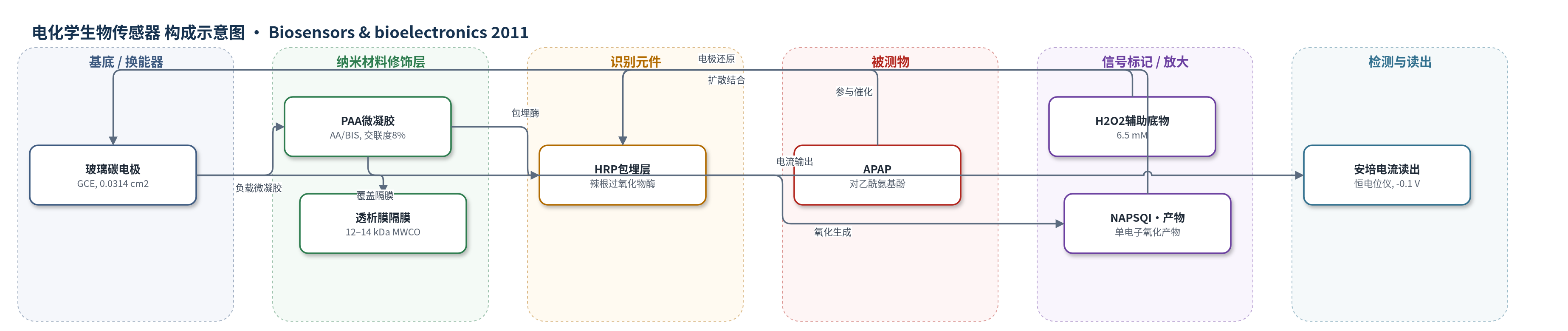
点击图片查看大图 · 依据论文自动绘制
传感器类型
电化学生物传感器
检测对象
对乙酰氨基酚(acetaminophen, APAP/paracetamol);样品基质:PBS标准溶液、商业药物片剂提取液。
检测原理
该传感器以包埋HRP的PAA微凝胶为生物识别层。APAP从溶液扩散进入微凝胶,与HRP接触;在H2O2存在下,HRP催化APAP发生单电子氧化,生成NAPSQI•自由基。NAPSQI•再扩散至玻璃碳电极表面,并在−0.1 V下被还原,产生稳态安培电流。电流大小随APAP浓度升高而增大。PAA微凝胶的交联度决定孔径和含水量:交联度过低时HRP泄漏,过高时APAP及产物扩散受阻;8%交联度兼顾酶保留与传质。低交联体系呈动力学控制,高交联体系呈扩散控制。由于固定化酶存在扩散限制,校准曲线偏离Michaelis–Menten行为,可用Hill方程拟合并扩展线性范围。
检测灵敏度
LOD: 3.1 × 10⁻⁶ M(S/N = 3);线性范围: 1.0 × 10⁻⁵–4.9 × 10⁻⁴ M(表1: 10.2–490.2 μM);灵敏度: 74.9 mA M−1 cm−2(表1: 74.90 mA M−1 cm−2);线性拟合: y = 0.010 + 2.336x,R^2 = 0.9995;Hill扩展范围: 5.7 × 10⁻³ M(表1: 10.2–5769.2 μM)。
效应效果
0.2 mM下抗坏血酸钠、柠檬酸钠、水杨酸、咖啡因、甘露醇和葡萄糖无响应;抗坏血酸:APAP>1:1时电流升高。选择性源于HRP特异性和−0.1 V低电位。冻干微凝胶活性至少保持12个月;PBS 4°C保存4天后保留67.7%信号,7天后32.3%。重复性RSD 3.5%,步长变异10.9%,三传感器重现性RSD 4.1%。与HPLC比较三种片剂:样品1 0.109±0.002 vs 0.124±0.004 mM(RSD 2.9%);样品2 0.107±0.002 vs 0.128±0.003 mM(RSD 2.1%);样品3 0.095±0.001 vs 0.112±0.005 mM(RSD 4.1%)。
传感器的构成
- 工作电极:玻璃碳电极(GCE),面积0.0314 cm2,经氧化铝抛光和+1.8 V NaOH预处理,作为安培换能器。
- 微凝胶修饰层:交联聚丙烯酰胺(PAA)微凝胶微粒,由丙烯酰胺(AA)和N,N'-亚甲基双丙烯酰胺(BIS)聚合,交联度8%,粒径1–32 μm,作为酶载体与扩散屏障。
- 识别元件:辣根过氧化物酶(HRP),包埋于PAA微凝胶中,催化APAP在H2O2存在下单电子氧化。
- 辅助底物:过氧化氢(H2O2,6.5 mM),与HRP形成催化体系,促进APAP氧化。
- 隔膜层:透析膜(12,000–14,000 MWCO),覆盖在微凝胶表面并固定,限制微粒并允许小分子扩散。
- 参比/对电极:Ag/AgCl(3 M KCl)参比电极与Pt对电极,构成三电极安培检测体系。
- 信号产物:N-乙酰-p-苯半醌亚胺自由基(NAPSQI•),在GCE表面−0.1 V被还原产生电流。
中文摘要
本文采用浓乳液聚合方法,将辣根过氧化物酶(HRP)包埋于交联聚丙烯酰胺(PAA)微凝胶微粒中,并研究以该固定化酶体系为生物识别元件、在过氧化氢存在下安培检测对乙酰氨基酚(APAP)的可行性。结果表明,既能保留酶蛋白又允许酚类药物扩散进入微粒的最佳交联度为8%。利用Cottrell方程计算了APAP在不同交联度微凝胶中的表观扩散系数;随交联度升高,扩散系数下降,数据符合单指数方程。交联度低于5%的微粒处于动力学控制,高于5%则处于扩散控制。通过优化H2O2浓度和酶负载,最佳条件下传感器对APAP的灵敏度为74.9 mA M−1 cm−2,检出限为3.1×10⁻⁶ M(S/N=3),响应时间为135 s。线性范围为1.0×10⁻⁵–4.9×10⁻⁴ M,利用Hill方程可延伸至5.7×10⁻³ M。该传感器对APAP具有选择性,并成功用于三种商业药物制剂中APAP浓度的测定。
英文摘要
In this work, horseradish peroxidase (HRP) has been entrapped in cross-linked polyacrylamide microparticles using the concentrated emulsion polymerization method. The feasibility of amperometric detection of acetaminophen (APAP) in a biosensor using this HRP immobilized system as the biological material in the presence of hydrogen peroxide was investigated. We found that the optimum microgel cross-linking degree required to retain the protein and to allow the diffusion of the phenolic drug onto the microparticles was 8%. The apparent diffusion coefficients of APAP across the different microparticles have been calculated using the Cottrell equation. The diffusion coefficients decrease as the microgel cross-linking increases, and the data fit an uniexponential equation well. Those microparticles with a cross-linking degree lower than 5% operated under kinetic control, whereas those whose cross-linking degree was above this value operated under diffusion control. Biosensor response was also optimized to investigate the effect of H(2)O(2) concentration and enzyme loading on the current intensity. Under optimal conditions, the sensitivity of this biosensor for APAP was 74.9 mA M(-1) cm(-2), the detection limit was 3.1×10(-6) M based on S/N=3 and the response time was 135 s. The linear range goes from 1.0×10(-5) to 4.9×10(-4) M APAP, and can be extended using the Hill equation to 5.7×10(-3) M. The biosensor is selective for APAP and was applied to determine the APAP concentration in three commercial pharmaceutical formulations.