组成图示
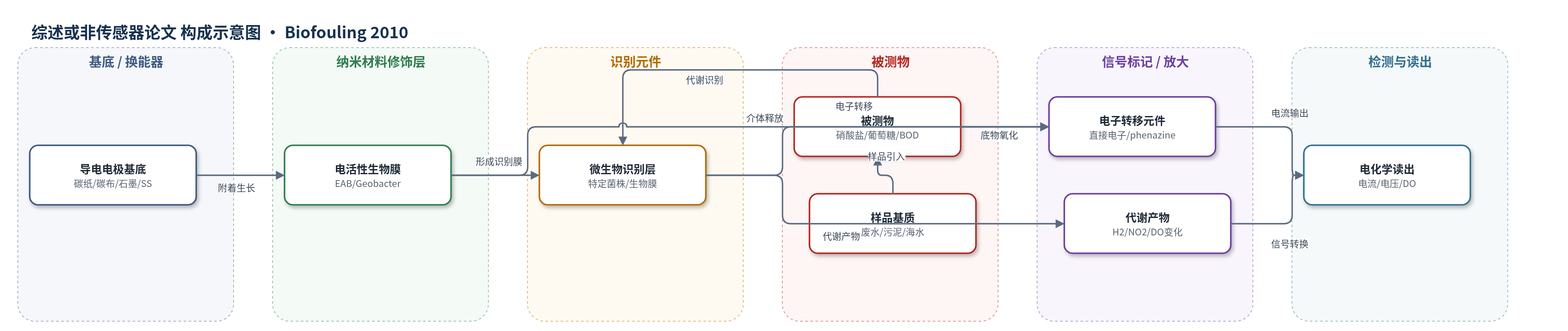
点击图片查看大图 · 依据论文自动绘制
传感器类型
综述或非传感器论文
检测对象
硝酸盐/亚硝酸盐(nitrate/nitrite, NO3-/NO2-)、葡萄糖(glucose)、生化需氧量/可降解有机物(BOD/biodegradable organic matter);样品基质:废水、活性污泥、海水/沉积物、环境水样
检测原理
EAB 生物传感器以导电电极上的微生物膜为识别与催化单元。目标物(如硝酸盐/亚硝酸盐、葡萄糖或可降解有机物)进入样品后,被特定菌株代谢:硝酸盐/亚硝酸盐可被还原为 N2O 等产物并发生电化学检测;葡萄糖或 BOD 底物被氧化,电子经细胞膜细胞色素或细菌自产介体(phenazine)传递到电极。由于呼吸链中电子供体氧化与电极电子受体还原按化学计量耦合,电极电流随底物浓度或微生物呼吸速率增加而增大。该过程无需外源标记,主要依靠微生物代谢放大和直接电子转移,实现电流/电压或溶解氧变化读出。
检测灵敏度
LOD: 550 mg of total nitrogen per liter (mg N l-1)(硝酸盐/亚硝酸盐);线性范围: up to 1.5 mM(硝酸盐/亚硝酸盐);LOD: 0.025 g l-1(葡萄糖);线性范围: 0 to 25 g l-1(葡萄糖)
效应效果
综述报道的 EAB 生物传感器强调快速在线监测:硝酸盐/亚硝酸盐传感器响应时间 530 s,检出限 550 mg N/L,并用于废水长期在线测量;葡萄糖传感器测量时间 3–5 min,线性范围 0–25 g/L,检出限 0.025 g/L;BOD 传感器可替代 5 天或 7 天标准法。文中未报告 RSD、加标回收率或与 ELISA/HPLC/qPCR 的对比。作者认为 EAB 传感器可用于污水处理厂过程控制、生物膜发展监测、毒性物质筛查及废水/环境水样的实时分析。
传感器的构成
- 基底/换能器电极:碳纸、碳布、石墨、不锈钢(SS)或镍泡沫,提供导电界面并收集电流
- 修饰层:电活性生物膜(EAB)附着于电极表面,形成生物催化层
- 识别元件:特定菌株(G. sulfurreducens、S. oneidensis、S. nitritireducens 等)代谢氧化/还原目标物
- 信号标记物:无外源标记,依赖直接电子转移或细菌自产介体(phenazine)传递电子
- 电子供体/底物:葡萄糖、乙酸、硝酸盐/亚硝酸盐、可降解有机物,作为代谢底物或检测对象
- 读出界面:电化学电流/电压或溶解氧变化,经外部电路/电位计测量
中文摘要
电活性生物膜(EAB)概念源于部分细菌能在导电材料表面形成生物膜,并通过细胞膜组分与电极直接交换电子,无需外源介体。该电催化特性与 Geobacter sulfurreducens、Rhodoferax ferrireducens 等特定菌株有关。EAB 主要可来自土壤、海水/淡水沉积物,或污泥、工业/生活废水等富微生物环境。将微生物代谢直接接入外部电路具有重要应用价值,最典型的是微生物燃料电池(MFC),可将生物质转化为电能。此外,涂覆在电极上的 EAB 也日益受到关注,并应用于生物修复、生物合成、生物传感器设计和生物制氢等领域。
英文摘要
The concept of an electro-active biofilm (EAB) has recently emerged from a few studies that discovered that certain bacteria which form biofilms on conductive materials can achieve a direct electrochemical connection with the electrode surface using it as electron exchanger, without the aid of mediators. This electro-catalytic property of biofilms has been clearly related to the presence of some specific strains that are able to exchange electrons with solid substrata (eg Geobacter sulfurreducens and Rhodoferax ferrireducens). EABs can be obtained principally from natural sites such as soils or seawater and freshwater sediments or from samples collected from a wide range of different microbially rich environments (sewage sludge, activated sludge, or industrial and domestic effluents). The capability of some microorganisms to connect their metabolisms directly in an external electrical power supply is very exciting and extensive research is in progress on exploring the possibilities of EABs applications. Indeed, the best known application is probably the microbial fuel cell technology that is capable of turning biomass into electrical energy. Nevertheless, EABs coated onto electrodes have recently become popular in other fields like bioremediation, biosynthesis processes, biosensor design, and biohydrogen production.