组成图示
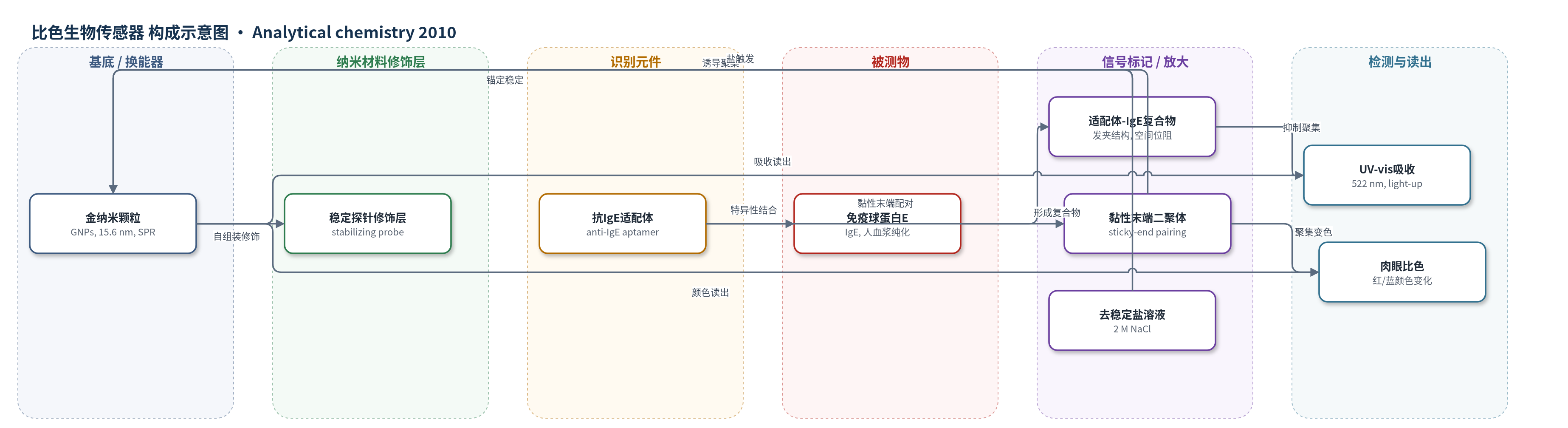
点击图片查看大图 · 依据论文自动绘制
传感器类型
比色生物传感器
检测对象
免疫球蛋白E(IgE);样品基质:人血浆纯化IgE蛋白样品(PBS1缓冲液)
检测原理
无目标时,抗IgE适配体在GNP表面附近通过黏性末端头尾配对形成二聚体,加入2 M NaCl后静电排斥被屏蔽,二聚体桥联颗粒并诱导GNP聚集,520 nm吸收降低并红移,溶液由红变蓝。加入IgE后,适配体与目标结合并转变为发夹构象,破坏黏性末端二聚体;随后适配体-IgE复合物锚定到GNP表面,增加空间位阻和静电排斥,抑制盐诱导聚集。因此含IgE样品在加盐后仍保持分散,522 nm吸收较高,呈红色;IgE浓度越高,聚集抑制越强,522 nm吸收越高,实现“点亮”型比色读出。
检测灵敏度
LOD: 1.89 × 10^-13 M;线性范围: 9.45 × 10^-13–1.89 × 10^-8 M;R^2 = 0.9904;肉眼半定量范围: 10 nM–1 pM
效应效果
该体系选择性良好:IgG、BSA和HSA即使浓度高于IgE也不能抑制GNP聚集,溶液仍发生聚集;IgE样品可保持分散,稀释5倍后肉眼仍可区分。重现性方面,6个浓度水平三次重复的RSD为2.1%、3.4%、8.7%、3.4%、2.9%和3.2%。回收率实验在支持信息中给出,正文未列具体数值。与荧光各向异性、分子发光和场效应晶体管方法相比,检出限低约3个数量级;与近期电化学适配体传感器相比,检测能力提高200倍以上,动态范围宽约30倍。方法成本低、响应快,适合现场和即时检测。
传感器的构成
- 换能纳米材料:金纳米颗粒(GNPs,约15.6 nm,柠檬酸稳定),提供约520 nm局域表面等离子共振吸收,聚集时发生红移和颜色变化。
- 稳定修饰层:稳定探针(stabilizing probe,5′-SH-TCC TCT CTC TCT CTT TTT T-3′)经硫醇自组装锚定于GNP表面,维持胶体分散稳定性。
- 识别元件:抗IgE适配体(anti-IgE aptamer,5′-SH-GGG GCA CGT TTA TCC GTC CCT CCT AGT GGC GTG CCC C-3′),游离识别IgE并诱导发夹构象。
- 目标结合复合物:IgE-适配体复合物,结合后破坏黏性末端二聚体,并锚定到GNP表面提供空间位阻与静电排斥。
- 聚集触发剂:2 M NaCl去稳定溶液(destabilizing solution),用于触发无目标时黏性末端配对诱导的GNP聚集。
- 缓冲基质:PBS1(138 mM NaCl、1 mM KCl、1 mM MgCl2、10 mM磷酸盐,pH 7.4),用于蛋白样品与适配体孵育。
中文摘要
金纳米颗粒(GNPs)具有强距离依赖光学性质和高消光系数,是重要的比色材料。本文报道了一种新的比色工作机理——发夹适配体黏性末端配对诱导的GNP聚集。作者发现,寡核苷酸探针修饰的GNPs在盐诱导下可因黏性末端配对效应而迅速聚集;加入目标分子后,探针序列更易形成发夹结构,从而显著抑制纳米颗粒组装。基于该发现,以免疫球蛋白E(IgE)为模型分析物,构建了均相比色“点亮”检测体系,将传统“熄灭”比色传感器转变为“点亮”型。从适配体构象转变和空间位阻两方面看,寡核苷酸-GNP在结合目标后具有额外稳定性。该体系在肉眼观察和吸光度测量中均表现出极高灵敏度,与现有IgE检测策略相比分析性能显著提升。研究发夹适配体修饰GNPs的组装行为有助于理解GNP性质对结构开关的依赖,并为设计信号探针和开发比色检测方案提供新途径。
英文摘要
Gold nanoparticles (GNPs) possessing strong distance-dependent optical properties and high extinction coefficients have emerged as important colorimetric materials. Almost all colorimetric studies are based on two working mechanisms: sandwich cross-linking and non-cross-linking systems. In the present study, a new working mechanism, hairpin sticky-end pairing-induced GNP assembly, is introduced based on the discovery of unique aggregation behavior of aptamer-functionalized GNPs. The salt-induced aggregation of oligonucleotide probe-modified GNPs can readily occur due to the sticky-end pairing effect while addition of target molecules favors the formation of the hairpin structure of probe sequences and substantially inhibits the nanoparticle assembly. Along this line, we developed a proof-of-concept colorimetric homogeneous assay using immunoglobulin E (IgE) as an analyte model via transforming a commonly designed "light-down" colorimetric biosensor into a "light-up" one. From the point of view of both conformational transition of aptamer and steric bulk, oligonucleotide-GNPs display an additional stability upon binding to target molecules. The assay showed an extremely high sensitivity from both naked eye observations and absorbance measurements. Compared with almost all existing IgE sensing strategies, the proposed colorimetric system possesses a substantially improved analytical performance. Investigating the assembly behavior of hairpin aptamer-modified GNPs could offer new insight into the dependence of the GNP properties on the structure switching and open a new way to design signaling probes and develop colorimetric assay schemes.