组成图示
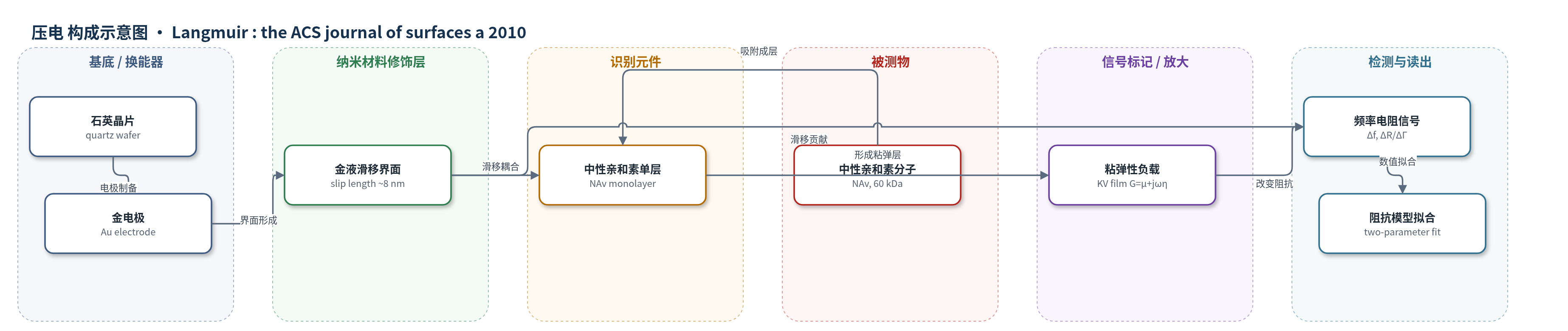
点击图片查看大图 · 依据论文自动绘制
传感器类型
压电(QCM)生物传感器
检测对象
中性亲和素(neutravidin, NAv);样品基质:缓冲液(近似水,ρ≈1 g/cm3,η≈1 cP)
检测原理
TSM器件在石英晶片金电极上激发厚度剪切驻波,液体环境使表面存在粘弹性负载。中性亲和素(NAv)吸附到金表面后形成约42 Å的水合粘弹性单层,改变表面声学阻抗;同时裸金-缓冲液界面存在滑移,使液体剪切耦合偏离无滑移边界条件。识别事件(NAv吸附/覆盖度变化)引起单层密度、剪切模量G=μ+jωη及界面滑移参数s变化,进而改变负载阻抗ZL。器件读出为串联谐振频率下降Δf和运动电阻/带宽变化ΔR/ΔΓ;通过Kelvin-Voigt粘弹性模型与滑移阻抗方程进行两参数数值拟合,可分离质量、粘弹性和界面滑移贡献。文中未使用酶催化、HCR、RCA等信号放大策略。
检测灵敏度
原文未报告 LOD、线性范围、灵敏度斜率或相关系数。
效应效果
本文未评估选择性、抗干扰或实际样品加标回收率。重现性以24次实验的标准差表示:NAv吸附平均Δf=-180±16 Hz,ΔR=1.8±0.4 Ω。纯质量模型预测完全覆盖约-77 Hz,实际表面浓度约1.1–1.5 pmol/cm2时仅约-11至-12 Hz,无法解释实测信号;纯粘弹性模型最低相对误差约78%,改变覆盖度后约46%。引入裸金界面滑移后,拟合得到滑移长度8±1 nm、NAv剪切刚度约1.2×10^6 g cm^-1 s^-2、剪切粘度约1×10^-2 g cm^-1 s^-1,与文献蛋白单层和SFA滑移结果量级一致。作者认为该参数可为NAv连接蛋白的多层声学传感建模提供框架。
传感器的构成
- 换能器基底:石英晶片(quartz wafer)与金电极(Au),产生厚度剪切驻波并作为传感界面
- 界面滑移层:裸金-缓冲液界面(Au/buffer),存在约8 nm滑移长度,影响声学耦合
- 识别/连接元件:中性亲和素(neutravidin, NAv)单层,约42 Å厚,表面浓度约1.5 pmol/cm2,用于结合生物素(biotin)
- 负载液体层:缓冲液(buffer,近似水,ρ≈1 g/cm3,η≈1 cP),提供半无限粘弹性负载
- 信号换能层:NAv 水合粘弹性单层,用 Kelvin-Voigt 模型描述,G=μ+jωη
中文摘要
厚度剪切模式(TSM)声学波器件可实时、无标记地检测表面生物分子的构象变化,但生物单层的材料变化及基底与周围液体的耦合使信号解释困难。本文以中性亲和素(neutravidin, NAv)在金电极上的吸附为例,将其描述为水合粘弹性单层,并允许各界面存在滑移。采用一维声学阻抗模型,结合两参数最小化算法对实验频率和电阻变化进行数值拟合,获得 NAv 单层的剪切模量,其量级与类似蛋白文献值一致。结果表明,在 NAv 吸附之前,裸金电极与缓冲液界面已存在滑移;NAv 吸附后形成薄粘弹性层,界面耦合改变。这些材料参数可为后续以 NAv 为连接蛋白的多层生物传感建模提供基础。
英文摘要
Transverse-shear mode acoustic wave devices have been used as real-time, label-free detectors of conformational shifts in biomolecules on surfaces. However, material changes in the biochemical monolayers and coupling between the substrate and the surrounding liquid make it difficult to isolate the desired signal, so an understanding of these phenomena is required. An important step in this understanding is knowledge of the material properties of the linker layer that attaches a biochemically selective molecule to the gold surface, in our case, neutravidin. With the goal of obtaining material properties for a neutravidin monolayer, for use in future studies, neutravidin adsorption to the gold surface of an acoustic wave biosensor is described as a viscoelastic monolayer using one-dimensional modeling. Neutravidin is described as forming hydrated, viscoelastic monolayers, and slip is allowed at all interfaces. An impedance model is numerically fit to experimental values using a two-parameter minimization algorithm and values for the shear modulus of the neutravidin monolayer, in agreement with literature values for similar proteins, are obtained. Slip is found on the electrode surface prior to neutravidin adsorption. These results will be used for future modeling studies involving this protein as a linker protein.