组成图示
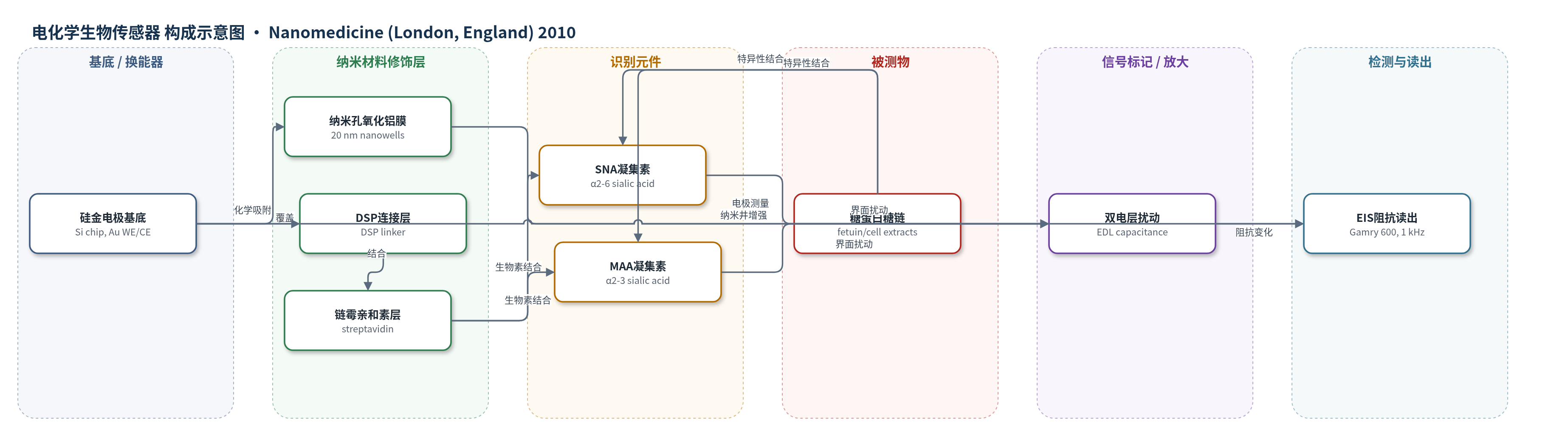
点击图片查看大图 · 依据论文自动绘制
传感器类型
电化学生物传感器
检测对象
糖蛋白糖链/糖基化形式(glycan/glycoprotein glycoforms,包括 fetuin 变体 ASF、3SF、6SF 及 BxPC-3/HPDE6 细胞总蛋白提取物中的 α(2–3)/α(2–6) 唾液酸糖链);样品基质:PBS 稀释糖蛋白溶液、细胞总蛋白提取物,临床样品如血清、唾液、尿液(作者展望)
检测原理
NanoMonitor 以金电极/纳米孔氧化铝膜界面为换能器,凝集素 SNA 或 MAA 通过 DSP–链霉亲和素–生物素化学固定于纳米孔底部。样品中糖蛋白的特定糖链与凝集素特异性结合后,结合事件发生在固/液界面约 50 nm 的双电层内,改变界面电荷分布与双电层电容。器件施加 100 mV 小振幅交流信号并在 50 Hz–3 kHz 扫描,阻抗分析仪读取工作电极与对电极间的阻抗;在 1 kHz 处阻抗变化最大。被测糖链浓度越高,结合量越大,阻抗相对基线的百分比变化越大。纳米孔氧化铝形成高密度纳米井,通过纳米限域和双电层扰动增强信号,实现无标记、无氧化还原探针的 EIS 检测。
检测灵敏度
LOD: 1 pg/ml;线性范围: 1 pg/ml–10 ng/ml
效应效果
NanoMonitor 与凝集素 ELISA 结果一致,但灵敏度约高五个数量级:ELISA 对 3SF/6SF 下限为 0.156/0.312 µg/ml,NanoMonitor 为 1 pg/ml,线性范围 1 pg/ml–10 ng/ml。选择性上,3SF 与 MAA 在 1 pg/ml 可区分(13% vs SNA 5%),6SF 与 SNA 在 100 pg/ml 以上可区分;BxPC-3 提取物与 MAA 阻抗变化 65%,SNA 仅 9%,正常细胞无显著差异。检测仅需 10 µl、<15 min,ELISA 约 4 h 且最少 50 µl;作者称响应稳健可重复(n=3)。适合开发为临床糖链标志物便携式无标记电子生物传感器。
传感器的构成
- 基底/换能器电极:硅微平台(silicon microplatform)与金电极(gold electrodes),内工作电极 25 µm、外对电极 125 µm,用于 EIS 阻抗测量
- 纳米材料修饰层:纳米孔氧化铝膜(nanoporous alumina membrane,孔径 20 nm、孔隙率 50%、10^6 pores/mm2),形成高密度纳米井并增强双电层扰动
- 界面连接层:DSP(dithiobis succinimidyl propionate)交联剂化学吸附于金表面,提供 NHS 酯连接蛋白
- 桥接蛋白层:链霉亲和素(streptavidin)结合 DSP 的氨基,再结合生物素化凝集素
- 识别元件:生物素化凝集素 SNA(Sambucus nigra agglutinin)和 MAA(Maackia amurensis agglutinin),分别识别 α(2–6) 和 α(2–3) 末端唾液酸
- 封闭剂:SuperBlock blocking buffer 封闭非特异结合位点
- 微流控腔:丙烯酸微流控腔(acrylic microfluidic chamber),8 个独立通道、每通道 10 µl,覆盖传感位点并固定氧化铝膜
中文摘要
本研究开发了一种名为 NanoMonitor 的超灵敏无标记诊断平台,用于快速分析蛋白糖基化产生的糖链生物标志物。该器件由带多个金电极传感位点的硅芯片构成,基于电化学阻抗谱(EIS)工作;每个传感位点覆盖纳米孔氧化铝膜,形成高密度纳米孔,并在电极表面固定凝集素。当样品中特异性糖链与纳米孔底部的凝集素结合时,固/液界面双电层发生扰动,引起阻抗变化。作者利用 Sambucus nigra agglutinin(SNA)和 Maackia amurensis agglutinin(MAA)分析 fetuin 的糖链变体,并检测人胰腺癌细胞系 BxPC-3 蛋白提取物。结果显示,NanoMonitor 与凝集素 ELISA 结果高度一致,但检测快速、完全无标记、仅需 10 µl 样品,灵敏度约提高五个数量级,并在较宽糖蛋白浓度范围内具有高度选择性。该器件有望发展为用于临床样品糖链生物标志物常规检测的便携式电子生物传感器。
英文摘要
AIM: The goal of our research is to develop an ultrasensitive diagnostic platform called 'NanoMonitor' to enable rapid label-free analysis of a highly promising class of biomarkers called glycans (oligosaccharide chains attached to proteins) with high sensitivity and selectivity. The glycosylation of fetuin - a serum protein - and extracts from a human pancreatic cancer line was analyzed to demonstrate the capabilities of the NanoMonitor.
MATERIAL & METHODS: The NanoMonitor device consists of a silicon chip with an array of gold electrodes forming multiple sensor sites and works on the principle of electrochemical impedance spectroscopy. Each sensor site is overlaid with a nanoporous alumina membrane that forms a high density of nanowells on top of each electrode. Lectins (proteins that bind to and recognize specific glycan structures) are conjugated to the surface of the electrode. When specific glycans from a test sample bind to lectins at the base of each nanowell, a perturbation of electrical double-layer occurs, which results in a change in the impedance. Using the lectins Sambucs nigra agglutinin (SNA) and Maackia amurensis agglutinin (MAA), subtle variations to the glycan chains of fetuin were investigated. Protein extracts from BXPC-3, a cultured human pancreatic cancer cell line were also analyzed for binding to SNA and MAA lectins. The performance of the NanoMonitor was compared to a conventional laboratory technique: lectin-based enzyme linked immunosorbent assay (ELISA).
RESULTS & DISCUSSION: The NanoMonitor was used to identify glycoform variants of fetuin and global differences in glycosylation of protein extracts from cultured human pancreatic cancerous versus normal cells. While results from NanoMonitor correlate very well with results from lectin-based ELISA, the NanoMonitor is rapid, completely label free, requires just 10 microl of sample, is approximately five orders of magnitude more sensitive and highly selective over a broad dynamic range of glycoprotein concentrations.
CONCLUSION: Based on its performance metrics, the NanoMonitor has excellent potential for development as a point-of-care handheld electronic biosensor device for routine detection of glycan biomarkers from clinical samples.