组成图示
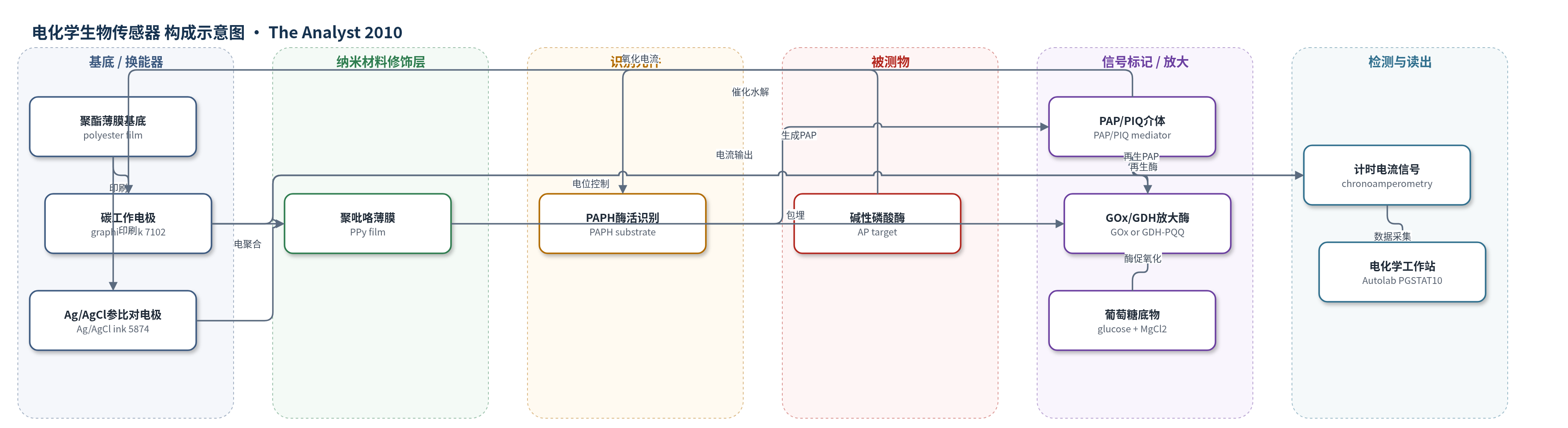
点击图片查看大图 · 依据论文自动绘制
传感器类型
电化学生物传感器
检测对象
碱性磷酸酶(alkaline phosphatase, AP);样品基质为0.2 M醋酸缓冲液(pH 4.7)溶液,文中未报告实际生物/食品样品。
检测原理
碱性磷酸酶(AP)催化对氨基苯磷酸酯(PAPH)水解生成对氨基酚(PAP)。PAP在丝网印刷碳工作电极上于0.15 V被氧化为p-亚胺醌(PIQ),产生计时电流。PIQ可再氧化被葡萄糖还原的GOx或GDH-PQQ,酶随后催化葡萄糖氧化并再生PAP/PIQ介体,形成酶促电化学放大循环。AP浓度越高,初始PAPH水解产生的PAP越多,稳态氧化电流越大。低体积微系统缩短扩散路径,GDH-PQQ不依赖氧作为电子受体,避免与溶解氧竞争,因此灵敏度优于GOx。
检测灵敏度
LOD(AP, GOx): 9.05 × 10^-13 M (70 ng L^-1, 20 min);2.36 × 10^-12 M (207 ng L^-1, 30 min);4.09 × 10^-12 M (356 ng L^-1, 40 min);LOD(AP, GDH-PQQ): 9.11 × 10^-15 M (0.80 ng L^-1, 15 min);LOD(PAP): 24.9、7.01、1.86 × 10^-8 M(0.65、0.8、0.9 V);PAP灵敏度: 0.044、0.0505、0.0485 A M^-1 cm^-2(0.9、0.8、0.65 V)
效应效果
优化电位脉冲电聚合后,2个0.9 V脉冲形成的较薄PPy-GOx膜给出最高PAP响应,灵敏度较文献中其他PPy-GOx修饰电极提高5–10倍。AP检测中,GOx体系在20 min孵育下LOD为9.05×10^-13 M,延长至30–40 min因PAPH自发降解使空白升高,LOD反而变差;GDH-PQQ体系15 min孵育LOD达9.11×10^-15 M,优于简单碳丝网印刷电极及更复杂系统。作者强调低体积微系统、稳定可重复的PPy酶膜和低成本集成优势,适用于病原、食品和环境监测中的AP电化学检测。
传感器的构成
- 基底/微通道:聚酯薄膜(polyester film)基底,丝网印刷形成约20 µL微通道,兼具结构与流体约束作用。
- 工作电极:石墨碳导电油墨(DuPont 7102 carbon ink)印刷的碳电极,暴露面积约0.1 cm²,用于PAP氧化和电流读出。
- 参比/对电极:Ag/AgCl导电油墨(DuPont 5874 Ag/AgCl ink)印刷电极,作为参比兼对电极,维持0.15 V计时电流测量。
- 电极活化处理:饱和Na2CO3溶液在1.2 V下300 s电化学活化,提高碳电极电催化活性、亲水性和重现性。
- 修饰层:吡咯(pyrrole)经电位脉冲电聚合形成的聚吡咯(PPy)薄膜,控制电荷/厚度,包埋酶并允许底物扩散。
- 识别/底物:对氨基苯磷酸酯(PAPH)作为AP的酶活识别底物,被AP水解生成对氨基酚(PAP)。
- 放大元件:葡萄糖氧化酶(GOx)或葡萄糖脱氢酶(GDH,含PQQ辅因子)包埋于PPy中,利用葡萄糖底物形成酶促电化学放大。
- 介质/冲洗:0.2 M醋酸缓冲液(pH 4.7)用于测量,PBS-Tween冲洗去除未包埋酶,醋酸缓冲液4°C储存。
中文摘要
本文利用丝网印刷技术制备了一种微型电化学系统,其中石墨基电极同时承担功能与结构作用。厚膜印刷工艺使器件体积降至约20 µL(原文排版为20 mL),可高效完成多种电化学操作。通过在微系统中原位生成并优化电位脉冲电聚合聚吡咯膜,包埋葡萄糖氧化酶(GOx)或葡萄糖脱氢酶(GDH),实现了生物分子固定化。该生物修饰微系统用于碱性磷酸酶(AP)的超灵敏电化学检测,在15 min孵育时间内,GOx修饰系统检出限低于10^-12 M,GDH修饰系统达到10^-15 M。结果表明,低体积微系统与优化的聚吡咯–酶膜结合,具有良好固定化效率和物质扩散能力,为稳定、可重复的电化学集成生物传感器平台提供了新途径。
英文摘要
Screen printing technique has been used to manufacture a microsystem where the graphite-based electrodes hold both a functional and an architectural task. The thick film manufacturing technique has proved valid to develop a very low volume (ca. 20 microL) device where different electrochemical operations can be very efficiently performed. Biomolecule immobilisation within the microsystem for biosensors applications has been explored by inducing and optimizing the in situ generation of a potential pulse polypyrrole electropolymerised film entrapping either glucose oxidase or glucose dehydrogenase. This biomodified microsystem was applied to the ultrasensitive electrochemical detection of alkaline phosphatase yielding limits of detection below 10(-12) M for glucose oxidase and of 10(-15) M for glucose dehydrogenase modified systems, within 15 min of incubation time. The results obtained showed the advantages of using low volume microsystems in combination with an optimised polypyrrole-enzyme film, which displayed a good immobilisation efficiency in conjunction with a good diffusion of species through. Ultrasensitive detection of AP in combination with a stable and reproducible surface modification for entrapping of biomolecules opens the window for new electrochemical detection platform with great potential for integrated biosensor applications.