组成图示
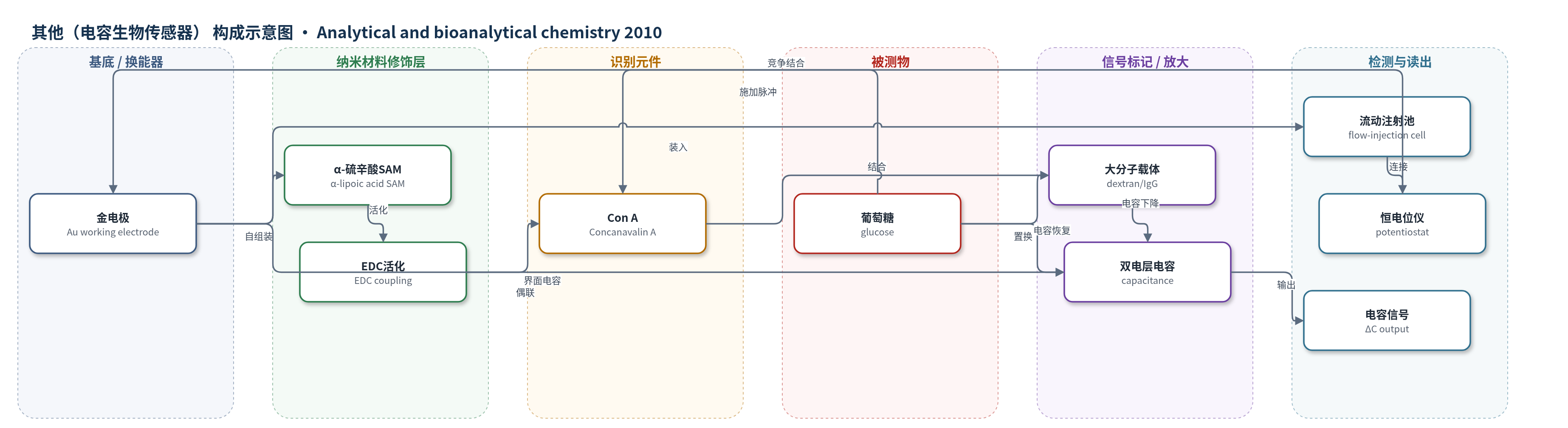
点击图片查看大图 · 依据论文自动绘制
传感器类型
其他(电容生物传感器)
检测对象
葡萄糖(glucose);另以果糖(fructose)、麦芽糖(maltose)、甲基-α-D-葡萄糖苷(Me-α-Glu)、甲基-α-D-甘露糖苷(Me-α-Man)作 Con A 亲和力研究。样品基质:Tris–HCl 缓冲液(含 CaCl2、MgCl2、MnCl2,pH 7.4)流动注射样品。
检测原理
该传感器以固定化 Con A 为弱亲和识别元件。先注入葡聚糖或 IgG 等大分子糖缀合物,使其结合 Con A,增加电极表面介电层厚度并排开双电层,导致电容下降。随后注入葡萄糖,葡萄糖与 Con A 结合位点竞争,置换部分大分子,使介电层变薄、双电层恢复,电容回升。电容恢复量 ΔCc 随葡萄糖浓度增加而增大,在对数浓度范围内近似线性。系统对金电极施加 +50 mV 恒电位脉冲,以 50 kHz 采样电流衰减,按 RC 模型计算总电容,从而读出葡萄糖浓度。
检测灵敏度
LOD: 1.0×10⁻⁶ M (0.18 µg mL−1, S/N=3);线性范围: 1.0×10⁻⁵–1.0×10⁻¹ M (1.8 µg mL−1–18 mg mL−1);回归方程: y=0.694x+5.428;灵敏度斜率: 0.694 nF/log M;R^2 = 0.997
效应效果
优化后,葡萄糖检测 RSD 为1.5%–3.7%;用 1.0×10⁻³ M 39 kDa 葡聚糖再生后可迅速回到基线,响应时间约15 min,适合离线分析。在 1.0×10⁻⁴、1.0×10⁻³、1.0×10⁻² 和 1.0×10⁻¹ M 葡萄糖下,平均响应增幅分别为150.5%、126.8%、115.7%和89.2%。多种糖的置换能力与 Con A 结合常数线性相关(R^2=0.97),RSD 为1.2%–6.5%,显示良好选择性。未报告实际样品加标回收率及与 ELISA/HPLC/qPCR 对比。作者认为该方法动态范围宽、灵敏度高、可重复使用,并可用于葡聚糖分子量及糖–Con A 亲和力监测。
传感器的构成
- 基底/换能器电极:金电极(Au,Ø3 mm,99.99%),作为电容换能器的工作电极
- 自组装单分子层:α-硫辛酸(α-lipoic acid, LA)SAM,提供羧基用于固定识别元件
- 活化/偶联层:EDC(N-(3-dimethylaminopropyl)-N'-ethylcarbodiimide)活化羧基,实现 Con A 共价偶联
- 识别元件:刀豆蛋白A(Concanavalin A, Con A),弱亲和结合葡萄糖及葡萄糖聚合物/糖缀合物
- 封闭层:1-十二烷硫醇(1-dodecanethiol)SAM,封闭金表面并提高绝缘性
- 大分子载体/信号元件:葡聚糖(dextran, Dx39 等)或免疫球蛋白G(IgG)糖缀合物,结合 Con A 改变双电层厚度
- 流动注射池:四电极流动注射池(10 µL),含 Pt 辅助电极、Pt 伪参比电极和 Ag/AgCl 参比电极
- 读出系统:恒电位仪与数据采集单元(Keithley),施加 +50 mV 脉冲并采样电流衰减计算电容
中文摘要
本文提出一种用于监测低分子量分析物的竞争式电容生物传感技术(CCBT),并以葡萄糖为模型研究。该技术基于流动注射电容生物传感器,利用小分子分析物从固定化生物识别元件的弱亲和结合位点置换预先结合的大分子分析物–载体缀合物。在无葡萄糖时,葡聚糖或糖缀合物与固定化刀豆蛋白A(Con A)结合,使电极表面介电层增厚,电容下降;加入葡萄糖后,葡萄糖竞争置换部分结合的大分子,使电容部分恢复。实验表明,电容变化在葡萄糖浓度1.0×10⁻⁵至1.0×10⁻¹ M(1.8 µg/mL至18 mg/mL)的对数范围内线性,优化条件下检出限为1.0×10−6 M(0.18 µg/mL)。通过改变葡萄糖聚合物分子量、Con A用量和缓冲液组成,可调节检测范围。该方法具有动态范围宽、灵敏度高和可重复使用性好的优点。
英文摘要
A novel technique for monitoring of low molecular mass analytes using a flow-injection capacitive biosensor is presented. The method is based on the ability of a small molecular mass analyte to displace a large analyte-carrier conjugate from the binding sites of an immobilized biorecognition element with weak affinity to both compounds. A model study was performed on glucose as the small molecular mass analyte. In the absence of glucose, binding of a glucose polymer or a glycoconjugate to concanavalin A results in a capacitance decrease. Upon introduction of glucose, it displaces a part of the bound glucose polymer or glycoconjugate leading to a partial restoration of capacitance. Experimental results show that the change in capacitance depends linearly on glucose concentration within the range from 1.0 x 10(-5) to 1.0 x 10(-1) M, corresponding to 1.8 microg ml(-1) to 18 mg ml(-1) in a logarithmic plot, with a detection limit of 1.0 x 10(-6) (0.18 microg ml(-1)) under optimized conditions. In addition, by modifying the molecular mass of the glucose polymer, amount of biorecognition element, and buffer composition, we were able to tune the analyte-sensing range. The developed technique has the benefits of expanded dynamic range, high sensitivity, and excellent reusability.