组成图示
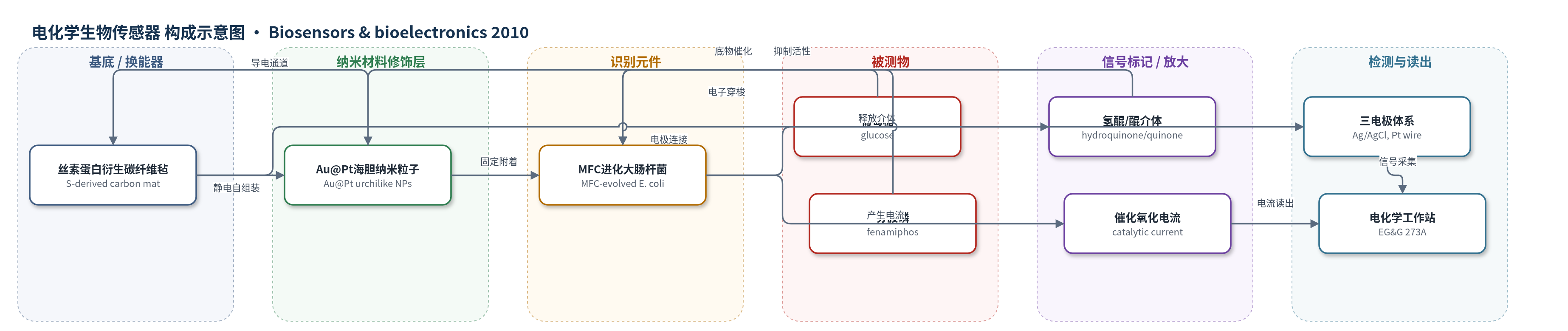
点击图片查看大图 · 依据论文自动绘制
传感器类型
电化学生物传感器
检测对象
葡萄糖(glucose,菌活性底物)、芬胺磷(fenamiphos,有机磷农药);样品基质为 pH 7.0 PBS 缓冲液(芬胺磷用 50 mM PBS 稀释),面向环境水样监测。
检测原理
传感器以 MFC 进化大肠杆菌为生物催化元件,固定于 Au@Pt 海胆状纳米粒子修饰的丝素蛋白衍生碳纤维毡上。葡萄糖作为电子供体进入菌体并被催化氧化,电子经细胞内源醌/氢醌介体穿梭,并通过 Au@Pt 纳米粒子的高导电通道和碳纤维表面醌基辅助转移至电极,在恒电位下产生与菌代谢活性成正比的催化电流。芬胺磷等有机磷农药与菌体作用后抑制其代谢和电子传递,使葡萄糖氧化电流下降;以电流抑制率 I=100×(Inor−Itox)/Inor 表征毒性,抑制率随 −log[fenamiphos] 线性变化。Au@Pt 纳米粒子的大比表面积、电催化活性及碳纤维醌基共同实现信号放大。
检测灵敏度
LOD: 0.3 μM;线性范围: 1 μM–538 μM;LOEC: 0.09 mg/L;线性范围: 0.5 mg/L–36.6 mg/L(对 −log[fenamiphos]);对照碳纸传感器 LOD: 10 μM;线性范围: 50 μM–237 μM。
效应效果
该传感器性能优于商用碳纸电极:葡萄糖检测线性范围 1–538 μM,LOD 0.3 μM,而碳纸为 50–237 μM、LOD 10 μM。4 ℃ PBS 保存 1 个月对 5 mM 葡萄糖响应保留 88%,2 个月保留 80%;共聚焦显示 2 个月后多数细胞仍具代谢活性。芬胺磷检测中,15 mg/L 孵育 10 min 即明显降低电流,1.5 mg/L 孵育 10 min 活性下降约 3%,1 h 内几乎完全抑制;30 min 暴露下抑制率与 −log[fenamiphos] 在 0.5–36.6 mg/L 线性,LOEC 0.09 mg/L,重现性 RSD <3.7%(n=6),检测时间内无明显电极污损。作者认为可用于环境毒性监测。
传感器的构成
- 基底/换能器电极:丝素蛋白衍生碳纤维毡(S-derived carbon fiber mat),由蚕丝在 N2 中 800 ℃ 碳化得到,含氨基、吡啶、羰基/醌基,提供导电、生物相容微环境和电子转移位点。
- 纳米材料修饰层:Au@Pt 海胆状纳米粒子(Au@Pt urchilike NPs),通过静电自组装沉积于碳纤维表面,提供高导电通道和电催化活性。
- 生物识别/催化元件:MFC 进化大肠杆菌(MFC-evolved E. coli DH5α),固定于电极表面,催化葡萄糖氧化并响应芬胺磷抑制。
- 电子供体/底物:葡萄糖(glucose),作为初级底物被 E. coli 催化氧化,产生与菌活性相关的电流。
- 内源电子介体:氢醌/醌类介体(hydroquinone/quinone mediator),由 MFC 进化 E. coli 自分泌,促进细胞与电极间电子转移。
- 电化学测量系统:Ag/AgCl 参比电极、铂丝对电极和 EG&G 273A 电化学工作站,用于三电极电化学测量与信号读出。
中文摘要
本文提出一种简便高效的路线,制备 Au@Pt 海胆状纳米粒子(Au@Pt NPs)修饰的丝素蛋白衍生碳纤维毡,并基于该材料构建大肠杆菌(E. coli)电化学生物传感器。蚕丝是天然蛋白纤维,衍生碳纤维毡含有氨基、吡啶和羰基等功能基团,这些天然存在的官能团使 Au@Pt NPs 能自组装到碳纤维表面,并为细菌提供生物相容微环境。Au@Pt NPs 修饰的丝素蛋白衍生碳纤维可灵敏检测 E. coli 活性,检测限低,其中葡萄糖用作评价菌活性的初级底物。该 Au@Pt/碳纤维毡生物传感器性能明显优于商用碳纸生物传感器。其高灵敏度来源于 Au@Pt 海胆状 NPs 的独特电催化性质和丝素蛋白衍生碳纤维中的醌基。该传感器还用于检测有机磷农药芬胺磷,E. coli 活性相对抑制率与 −log[fenamiphos] 在 0.5–36.6 mg/L 范围内线性,最低可观察效应浓度(LOEC)为 0.09 mg/L。该材料具有高导电性、生物相容性和高电催化活性,可作为微生物传感器改进的先进电极材料,并在环境监测中具有潜在应用。
英文摘要
We present here a facile and efficient route to prepare silk derived carbon mat modified with Au@Pt urchilike nanoparticles (Au@Pt NPs) and develop an Escherichia coli (E. coli)-based electrochemical sensor using this material. Silk is a natural protein fiber, and it is abundant with kinds of functionalities which are important in the development of the derived material. The S-derived carbon fiber mat have amino, pyridine and carbonyl functional groups, these natural existent functionalities allow the Au@Pt NPs to self-assemble on the carbon fiber surface and provide a biocompatible microenvironment for bacteria. The Au@Pt NPs modified S-derived carbon fiber is sensitive to detect the E. coli activities with a low detection limit, where glucose is used as a prelimiltary substrate to evaluate them. The performance of Au@Pt/carbon fiber mat based biosensor is much better than that of commercial carbon paper based biosensor. The high sensitivity of this biosensor stems from the unique electrocatalytic properties of Au@Pt urchilike NPs and quinone groups presented in S-derived carbon fiber. This biosensor is also tested for detection of organophosphate pesticides, fenamiphos. The relative inhibition of E. coli activity is linear with -log[fenamiphos] at the concentration range from 0.5mg/L to 36.6 mg/L with lowest observable effect concentration (LOEC) of 0.09 mg/L. The Au@Pt NPs modified S-derived carbon fiber mat possesses high conductivity, biocompatibility and high electrocatalytic activity and be can used as advanced electrode materials for microbial biosensor improvement. The microbial biosensor based on this material shows potential applications in environmental monitoring.