组成图示
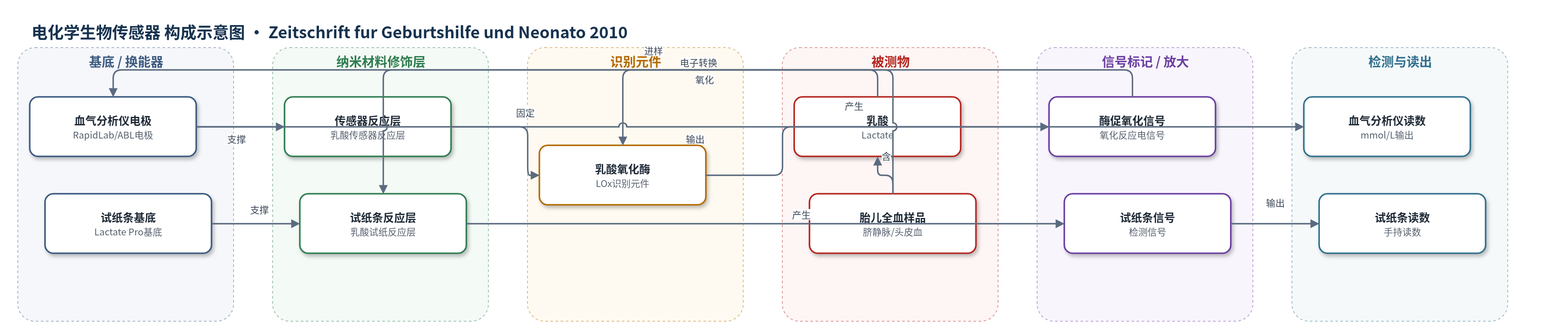
点击图片查看大图 · 依据论文自动绘制
传感器类型
电化学生物传感器
检测对象
乳酸(Lactate, Lac);样品基质:胎儿全血(脐静脉血、胎儿头皮血,部分经 pO2 10/20 mmHg 调气)
检测原理
胎儿全血中的乳酸进入传感器反应层后,被固定在其上的乳酸氧化酶(LOx)识别并催化氧化。该酶促反应改变电极界面或试纸条反应层的化学状态,产生与乳酸浓度相关的电化学或试纸条信号;仪器将信号转换为以 mmol/L 表示的乳酸浓度。乳酸浓度越高,氧化反应产生的信号越强。由于红细胞在体外仍进行糖酵解,采血后乳酸会随时间继续升高,因此测量延迟、调气(pO2 10/20 mmHg)和样品处理时间会引入前分析偏差,使重复测量标准差和变异系数增大。
检测灵敏度
原文未报告 LOD、线性范围、灵敏度斜率或相关系数;仅报告有效浓度范围:0–30 mmol/L(乳酸生物传感器)、0.8–23.3 mmol/L(Lactate Pro™)。
效应效果
在1392份有效胎儿全血样品中,三种血气分析仪乳酸生物传感器连续10次重复测量 CV 为1.55%–3.16%,SD 为0.042–0.053 mmol/L;Lactate Pro™ 试纸条 CV 为3.99%,SD 为0.117 mmol/L。重复测量中,生物传感器原始血 CV 低于3.5%,试纸条约6%;40 min调气后精度下降,2b组 ABL 700 CV达14.6%、Lactate Pro™ 10.4%、Siemens 865 6.9%、ABL 625 6.1%。与三仪器均值参考相比,ABL 625 系统误差最小(−0.1%),Siemens 865 高估8.9%,ABL 700 低估6.2%,Lactate Pro™ 低估3.7%。作者认为各生物传感器满足产程常规使用,但不同装置结果不可直接互换,时间延迟会显著降低重复性。
传感器的构成
- 换能器电极:血气分析仪内置乳酸生物传感器(RapidLab 865、ABL 625、ABL 700),用于将乳酸氧化反应转换为电信号。
- 识别元件:乳酸氧化酶(LOx),催化乳酸氧化,其活性限制传感器寿命。
- 试纸条反应层:Lactate Pro™ 试纸条,用于手持式单独检测乳酸。
中文摘要
胎儿血乳酸对判断缺氧所致胎儿窘迫具有重要诊断价值,可评估代谢性酸中毒的持续时间与强度。现代生物传感器技术可在产房中即时检测胎儿乳酸。本研究在常规产程条件下评估三种乳酸生物传感器(Siemens RapidLab 865、Radiometer ABL 625 和 ABL 700)及一种试纸条装置(Lactate Pro™)的前分析误差与分析误差。对超过1350份胎儿全血样品进行连续和重复测量,计算变异系数(CV)和标准差(SD),并以三种生物传感器均值作为人工参考值;同时通过调气至 pO2 10 和 20 mmHg 模拟胎儿低氧。结果显示,生物传感器连续测量 CV 为1.55%–3.16%,SD 为0.042–0.053 mmol/L;试纸条 SD 为0.117 mmol/L,CV 为3.99%。与参考值相比,ABL 625 偏差最小(−0.1%),RapidLab 865 高估8.9%,ABL 700 低估6.2%,Lactate Pro™ 低估3.7%。结论:常规使用中各生物传感器精度足够,试纸条标准差略高;不同装置乳酸值直接比较需谨慎,且随时间延长精度下降。
英文摘要
INTRODUCTION: Lactate in fetal blood has a high diagnostic power to detect fetal compromise due to hypoxia, as lactate allows an estimation of duration and intensity of metabolic acidemia. Biosensor technology allows an instantaneous diagnosis of fetal compromise in the delivery room. The goal of the current investigation is to define the preanalytical and analytical biases of this technology under routine conditions in a labour ward in comparison to test-strip technology, which allows measurement of lactate alone.
MATERIAL AND METHODS: Three lactate biosensors (RapidLab 865, Siemens Medical Solutions Diagnostics, Bad Nauheim, Germany; Radiometer ABL625 and ABL 700, Radiometer Copenhagen, Denmark) and one test-strip device (Lactate Pro, Oxford Instruments, UK) were evaluated regarding precision in serial and repetitive measurements in over 1350 samples of fetal whole blood. The coefficient of variation (CV) and the standard deviation (SD) were calculated. The average value of all three biosensors was defined as an artificial reference value (refval). Blood tonometry was performed in order to test the quality of respiratory parameters and to simulate conditions of fetal hypoxia (pO (2): 10 and 20 mmHg).
RESULTS: The precision of serial measurements of all biosensors indicated a coefficient of variation (CV) between 1.55 and 3.16% with an SD from 0.042 to 0.053 mmol/L. The test-strip device (Lactate Pro) mounted to 0.117 mmol/L and 3.99% (SD, CV). When compared to our reference value (refval) ABL 625 showed the closest correlation of -0.1%, while Siemens RapidLab 865 showed an overestimation of +8.9%, ABL700 an underestimation of -6.2% and Lactate Pro of -3.7%.
CONCLUSION: For routine use all tested biosensors show sufficient precision. The test-strip device shows a slightly higher standard deviation. A direct comparison of measured lactate values from the various devices needs to be interpreted with caution as each method detects different lactate concentrations. Furthermore, the 40 min process of tonometry led to an increase of SD and coefficient of variation in all devices. This results in the important preanalytical finding that the precision of replicated measurements worsens significantly with time. The clinician should be aware of the type of analyser used and of preanalytical biases before making clinical decisions on the basis of lactate values.