组成图示
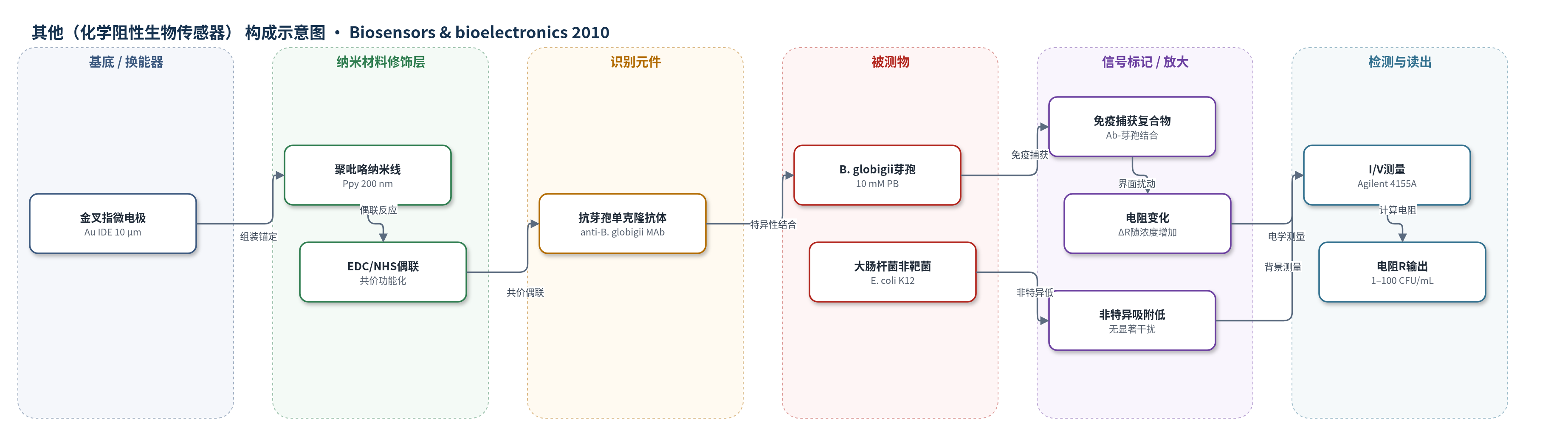
点击图片查看大图 · 依据论文自动绘制
传感器类型
其他(化学阻性生物传感器)
检测对象
Bacillus globigii 芽孢(B. globigii spores,Bacillus anthracis 模拟物);样品基质:10 mM 磷酸盐缓冲液(PB,pH 7.4)
检测原理
该传感器为无标记化学阻性免疫传感。金叉指微电极上组装聚吡咯(Ppy)纳米线,并用 EDC/NHS 将抗 B. globigii 单克隆抗体共价固定于纳米线表面。目标芽孢在 10 mM 磷酸盐缓冲液(pH 7.4)中孵育 30 min,被抗体特异性捕获。由于 B. globigii 芽孢等电点约为 2–3.6,在 pH 7.4 下整体带负电,且芽孢尺寸远大于溶液 Debye 长度,靠近传感表面的负电荷会扰动 Ppy 纳米线界面电荷分布与导电性,使电阻增加。电阻变化随芽孢浓度在 1–100 CFU/mL 内线性增大,超过 100 CFU/mL 后饱和。系统通过 I/V 测量计算电阻 R,无需酶或荧光标记放大。
检测灵敏度
LOD: 1 CFU/mL(3×空白标准差);线性范围: 1–100 CFU/mL;r^2 = 0.992
效应效果
传感器选择性良好:无抗 B. globigii 抗体、仅 BSA 封闭的对照未显示显著非特异响应;非靶大肠杆菌(E. coli K12)浓度高达 10^6 CFU/mL 时也未产生可检测的非特异吸附。Ppy 纳米线组装后初始电阻变化约 100 kΩ,抗体偶联后电阻平均增加 60%,且至少 24 h 稳定;结果高度可重复,标准偏差小。响应时间为 30 min,超过 100 CFU/mL 后信号饱和。光学显微镜确认芽孢附着于纳米线。作者认为该平台可发展为低成本、易操作、无标记、微型化生物 MEMS,用于芽孢及其他大分子/微生物检测,并可通过多传感器阵列实现多目标分析。
传感器的构成
- 基底/换能器电极:金叉指微电极(Au interdigitated microelectrodes),10 μm 宽、10 μm 间距,提供电阻测量通道
- 纳米材料修饰层:聚吡咯纳米线(Ppy nanowires),直径约 200 nm、长 15–20 μm,作为导电传感层并增大比表面积
- 偶联功能化层:EDC/NHS(N-(3-dimethylaminopropyl)-N′-ethylcarbodiimide hydrochloride / N-hydrosuccinimide),介导抗体羧基与纳米线氨基共价结合
- 识别元件:抗 B. globigii 单克隆抗体(anti-B. globigii MAb),特异性捕获目标芽孢
- 封闭剂:牛血清白蛋白(BSA,1% w/v),封闭非特异结合位点;阴性对照以 BSA 替代抗体
- 信号读出:半导体参数分析仪(Agilent 4155A)测量 I/V 并计算电阻 R
中文摘要
本研究将聚吡咯纳米线(Ppy)组装到微加工金叉指微电极上,构建用于检测 Bacillus globigii 芽孢的化学阻性生物传感器;B. globigii 作为生物恐怖威胁病原体 Bacillus anthracis 的模拟物。该传感器通过监测免疫捕获后电阻变化实现无标记检测。所制备传感器在 1–100 CFU/mL 的低芽孢浓度范围内呈现良好线性相关(r^2 = 0.992),该浓度水平可能用于生物恐怖攻击,响应时间为 30 min,之后传感器达到饱和。研究还评估了无抗 B. globigii 抗体以及存在非靶细菌大肠杆菌(Escherichia coli)时的性能,未观察到显著非特异性相互作用。作者认为 Ppy 纳米线是检测并定量低浓度大分子和生物组分的良好平台。
英文摘要
Polypyrrole nanowires (Ppy) were assembled onto microfabricated gold interdigitated microelectrodes, to construct a chemiresistive biosensor for the detection of Bacillus globigii, used as simulant of the threatening bioterrorism agent B. anthracis. The fabricated biosensor showed good linear correlation (r(2)=0.992) for low spore concentrations ranging from 1 to 100 CFU (colony forming units)/mL, a concentration that could be used in a bioterrorism attack, with a response time of 30 min, after which the sensor was saturated. The performance of the biosensor was also assessed in the absence of anti-B. globigii antibodies and in the presence of non-target bacterial cells (Escherichia coli) showing no significant non-specific interactions. We believe that Ppy nanowires are a good platform for the detection and also quantification of large molecules and biocomponents even at low concentrations.