组成图示
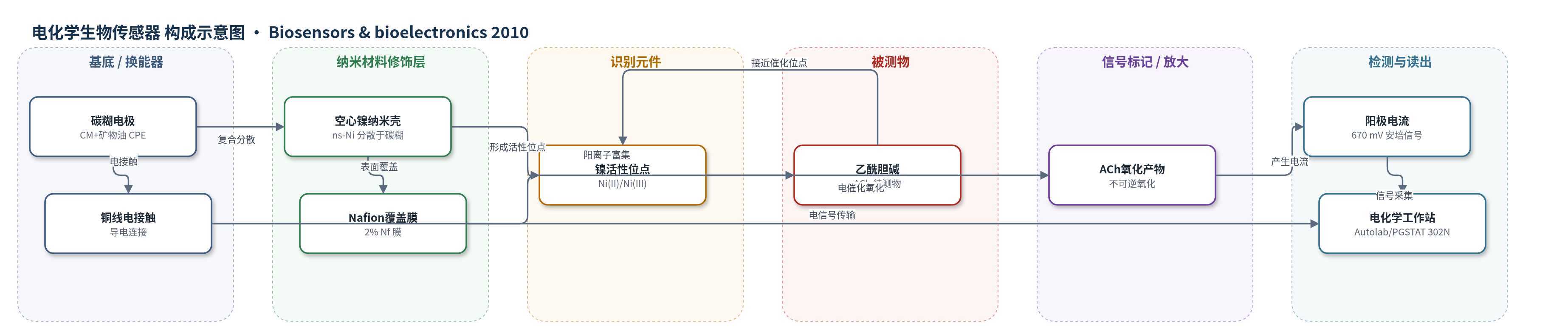
点击图片查看大图 · 依据论文自动绘制
传感器类型
电化学生物传感器
检测对象
乙酰胆碱(acetylcholine, ACh);样品基质:100 mM NaOH 溶液(碱性支持电解质)
检测原理
该传感器为非酶电化学生物传感器。ACh 扩散至 ns-Ni-CC/Nf 电极表面后,被空心镍纳米壳表面生成的 Ni(III) 活性物种氧化,同时 Ni(III) 被还原为 Ni(II),Ni(II) 在电极上再氧化再生,形成 EC′ 电催化循环。Nafion 覆盖膜带负电,可排斥阴离子干扰物并富集阳离子 ACh,提高界面局部浓度和选择性。在 670 mV 恒电位下,ACh 氧化产生电子转移,形成与 ACh 浓度成正比的阳极电流;电流受 ACh 扩散控制,因此可通过安培响应定量 ACh。
检测灵敏度
LOD: 49.33 nM;线性范围: 0.24–828 μM;灵敏度: 48.58 ± 0.52 mA M−1 cm−2;LOQ: 164.40 nM
效应效果
该传感器表现出良好的抗污性和稳定性:在 1 mM ACh 中连续 50 次循环伏安扫描后,ACh 氧化峰电流和峰电位变化小于 4%;在 100 mM NaOH 中连续 100 次扫描后峰电流变化小于 5%;电极在 100 mM NaOH 中保存 5 周仍保持电活性。校准曲线 RSD 为 1.72%、偏差 1.34%;五个同法制备电极对 1 mM ACh 的安培响应 RSD 为 3.7%。对 L-抗坏血酸、多巴胺、D-葡萄糖、尿酸、L-半胱氨酸、麻黄碱和伪麻黄碱未观察到化学干扰,作者归因于 Nafion 膜对干扰物扩散的排斥。作者认为其灵敏度和检出限优于文献报道,可用于纳摩尔级 ACh 的安培检测。
传感器的构成
- 基底/换能器电极:碳糊电极(CPE),由碳微粒(CM)与矿物油(mineral oil)组成,提供导电基底与电子转导
- 纳米材料修饰层:空心镍微球纳米壳(ns-Ni)与碳微粒(CM)、矿物油按 60:20:20 wt% 混合,形成 ns-Ni-CC 复合电极,提供高比表面和 Ni(II)/Ni(III) 电催化位点
- 选择性/抗污膜:Nafion(Nf)低脂肪醇 2% (w/v) 溶液 10 µL 覆盖于 ns-Ni-CC 表面,形成 ns-Ni-CC/Nf,排斥阴离子干扰并富集阳离子 ACh
- 识别/催化元件:ns-Ni 表面 Ni(II)/Ni(III) 可逆电对,作为非酶识别与催化元件,介导 ACh 不可逆电催化氧化
- 信号读出:恒电位安培法在 670 mV 下读取 ACh 氧化产生的阳极电流
中文摘要
本文研究了不同镍基复合材料对乙酰胆碱(ACh)的电催化氧化行为,采用循环伏安法、稳态极化测量和计时电流法考察氧化机理与动力学。结果表明,ACh 在空心镍微球纳米壳–碳微粒–Nafion 纳米复合材料上发生不可逆氧化,并表现出优异的电催化活性。通过上述方法获得了 ACh 电催化氧化的催化速率常数、电子转移系数和扩散系数。作者建立了一种快速、灵敏的流体力学安培法用于 ACh 测定。该纳米复合材料具有制备简单、无需酶或试剂、催化活性高、灵敏度高、长期稳定性好以及对 ACh 及其氧化产物抗污等优点。其灵敏度为 48.58 ± 0.52 mA M−1 cm−2,检出限为 49.33 nM,作者认为其灵敏度和检出限优于文献报道。
英文摘要
Electrocatalytic oxidation of acetylcholine (ACh) on different nickel-based composites was investigated. Cyclic voltammetry, steady-state polarization measurements and chronoamperometry were employed to study the mechanism and kinetics of the oxidation process. The results showed that ACh was irreversibly oxidized on nickel nanoshells-carbon microparticles-Nafion nanocomposite with an excellent catalytic activity. The catalytic rate constant and the transfer coefficient for the electrocatalytic oxidation of ACh and the diffusion coefficient of ACh were obtained using cyclic voltammetry, steady-state polarization measurements and chronoamperometry. A sensitive and time-saving hydrodynamic amperometry method was developed for the determination of ACh. The nanocomposite showed a high sensing performance with a sensitivity of 48.58+/-0.52 mAM(-1)cm(-2) and a limit of detection of 49.33 nM. The nanocomposite represented many advantages as an ACh biosensor such as simple preparation method without using any specific enzyme or reagent, excellent catalytic activity, high sensitivity, long-term stability, and antifouling property toward ACh and its oxidation product(s). Sensitivity and detection limit of the present biosensor are better than all of the reports appeared in the literature.