组成图示
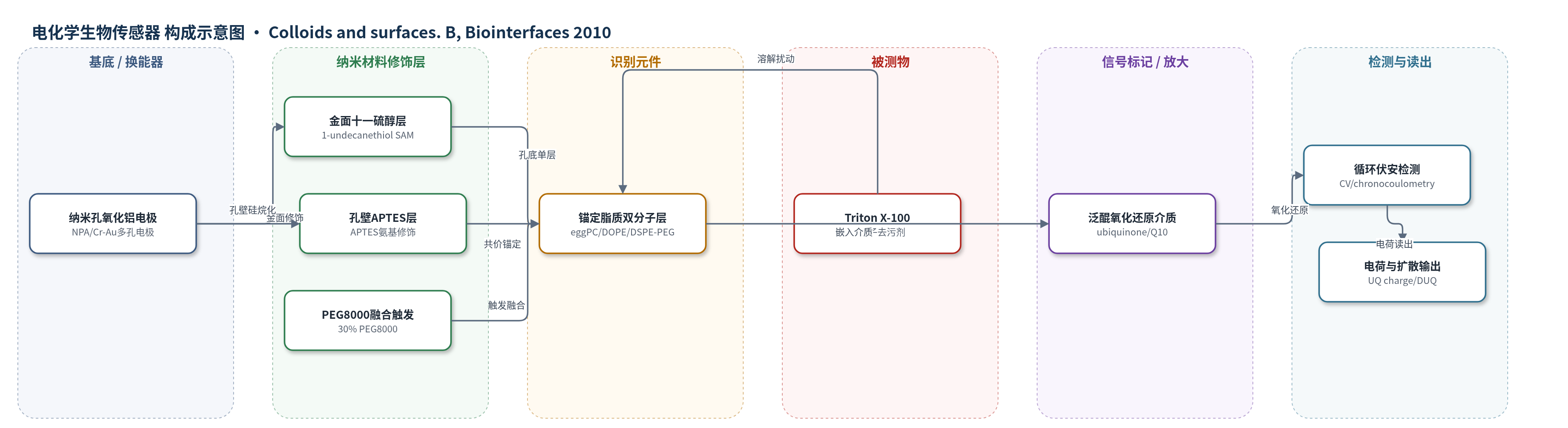
点击图片查看大图 · 依据论文自动绘制
传感器类型
电化学生物传感器
检测对象
Triton X-100(TX-100,非离子去污剂);样品基质:0.1 M 磷酸盐缓冲液(pH 7)
检测原理
传感器以纳米孔氧化铝内锚定脂质双分子层为识别/传感元件,泛醌(UQ)嵌入脂质酰链作为氧化还原介质。未受扰膜中 UQ 可经脂质层扩散至孔底金界面发生两电子氧化还原,循环伏安(CV)产生还原峰,峰面积电荷正比于膜中可及 UQ 量。加入 Triton X-100 后,去污剂插入并溶解脂质膜:浓度低于 CMC 时仅增加膜流动性,计时库仑法测得 UQ 扩散系数升高;浓度达到/超过 CMC 时膜被溶解为混合胶束,UQ 远离金界面,CV 电荷下降,电荷变化反映膜溶解程度。纳米孔提供高比表面积并保护膜,PEG-PE 提供水合与锚定。
检测灵敏度
—
效应效果
该传感器 5 天内稳定,脱湿后 UQ 电荷平均不低于初始值 80%;10 个电极平均电荷 11.7 ± 2.6 C,理论电荷约 17.2 C,膜覆盖 53–83%。TX-100 响应有阈值:0.12/0.24 mM 不降电荷,但 UQ 扩散系数由 4.75 ± 0.04 升至 4.91 ± 0.04 和 5.13 ± 0.08 ×10^-8 cm2/s;0.48 mM 电荷先降至约 45% 后恢复至约 80%;0.96 mM 800 s 内降至 0.2 ± 0.1 C。预溶解脂质体对照无 UQ 还原峰。作者认为可用于研究去污剂抗性膜、脂肪酶降解、肽插入及膜活性化合物检测。
传感器的构成
- 基底/换能器电极:纳米孔氧化铝(nanoporous aluminium oxide, NPA)多孔电极,孔底含 Cr/Au 导电层,提供高比表面积并收集电化学信号
- 金表面修饰层:十一硫醇(1-undecanethiol)自组装单层,修饰孔底金表面,形成疏水界面并支持脂质单层
- 孔壁修饰层:3-氨基丙基三乙氧基硅烷(APTES)气相沉积于氧化铝孔壁,提供氨基用于共价锚定脂质体
- 交联/偶联剂:EDC(N-3-二甲氨基丙基-N'-乙基碳二亚胺)激活 DSPE-PEG2000COOH 羧基,与 APTES 氨基形成酰胺键
- 识别/传感膜:锚定脂质双分子层(TLB),由 eggPC/DOPE/DSPE-PEG2000COOH/UQ 脂质体融合形成,作为膜结构与流动性传感元件
- 信号标记/氧化还原介质:泛醌(ubiquinone, UQ,辅酶 Q10)嵌入脂质酰链,发生两电子氧化还原并产生 CV 电荷信号
- 融合触发剂:PEG8000(30% w/v)处理 15 min,触发表面附着脂质体融合形成连续 TLB
中文摘要
模型脂质双分子层是研究膜水平分子过程的有力工具。其中,基底支撑双分子层因结构稳健且可用表面敏感技术(如电化学测量)研究而备受关注。在生物传感器中,脂质膜不仅可作为生物识别元件的支撑,还可作为传感元件本身,用于检测能够改变生物膜结构与性质的分子。本文制备了一种基于锚定脂质膜(tethered lipid membrane, TLB)的电化学生物传感器,可检测膜结构与流动性的改变。该锚定脂质膜制备于纳米孔氧化铝中,后者提供高比表面积并保护膜免受脱湿。膜中含有 PEG-PE 脂质,作为水合、保护和锚定剂,以及嵌入脂质酰链中的氧化还原亲脂介质泛醌(ubiquinone, UQ)。脂质膜通过在纳米孔支撑体孔内进行 PEG 触发的脂质体融合制备。该传感系统可有效检测由常用非离子去污剂 Triton X-100 引起的脂质膜结构改变。
英文摘要
Model lipid bilayers are versatile tools to investigate the molecular processes occurring at the membrane level. Among the model membranes, substrate supported bilayers have attracted much interest because they are robust and they can be investigated by powerful surface sensitive techniques such as electrochemical measurements. In a biosensor, lipid films can be used not only as a support for the biological sensing elements but also as sensing elements themselves to detect molecules that are able to alter the structure and the properties of biomembranes. In this work, we have prepared a tethered lipid membrane-based biosensor able to detect the alterations of membrane structure and fluidity. This tethered lipid membrane was prepared in a nanoporous aluminium oxide that provides a high surface area and a protective environment against dewetting. The membrane contained PEG-PE lipids as hydrating, protective and tethering agents and ubiquinone which is a redox lipophilic mediator embedded within the acyl chains of the lipid bilayer. The lipid membrane was prepared inside the pores of the nanoporous support by a PEG-triggered fusion of liposomes. This sensing system was efficient to detect the alterations of lipid membranes that are induced by the addition of a commonly used non-ionic detergent: Triton X-100.