组成图示
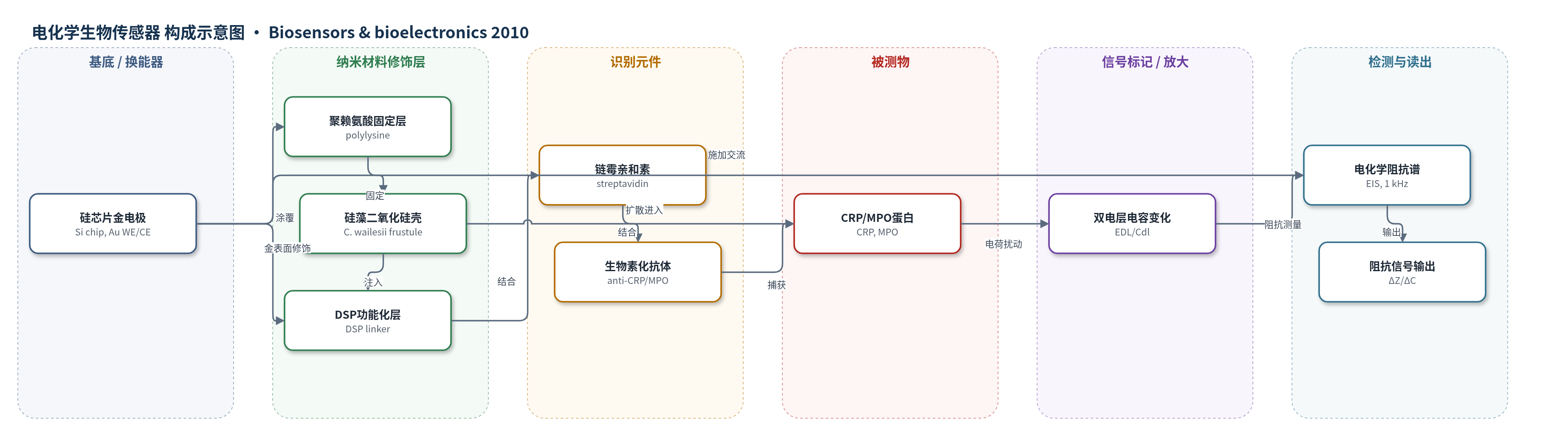
点击图片查看大图 · 依据论文自动绘制
传感器类型
电化学生物传感器
检测对象
C反应蛋白(C-reactive protein, CRP)、髓过氧化物酶(myeloperoxidase, MPO);样品基质:等渗缓冲液(PBS)和商品化人血清
检测原理
该传感器采用无标记电化学免疫检测原理。金电极表面经DSP、链霉亲和素和生物素化单克隆抗体功能化,形成特异性识别层;硅藻壳覆盖电极形成纳米井,使抗体-抗原结合发生在受限纳米空间内。当CRP或MPO进入纳米井并与抗体结合后,带电荷的生物分子改变固液界面电荷分布,使双电层(EDL)位置移动,双电层电容(Cdl)发生变化。EIS在100 mV、1 kHz下测量工作电极与对电极间阻抗,低频区电容分量主导,因此阻抗变化反映结合事件。目标蛋白浓度越高,结合量越大,Cdl变化越大,阻抗变化百分比越大。硅藻纳米孔通过限域效应增强抗体-抗原相互作用并累积多个纳米井信号,从而提高灵敏度。
检测灵敏度
LOD: 1 pg/ml for CRP and MPO in pure samples on diatom membranes;10 pg/ml on diatom membranes for CRP and MPO detection from human serum samples;线性范围: 1 pg/ml to 1 µg/ml;灵敏度: ∼1 pg/ml
效应效果
与平面金和纳米多孔氧化铝膜相比,生物源二氧化硅传感器在纯缓冲液和人血清中均表现出更高阻抗响应。纯样品中,从金到氧化铝灵敏度提高10倍,从氧化铝到硅藻提高100倍;人血清中分别为10倍和50倍。特异性实验中,在PBS和人血清里,目标蛋白在特异性抗体表面的阻抗响应均约为非特异性抗体表面的2倍。检测动态范围为1 pg/ml至1 µg/ml,跨越6个数量级,明显高于ELISA通常的1–2个数量级。稳态响应在15 min内获得,可在商品化人血清中实现pg/ml级检测。作者认为该平台适合发展为即时检测手持式电子生物传感器,用于心血管风险蛋白标志物筛查。
传感器的构成
- 基底/换能器电极:硅芯片(Si chip)上金(Au)微电极阵列,工作电极(WE)直径25 µm、对电极(CE)直径为其5倍,用于EIS信号读出
- 固定层:聚赖氨酸(polylysine)涂覆于金表面,用于吸附固定硅藻壳
- 纳米模板层:Coscinodiscus wailesii 硅藻生物源纳米多孔二氧化硅壳(biogenic nanoporous silica frustule),覆盖金电极形成纳米井,增强扩散与限域效应
- 表面功能化层:双硫代琥珀酰亚胺丙酸酯(DSP)连接分子,硫醇端结合金,NHS端连接链霉亲和素
- 识别元件:链霉亲和素(streptavidin)与生物素化单克隆抗体(biotinylated monoclonal antibodies,anti-CRP/anti-MPO),特异性捕获目标蛋白
- 封闭层:牛血清白蛋白(BSA)封闭未结合表面,降低非特异性吸附
- 信号标记物:无标记(label-free),目标蛋白自身电荷扰动双电层,无需荧光或酶标记
- 检测介质:0.15 M PBS 或商品化人血清(GIBCO),提供离子环境并作为样品基质
中文摘要
本研究旨在证明利用生物源纳米多孔二氧化硅构建生物传感器平台的可行性,用于从纯缓冲液和商品化人血清中快速、无标记电化学检测心血管生物标志物蛋白,并具有高灵敏度和选择性。该平台由硅芯片上的金电极阵列构成,基于电化学阻抗谱(EIS)工作。每个传感位点覆盖一层生物源纳米多孔二氧化硅膜,在电极表面形成高密度纳米井。当样品中的C反应蛋白(CRP)或髓过氧化物酶(MPO)与固定在纳米井底部金表面的抗体结合时,固液界面双电层受到扰动,引起阻抗变化。与纳米多孔氧化铝膜和金属薄膜传感器相比,生物源二氧化硅传感器在纯样品和人血清中对两种蛋白标志物的灵敏度和选择性均显著提高。其灵敏度约为1 pg/ml,并在1 pg/ml至1 µg/ml的宽动态范围内呈现线性剂量响应。基于上述性能,该传感器有望发展为用于临床样品蛋白标志物检测的即时检测手持式电子生物传感器。
英文摘要
The goal of our research is to demonstrate the feasibility of employing biogenic nanoporous silica as a key component in developing a biosensor platform for rapid label-free electrochemical detection of cardiovascular biomarkers from pure and commercial human serum samples with high sensitivity and selectivity. The biosensor platform consists of a silicon chip with an array of gold electrodes forming multiple sensor sites and works on the principle of electrochemical impedance spectroscopy. Each sensor site is overlaid with a biogenic nanoporous silica membrane that forms a high density of nanowells on top of each electrode. When specific protein biomarkers: C-reactive protein (CRP) and myeloperoxidase (MPO) from a test sample bind to antibodies conjugated to the surface of the gold surface at the base of each nanowell, a perturbation of electrical double layer occurs resulting in a change in the impedance. The performance of the biogenic silica membrane biosensor was tested in comparison with nanoporous alumina membrane-based biosensor and plain metallic thin film biosensor. Significant enhancement in the sensitivity and selectivity was achieved with the biogenic silica biosensor, in comparison to the other two, for detecting the two protein biomarkers from both pure and commercial human serum samples. The sensitivity of the biogenic silica biosensor is approximately 1 pg/ml and the linear dose response is observed over a large dynamic range from 1 pg/ml to 1 microg/ml. Based on its performance metrics, the biogenic silica biosensor has excellent potential for development as a point of care handheld electronic biosensor device for detection of protein biomarkers from clinical samples.