组成图示
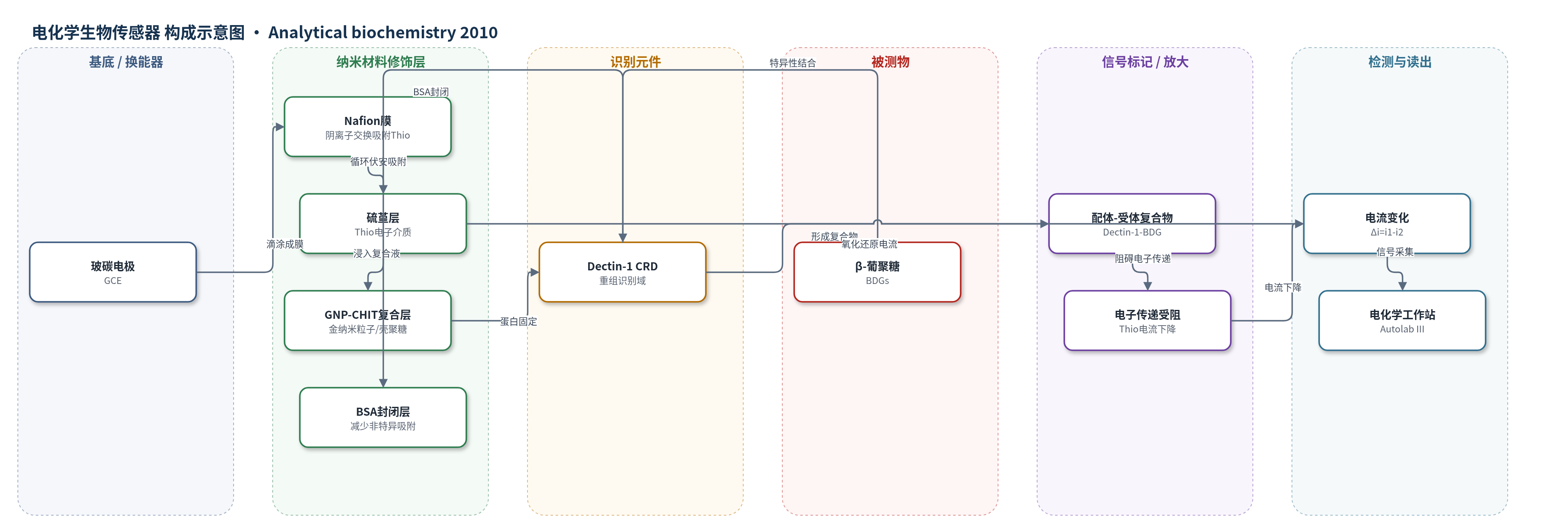
点击图片查看大图 · 依据论文自动绘制
传感器类型
电化学生物传感器
检测对象
β-葡聚糖(β-glucans, BDGs),样品基质为人血清(serum)及 PBS 标准液
检测原理
玻碳电极上依次构建 Nafion、硫堇(Thio)、金纳米粒子–壳聚糖(GNP–CHIT)多层膜。Nafion 通过阴离子交换吸附 Thio,Thio 作为氧化还原电子介质提供可监测电流;GNP 作为电子传导隧道或导线,促进电子转移并增强信号。重组 Dectin-1 胞外碳水化合物识别域(CRD)固定于壳聚糖层,特异性识别并结合样品中的 β-葡聚糖(BDGs)。Dectin-1–BDG 复合物形成后,电极界面电子传递受阻,Thio 氧化还原峰电流下降。以反应前后电流差 Δi=i1-i2 作为安培/伏安响应,BDG 浓度越高,复合物越多,电流下降越大,在 0.5–100 ng/ml 范围内呈线性。
检测灵敏度
LOD: 0.04 ng/ml(S/N=3);线性范围: 0.5–100 ng/ml;相关系数: 0.9921
效应效果
传感器选择性良好,半乳聚糖、甘露聚糖、普鲁兰多糖干扰电流分别为4.1±0.3、3.4±0.2、3.8±0.3 nA,未见明显干扰;溶血、胆红素、脂血可致假阴性。60 pg/ml BDG连续10次测定RSD为3.7%;4℃保存10、20、30 d响应下降1.3%、2.4%、3.8%。血清加标回收率95%–103.8%。与动力学浊度法比较10例酵母血培养阳性患者血清,结果一致,y=1.23+0.93x,r=0.977,P<0.0001。作者认为可用于血清BDG快速筛查,但敷料游离葡聚糖可致假阳性,不能替代影像诊断。
传感器的构成
- 基底电极:玻碳电极(GCE),抛光后作为工作电极与电子传导基底。
- 离子交换膜层:Nafion,滴涂形成膜,提供阴离子交换位点并吸附硫堇。
- 电子介质层:硫堇(Thio),通过循环伏安吸附于 Nafion,作为氧化还原介质产生电化学信号。
- 纳米复合修饰层:金纳米粒子–壳聚糖(GNP–CHIT),GNP 促进电子转移,CHIT 氨基固定 Dectin-1。
- 识别元件:重组 Dectin-1 胞外碳水化合物识别域(CRD),特异性结合 β-葡聚糖(BDGs)。
- 封闭层:牛血清白蛋白(BSA),封闭剩余活性位点,降低非特异吸附。
中文摘要
真菌感染早期诊断对提高抗真菌治疗反应至关重要,但微生物培养和组织病理诊断通常不敏感且耗时。本文报道一种基于 Dectin-1 与 β-葡聚糖高亲和相互作用的安培生物传感器。将重组 Dectin-1 胞外碳水化合物识别域(CRD)固定于 Nafion–硫堇–金纳米粒子–壳聚糖多层膜修饰的玻碳电极上,用于从样品溶液中捕获 β-葡聚糖。当 Dectin-1 与 β-葡聚糖形成配体–受体复合物后,电极界面电子传递受到抑制,导致修饰电极电化学信号下降,据此实现检测。Dectin-1 通过克隆小鼠 Dectin 基因胞外 CRD 至 pET28a(+) 原核表达载体并在大肠杆菌中表达纯化获得。研究优化了传感器组成与检测条件。最优条件下,传感器对 β-葡聚糖响应具有良好准确性、稳定性和重现性,可用于血清 β-葡聚糖快速分析,并作为侵袭性真菌感染的筛查方法。
英文摘要
Early diagnosis of fungal infection plays an important role in increasing antifungal therapeutic response, but meaningful tests such as microbiological cultures and histopathological diagnosis are usually insensitive and time-consuming. A sensitive amperometric biosensor for beta-glucans was fabricated by immobilizing Dectin-1 onto Nafion-thionine-gold nanoparticle-chitosan multilayer films to trap its corresponding ligand from sample solution. On formation of ligand-receptor complex, detection of beta-glucans was accomplished by monitoring the decrease of the electrochemical signal of the modified electrode due to the inhibition of the transmission of electrons. Dectin-1 was constructed by cloning the extracellular carbohydrate recognition domain of the mouse Dectin gene into the pET28a(+) prokaryotic expression vector. Optimal conditions and analytical performances of the described biosensor were investigated. Under the optimal conditions, the biosensor response for beta-glucans presented good accuracy, stability, and reproducibility. The proposed biosensor not only could be used for rapid analysis of serum beta-glucans but also provided a screening procedure for the determination of fungal infections.