组成图示
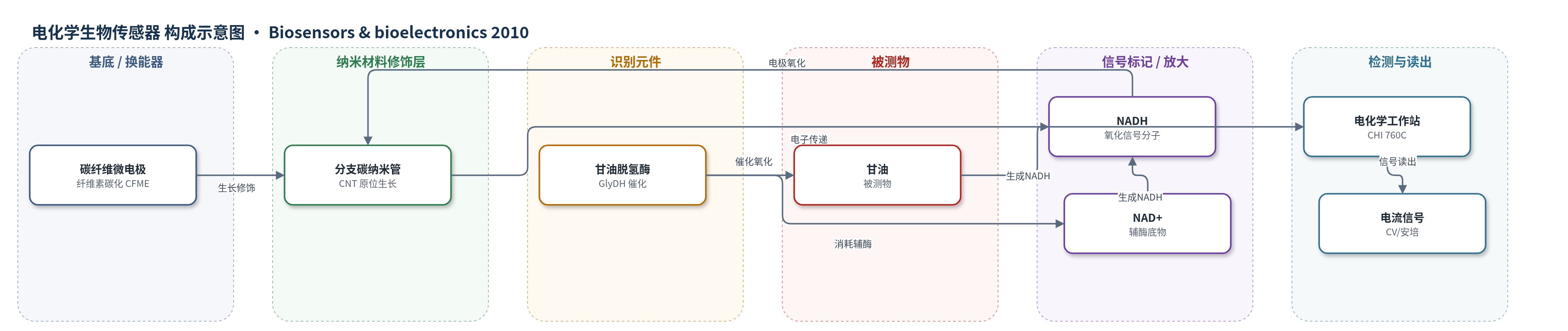
点击图片查看大图 · 依据论文自动绘制
传感器类型
电化学生物传感器
检测对象
NADH(烟酰胺腺嘌呤二核苷酸还原型)、甘油(glycerol)、甘油脱氢酶(glycerol dehydrogenase, GlyDH);样品基质为 NH4Cl–NH4OH 缓冲液/酶反应液
检测原理
该传感器以 CNT 修饰的单根碳纤维微电极为工作电极,利用甘油脱氢酶(GlyDH)催化甘油与 NAD+ 反应生成二羟基丙酮和 NADH。NADH 扩散至电极表面后,在约 0.55 V 发生直接电化学氧化,释放电子并形成电流。分支 CNT 增大了电极有效表面积,促进电子转移,使 NADH 氧化电位由 0.8 V 降至 0.55 V,并降低电极污损。安培或循环伏安电流随 NADH 浓度增加而增大;当甘油、NAD+ 或 GlyDH 中某一组分变化而其他组分过量时,电流可间接反映该组分的浓度或酶活性。
检测灵敏度
LOD: NADH 0.008 mM;甘油 0.04 mM;GlyDH 0.004 U/ml;线性范围: NADH 至 2.5 mM;甘油 0–0.25 mM(40–250 μM);GlyDH 0.004–0.05 U/ml
效应效果
与未修饰碳纤维微电极相比,CNT 修饰电极的 BET 比表面积由低于 10 m2/g 增至 36.4±0.2 m2/g,有效电化学面积由 2.0×10^-4 cm2/mm 增至 2.6×10^-4 cm2/mm,导电率由 3030±550 S/m 增至 4592±828 S/m。在 0.6 V 下 NADH 氧化电流为 0.28 μA,比 CFME 高 10 倍以上;电流响应时间约 14 s。甘油氧化体系中,NADH 氧化电流效率在 0.5 mM NAD 时为 65%,1.0 mM NAD 时达 93%。作者认为该纤维素基碳电极性能接近化石基碳材料,具有可持续、低样品量和小型化优势,可用于酶、甘油、NADH 传感及生物能量过程。
传感器的构成
- 基底/换能器电极:纤维素碳化单根碳纤维微电极(CFME),导电碳漆固定于铜线,毛细管与环氧树脂封装,作为工作电极
- 纳米材料修饰层:分支碳纳米管(CNT),Fe 催化原位生长于碳纤维表面,提高比表面积与电子转移
- 识别元件:甘油脱氢酶(GlyDH),催化甘油氧化并生成 NADH,作为溶液相生物催化识别元件
- 信号分子/电子供体:烟酰胺腺嘌呤二核苷酸还原型(NADH),在电极表面氧化释放电子产生电流
- 辅助试剂:烟酰胺腺嘌呤二核苷酸氧化型(NAD+),与甘油和 GlyDH 共同决定 NADH 生成量
- 检测系统:CHI 760C 电化学工作站,Ag/AgCl 参比电极与 Pt 对电极,循环伏安/安培读出
中文摘要
碳纤维微电极在高性能生物传感器、微型发射器和储能/发电器件中具有应用前景,但单根碳纤维因表面积小导致电子信号弱,限制了灵敏度。本文报道一种具有分支碳纳米管(CNT)的新型单根碳纤维微电极,用于增强生物电化学传感性能。该微电极由纤维素纤维碳化制备,并在铁催化下于纤维表面原位生长分支 CNT。BET 测试表明,引入 CNT 后材料比表面积由低于 10 m2/g 提高到 36.4 m2/g。以该单纤维电极为工作电极,对辅酶 NAD(H) 的氧化反应进行考察,结果显示 CNT 可促进电极表面氧化还原反应,将 NAD(H) 氧化电位从 0.8 V 降至 0.55 V。该电极还用于甘油检测,在 40–250 μM 浓度范围内获得线性响应。结果表明,纤维素基碳电极性能可与化石基碳材料相当,为生物电化学应用提供了可持续的替代材料。
英文摘要
Carbon fiber electrodes are greatly promising for microelectronic applications including high performance biosensors, miniaturized transmitters, and energy storage and generation devices. For biosensor applications, one drawback of using carbon fiber microelectrodes, especially single fiber electrodes, is the weak electronic signals, a consequence of low surface area of fibers, which ultimately limit the sensitivity of the sensors. In this paper, we report a novel single fiber microelectrode with branched carbon nanotubes for enhanced sensing performance. The fiber microelectrode was prepared from carbonization of cellulose fibers. Upon introduction of carbon nanotubes, the carbon fibers exhibited a significant increase in the specific surface area from <10 to 36.4 m(2)/g (determined by the BET method). A single fiber electrode with such a hierarchical structure was examined for redox reactions of coenzyme NAD(H) which is useful to mediate the assays and transformations of a broad range of biochemicals. Experimental results showed that carbon nanotubes enhanced the redox reactions on surfaces of the electrode by reducing the oxidation potential of NAD(H) from 0.8 to 0.55 V. The single carbon fiber with branched nanotubes was also examined for the detection of glycerol, and the results showed linear responding signals in a concentration range of 40-250 microM. These results are comparable to the properties of fossil-based carbon materials, and thus our cellulose-based carbon electrodes provide a potentially sustainable alternative in bioelectrochemical applications.