组成图示
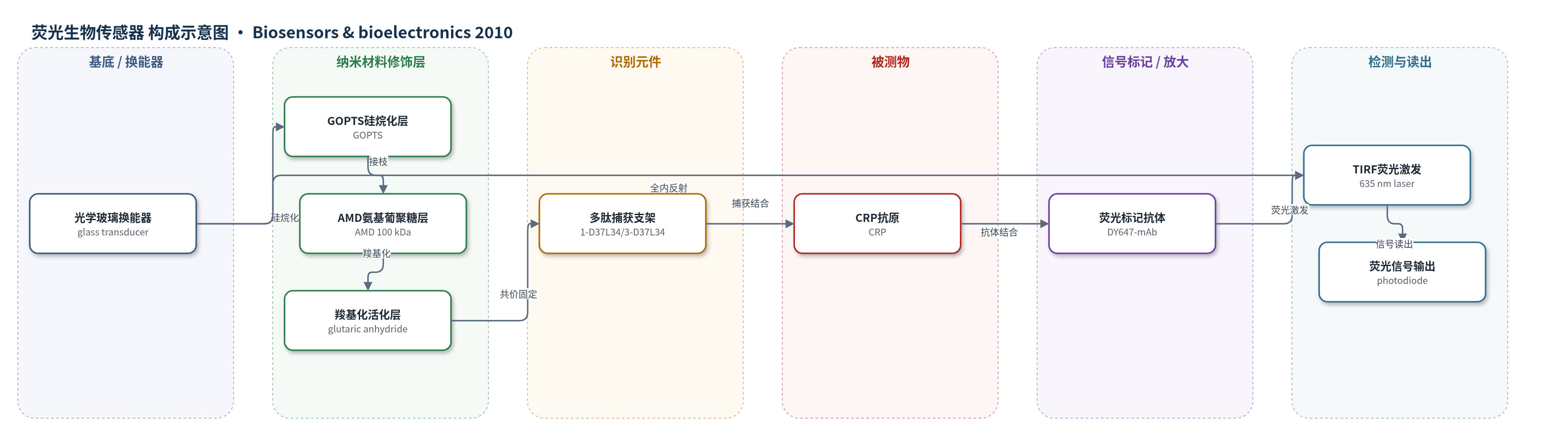
点击图片查看大图 · 依据论文自动绘制
传感器类型
荧光生物传感器
检测对象
C反应蛋白(C-reactive protein, CRP);样品基质:人血清/血浆(实验中以 0.2 mg/mL BSA 模拟血清蛋白)
检测原理
该传感器采用夹心免疫识别与全内反射荧光(TIRF)换能。固定于玻璃表面的多肽支架 1-D37L34 或 3-D37L34 通过磷酸胆碱 warhead 特异性捕获样品中的 CRP;随后 DY647 标记单克隆抗体与 CRP 的另一表位结合,形成捕获肽-CRP-荧光抗体复合物。635 nm 激光在玻璃基底中发生全内反射,产生仅穿透表面数百纳米的倏逝场,选择性激发近表面 DY647 荧光,从而降低背景。荧光强度随表面捕获的 CRP-抗体复合物数量增加而增强,经 690 nm 长通滤光片和光电二极管锁相检测后得到与 CRP 浓度相关的信号。不同亲和力的捕获肽可改变结合平衡,使校准曲线向低浓度或高浓度方向移动。
检测灵敏度
工作范围: 低亲和力 1-D37L34 为 0.22-5.75 mg/L(1.9×10^-9-5×10^-8 M);高亲和力 3-D37L34 为 0.039-2.3 mg/L(3.4×10^-10-2×10^-8 M);校准范围: 0.0075-15.1 mg/L。
效应效果
该体系以多肽支架和单克隆抗体双识别提高特异性。RIfS 动力学显示 1-D37L34 的 Kaff 约 4.19-8.80×10^7 L/mol,3-D37L34 约 6.95-12.8×10^7 L/mol,与抗体相当且可调节。TIRF 校准中,低亲和力支架工作范围 0.22-5.75 mg/L,高亲和力支架 0.039-2.3 mg/L,证明检测窗口可按需移动。在 0.2 mg/mL BSA 模拟 5% 血清蛋白条件下未见明显干扰,适合复杂血清基质。表面可再生数百次,作者强调稳定性和重现性好,但未给出 RSD、实际样品回收率或与 ELISA/HPLC/qPCR 的定量对比。其应用价值是覆盖 CRP 从 <1 mg/L 高敏监测到 2-500 mg/L 炎症监测的宽范围。
传感器的构成
- 基底/换能器:光学玻璃片(bulk optical glass slide),通过全内反射产生倏逝场以激发近表面荧光。
- 硅烷化层:3-环氧丙氧基丙基三甲氧基硅烷(GOPTS),在玻璃表面引入环氧基用于接枝聚合物。
- 亲水聚合物层:氨基葡聚糖(AMD,100 kDa),提供氨基并降低非特异性吸附。
- 羧基化层:戊二酸酐(glutaric anhydride),将 AMD 氨基转化为羧基以便共价偶联。
- 活化层:N-羟基琥珀酰亚胺(NHS)与二异丙基碳二亚胺(DIC),活化羧基以与多肽氨基形成酰胺键。
- 捕获识别元件:共轭结合肽 1-D37L34 或 3-D37L34(42 氨基酸螺旋-环-螺旋支架,含磷酸胆碱 warhead),特异性捕获 C 反应蛋白(CRP)。
- 检测标记元件:DY647 标记小鼠单克隆抗体,与 CRP 另一表位结合并提供荧光信号。
- 读出组件:635 nm 激光二极管、690 nm 长通滤光片、光电二极管与锁相检测,测量 TIRF 荧光强度。
中文摘要
本文提出一种用于临床诊断的新型夹心免疫分析设计,以高亲和力多肽支架作为固定化捕获元件,以抗体作为检测元件。该多肽支架对单一抗原具有良好亲和力,并可连接至生物传感器表面而不影响其结合能力;小肽结构稳定,使传感器表面可再生数百次并重复使用。此外,这些受体可按需合成出对同一抗原具有不同亲和力的版本,并通过无标记检测技术反射干涉光谱(RIfS)采集动力学数据加以表征。基于上述结果,作者建立了以荧光标记抗体为检测元件的夹心型生物传感器体系,证明分析工作范围可随捕获多肽支架的亲和力改变而移动:高亲和力支架可检测更低浓度,低亲和力支架可检测更高浓度。该设计避免了抗体固定化取向复杂的难题,同时保留抗体作为检测识别元件,在保持免疫分析优点的基础上,实现按需调节检测工作范围。
英文摘要
Herein, we present a new sandwich assay design containing a high affinity polypeptide scaffold as immobilized capture element and an antibody for detection. These polypeptide scaffolds provide a good affinity towards one antigen and can be linked to biosensor surfaces without affecting their binding capabilities. Furthermore, the small peptides are very stable, which allows for regenerating the surface several hundreds of times and thus for reuse of the biosensor. Moreover, these receptors can be synthesized with different affinities towards one antigen, which has been proven by characterizing them using a label-free detection method RIfS (reflectometric interference spectroscopy) for collecting kinetic data. Polypeptide scaffolds with different affinities have been chosen and characterized. Upon these results, sandwich-type assays have been set-up using a fluorescently labelled antibody as detection element. Thereby could be shown, that the working range of the assay can be shifted according to the affinity of the used capturing polypeptide scaffold. The scaffolds with a higher affinity towards the antigen can detect lower concentration, and in contrary, scaffolds with lower affinities can detect higher concentrations. In consequence, using this new sandwich-type assay, we avoid the complex procedure to immobilize antibodies in correct orientation, but simultaneously keep this well-known recognition element in the assay for detection. Furthermore, in addition to all the acknowledged properties of immunoassays, we add the possibility of tuning the working range of assays in distinct manner according to request.