组成图示
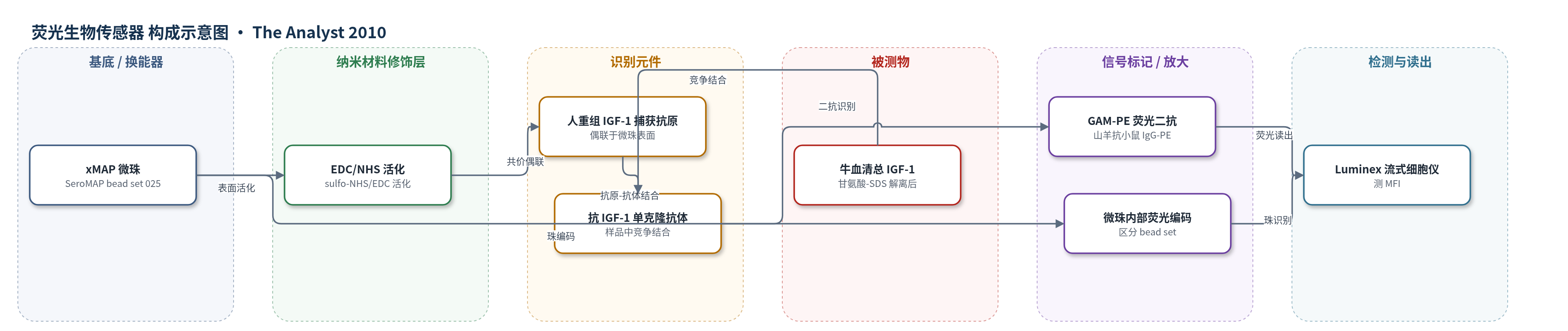
点击图片查看大图 · 依据论文自动绘制
传感器类型
荧光生物传感器
检测对象
总胰岛素样生长因子1(total IGF-1);胰岛素样生长因子结合蛋白2(IGFBP2,初步多路复用);样品基质:牛血清
检测原理
血清样品先经甘氨酸(pH 0.5)和甘氨酸-SDS(pH 10)处理,使 IGF-1 与 IGFBP/ALS 复合物解离,得到总 IGF-1。预处理后的样品或标准品与抗 IGF-1 单克隆抗体孵育,样品中的 IGF-1 与微珠表面偶联的人重组 IGF-1 竞争结合抗体。未被样品 IGF-1 占据的抗体结合到微珠捕获抗原上,再加入 GAM-PE 荧光二抗标记。Luminex 流式细胞仪根据微珠内部荧光编码识别 bead set,并检测 PE 荧光平均荧光强度(MFI)。样品 IGF-1 浓度越高,结合到微珠上的抗体越少,MFI 越低,形成抑制型剂量-响应关系。
检测灵敏度
原文未报告 LOD、线性范围、灵敏度斜率或 R^2;报告 IC50: ca. 40 ng mL−1(BIA)、1 ng mL−1(FCIA)、83 ng mL−1(FCIA 血清校准曲线)、3 ng mL−1(IGFBP2);measurement range up to 400 ng mL−1;MFI: 1000(空白)和 50(1000 ng mL−1 IGF-1)。
效应效果
FCIA 批内 CV<7.7%,批间 CV<11.3%,高浓度小牛血清批间 CV 为 15.1%;加标回收率平均 98%(SD 10%)。对 IGF-2 和胰岛素无交叉反应。与商品 ELISA 结果相近,而商品 FCIA 对牛血清检测偏低;本方法约 4 h 完成,商品 FCIA 超过 20 h,BIA 96 孔板需 10 h 以上而 FCIA 约 30 min。xMAP 平台可扩展至 100 种微珠集,IGFBP2 初步多路复用结果支持其用于 rbST 滥用筛查。
传感器的构成
- 微珠基底:xMAP SeroMAP 微珠(bead set 025),内部荧光编码用于多路复用识别。
- 表面活化层:EDC 与 sulfo-NHS 处理微珠羧基表面,形成活性酯用于共价偶联。
- 捕获抗原:人重组 IGF-1 偶联于微珠表面,作为抑制型免疫分析的固定化抗原。
- 识别抗体:抗 IGF-1 单克隆抗体(Mab)在样品中与 IGF-1 结合,并与微珠捕获抗原竞争。
- 样品前处理:甘氨酸(pH 0.5)和甘氨酸-SDS(pH 10)解离 IGF-1/IGFBP/ALS 复合物,保留其他蛋白。
- 封闭剂:PBS/0.1% BSA/0.02% Tween-20/0.05% NaN3 封闭未结合位点。
- 信号标记物:GAM-PE(山羊抗小鼠 IgG-藻红蛋白)识别结合在微珠上的抗 IGF-1 抗体。
- 读出系统:Luminex 100 流式细胞仪检测微珠 PE 荧光平均荧光强度(MFI)。
中文摘要
欧盟禁止在奶牛中使用重组牛生长激素(rbST)。由于 rbST 半衰期短、与内源激素相似且血清浓度低,直接检测困难,基于多种 rbST 依赖性生物标志物变化的方法具有监测潜力。本研究建立牛血清总胰岛素样生长因子1(IGF-1)免疫分析方法,并比较多通道表面等离子共振(SPR)生物传感器和颜色编码微珠流式细胞术两种多路复用格式。同时开发新样品前处理,解离血清中复合物形式的 IGF-1,同时保留其他生物标志物。与 SPR 免疫分析相比,流式细胞免疫分析(FCIA)更灵敏、抗体消耗更少,且对样品处理中干扰试剂更不敏感。初步验证表明 FCIA 快速、特异、稳健,重复性和可靠性高,可获得牛血清真实 IGF-1 值,并保留同时检测其他标志物的潜力。借助 xMAP 技术可同时测量 100 种微珠集,总 IGF-1 分析可方便扩展;IGF-1 与 IGFBP2 多路复用初步结果支持该格式和通用前处理。
英文摘要
The European Union has banned the use of recombinant bovine somatotropins (rbST, growth hormones) to increase milk yield in dairy cattle. As direct detection of rbST in serum is problematic, methods based on the detection of changes in multiple rbST-dependent biomarkers have high potential for monitoring rbST abuse. In this study immunoassays were developed for total insulin-like growth factor 1 (IGF-1) in cow sera. Ultimately aiming at combination with other rbST-dependent biomarker assays two multiplex formats were studied and compared critically, a multi-channel surface plasmon resonance (SPR)-based biosensor and flow cytometry combined with color encoded microbeads. Moreover, a new dedicated sample pretreatment was developed for the dissociation of complexed IGF-1 in serum, while keeping other biomarkers in solution. Compared to the SPR biosensor immunoassay, the flow cytometric immunoassay (FCIA) was more sensitive, less antibody-consuming and less vulnerable to necessary but interfering reagents from the sample treatment. In an initial in-house validation study the developed FCIA showed to be fast, specific, robust, and a high repeatability and reliability, and generated realistic IGF-1 values for bovine serum, without compromising the potential for simultaneous detection of other biomarkers. Due to the xMAP technology, in which 100 different bead sets can be measured simultaneously, the total IGF-1 assay can easily be extended with other immunoassays for candidate biomarkers. Preliminary results about a FCIA for IGF-1 multiplexing with insulin-like growth factor binding protein 2 (IGFBP2) are presented which strongly supported both the FCIA multiplex format as well as the generic nature of the developed sample pretreatment.