组成图示
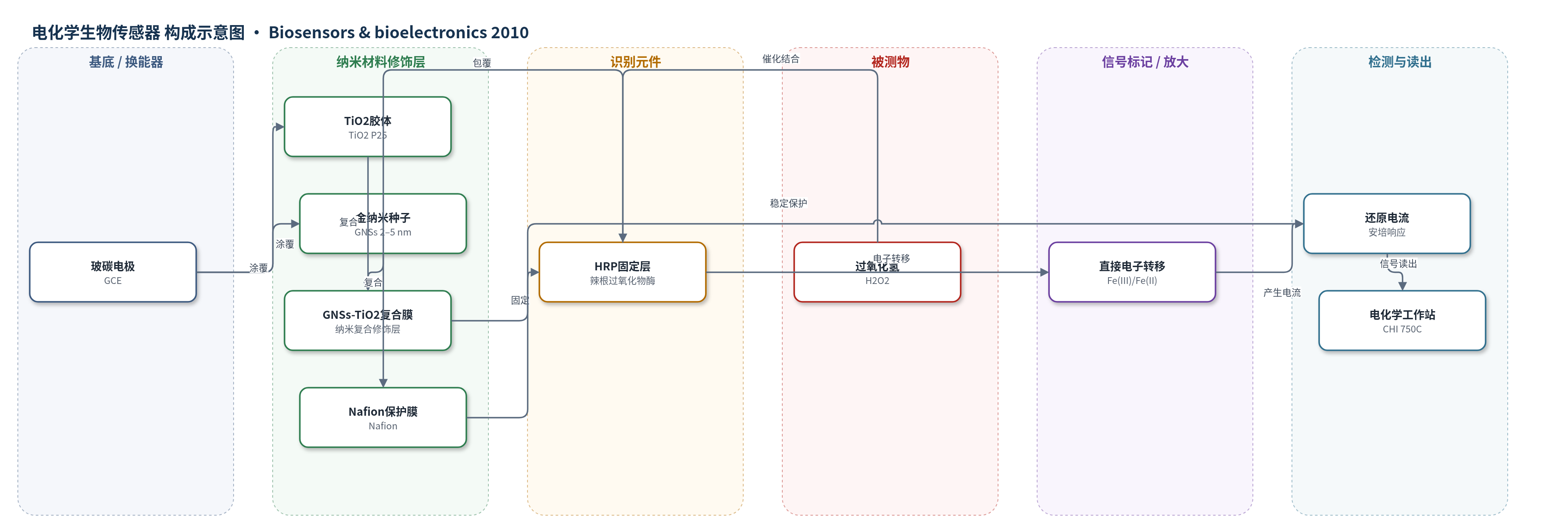
点击图片查看大图 · 依据论文自动绘制
传感器类型
电化学生物传感器
检测对象
过氧化氢(H2O2,hydrogen peroxide),样品基质:磷酸盐缓冲液(PBS,pH 7.0)
检测原理
HRP固定于GNSs–TiO2纳米复合膜中,TiO2胶体稳定GNSs并防止聚集,GNSs作为导电通道促进血红素铁与GCE之间的直接电子转移(DET)。在PBS中,HRP的血红素Fe(III)/Fe(II)产生准可逆氧化还原峰。加入H2O2后,HRP催化H2O2还原,消耗氧化态血红素并产生还原电流;H2O2浓度越高,电催化还原电流越大。Nafion膜提供质子传导并保护酶,提高稳定性。无外加电子媒介体,信号放大主要来自纳米复合膜增大酶负载量、改善电子转移和电催化活性。
检测灵敏度
LOD: 5.9 × 10⁻⁶ mol L−1 (S/N = 3);线性范围: 4.1 × 10⁻⁵–6.3 × 10⁻⁴ mol L−1;R^2 = 0.999;Kapp_M: 0.63 mmol L−1
效应效果
该传感器响应迅速,在-0.3 V下对H2O2的安培响应3 s内达到95%稳态电流。稳定性方面,连续100次循环伏安扫描无明显变化,保存2周后仍保留90.1%初始响应。重现性良好,7次连续测定0.1 mmol L−1 H2O2的RSD为4.0%,3个电极制备重现性RSD为4.2%。与文献中TiO2或金纳米粒子修饰的H2O2传感器相比,其线性范围、响应时间和表观Michaelis–Menten常数(0.63 mmol L−1)处于较优水平;Nafion膜有助于提高稳定性并降低干扰。论文未报告实际样品加标回收率,但作者认为该简便方法可有效防止金纳米粒子聚集,适用于开发酶基生物传感器。
传感器的构成
- 基底/换能器电极:玻碳电极(GCE),作为工作电极和电子传导基底
- 纳米材料修饰层1:TiO2 P25胶体(TiO2,粒径约20–60 nm),提供成膜、生物相容性并稳定GNSs
- 纳米材料修饰层2:金纳米种子(GNSs,2–5 nm),作为导电通道促进HRP直接电子转移
- 识别元件:辣根过氧化物酶(HRP),固定于GNSs–TiO2复合膜中,催化H2O2还原
- 保护层/封闭剂:Nafion(3 μL),覆盖在HRP–GNSs–TiO2膜外,形成质子导电保护膜,提高稳定性并减少干扰
中文摘要
将直径2–5 nm的金纳米种子(GNSs)点状分散于TiO2胶体中,并以简便有效的方法将辣根过氧化物酶(HRP)固定于所得GNSs–TiO2纳米复合材料上。该基质兼具GNSs与TiO2的优点,为HRP固定提供有利微环境。循环伏安结果表明,包埋的HRP在玻碳电极(GCE)上实现直接电子转移,在磷酸盐缓冲液中观察到一对稳定、准可逆氧化还原峰,峰间分离仅43 mV。经TiO2胶体稳定的GNSs作为导电通道有效促进电子转移,TiO2与GNSs协同作用改善了电化学行为。Nafion/HRP–GNSs–TiO2/GCE对H2O2还原表现出优异且快速的电催化响应。所构建生物传感器在4.1×10−5至6.3×10−4 mol L−1范围内呈良好线性响应,检出限为5.9×10⁻⁶ mol L−1(S/N=3),表观Michaelis–Menten常数为0.63 mmol L−1。此外,该传感器具有令人满意的稳定性和良好的重现性。
英文摘要
Gold nano-seeds (GNSs) (capital EF, Cyrillic=2-5 nm) were dotted in TiO(2) colloids and the horseradish peroxidase (HRP) was successfully immobilized on the as-made GNSs-TiO(2) nanocomposite by a convenient and effective method. The matrix integrates the merits of both GNSs and TiO(2), which provides a favorable microenvironment for the immobilization of HRP. The cyclic votammetric results demonstrated that the entrapped HRP achieves direct electron transfer at glassy carbon electrode (GCE). A pair of stable and quasi-reversible redox peaks with a small peak-to-peak separation of 43 mV was observed in phosphate buffer solution. The GNSs stabilized by TiO(2) colloids acted sufficiently as the conducting tunnel to promote the electron transfer. As a result, the electrochemical behaviors were improved in virtue of the synergic effect of TiO(2) and GNSs. The Nafion/HRP-GNSs-TiO(2)/GCE displayed an excellent and rapid electrocatalytic response to the reduction of H(2)O(2). The proposed biosensor exhibited a good linear response in the range from 4.1 x 10(-5) to 6.3 x 10(-4) mol L(-1), with a detection limit of 5.9 x 10(-6) mol L(-1) (at the ration of signal to noise, S/N=3). The apparent Michaelis-Menten constant was estimated to be 0.63 mmol L(-1). Furthermore, the biosensor possesses satisfactory stability and good reproducibility.