组成图示
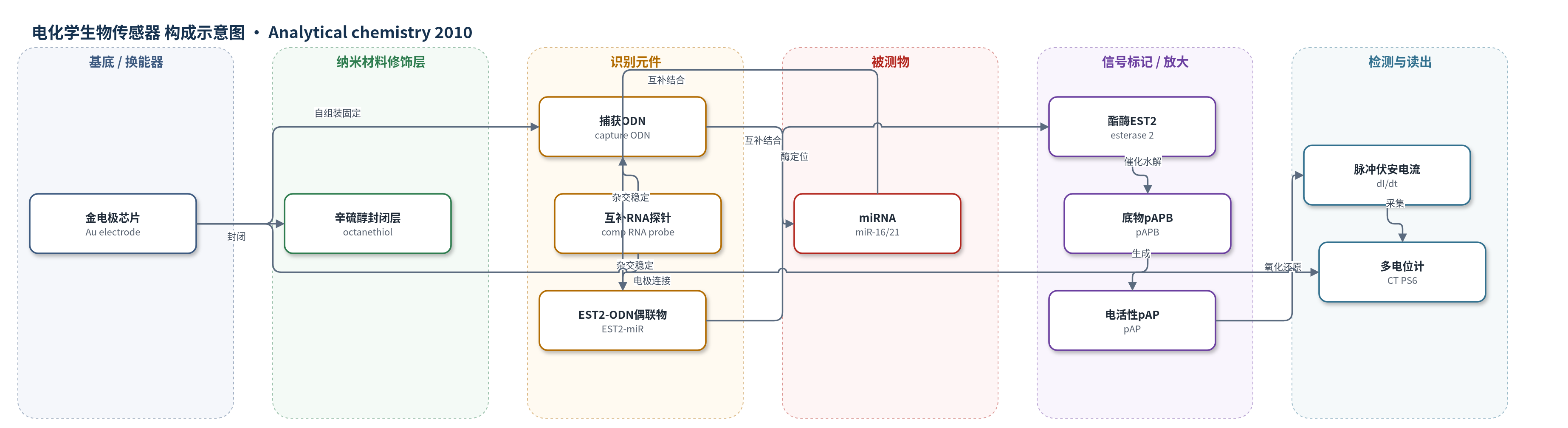
点击图片查看大图 · 依据论文自动绘制
传感器类型
电化学生物传感器
检测对象
microRNA(miRNA,miR-16、miR-21、miR-10a);样品基质:合成miRNA溶液、人乳腺癌MCF-7细胞总RNA及小RNA富集组分
检测原理
金电极表面固定捕获ODN。目标miRNA同时与捕获ODN和EST2-ODN检测偶联物互补结合,填充二者之间的缺口,并与互补RNA探针形成四组分连续碱基堆积,使EST2靠近电极。无miRNA时缺口未填充,碱基堆积中断,检测ODN杂交不稳定,EST2无法有效定位,信号极低。EST2催化底物pAPB水解为电活性pAP,pAP在电极发生氧化还原循环,酶高转换与氧化还原循环共同放大信号。脉冲伏安法读取电流变化dI/dt,其大小与电极表面结合的miRNA量成正比,从而实现定量检测。
检测灵敏度
LOD: 2.0 pM (2.0 amol);线性范围: 0.002 nM–200 nM;R^2 = 0.97
效应效果
该芯片在miR-15、miR-16、miR-21各200 nM混合体系中仅对miR-16产生显著信号;末端错配信号约20%,中央错配约50%,5/3′端5 nt延伸约40%,具单碱基错配区分能力。5′磷酸化miR-16信号2.88±0.50 nA/s,高于未磷酸化2.23±0.46 nA/s。MCF-7总RNA中miR-16、miR-21信号为0.38±0.08、0.80±0.21 nA/s,miR-10a与空白接近(0.01±0.03、-0.01±0.03 nA/s),证实miR-21高表达。总RNA与小RNA富集组分信号相近,长RNA过量不干扰。方法无需RT-PCR,含RNA提取约60 min,可用于临床早期癌症标志物快速检测。
传感器的构成
- 基底/换能器电极:金电极(Au)芯片,工作电极用于杂交与电化学测量,部分电极经Ag/AgCl2处理作参比电极
- 识别元件(捕获探针):3'-硫醇修饰DNA捕获寡核苷酸(capture ODN),经TCEP辅助自组装固定于金表面,提供miRNA特异性结合位点
- 封闭层:辛硫醇(octanethiol),封闭未结合金表面位点,降低核酸和蛋白非特异吸附
- 识别元件(杂交探针):互补RNA探针(complementary RNA probe),与捕获ODN、miRNA和检测ODN形成四组分连续碱基堆积
- 信号标记物:EST2-miR偶联物(esterase 2-ODN conjugate),5'-氨基ODN与热稳定酯酶EST2偶联,结合后使酶靠近电极
- 底物/信号分子:p-氨基苯丁酯(pAPB),被EST2水解为电活性p-氨基苯酚(pAP),经醌亚胺氧化还原循环放大
- 读出系统:多电位计(Siemens CT PS6)脉冲伏安法,测量电流变化dI/dt
中文摘要
microRNA(miRNA)因在肿瘤中发挥抑癌或促癌作用,可作为癌症早期诊断的分子标志物。本文建立了一种基于四组分DNA/RNA杂交和酯酶-寡核苷酸偶联物电化学检测的gap杂交检测法,用于快速、选择性和灵敏地检测成熟miRNA。当目标miRNA与由捕获寡核苷酸和检测寡核苷酸形成的缺口互补结合时,报告酶被拉近电极表面,并通过酶促反应产生电化学信号;若缺少miRNA,缺口未被填充,碱基堆积能缺失使杂交复合物不稳定,因而无信号。该方法可在其他miRNA混合物中选择性检测miR-16,并具备单碱基错配区分能力。检测miR-16的检出限为2 pM或2 amol。利用人乳腺癌MCF-7细胞总RNA,可平行检测miR-21和miR-16,并显示癌基因miR-21表达高于miR-16。包括RNA提取在内总检测时间约60 min,且无需逆转录PCR扩增,有望满足临床诊断中快速、简便检测早期癌症标志物的需求。
英文摘要
MicroRNAs have recently been associated with cancer development by acting as tumor suppressors or oncogenes and could therefore be applied as molecular markers for early diagnosis of cancer. In this work, we established a rapid, selective, and sensitive gap hybridization assay for detection of mature microRNAs based on four components DNA/RNA hybridization and electrochemical detection using esterase 2-oligodeoxynucleotide conjugates. Complementary binding of microRNA to a gap built of capture and detector oligodeoxynucleotide, the reporter enzyme is brought to the vicinity of the electrode and produces enzymatically an electrochemical signal. In the absence of microRNA, the gap between capture and detector oligodeoxynucleotide is not filled, and missing base stacking energy destabilizes the hybridization complex. The gap hybridization assay demonstrates selective detection of miR-16 within a mixture of other miRNAs, including the feasibility of single mismatch discrimination. Applying the biosensor assay, a detection limit of 2 pM or 2 amol of miR-16 was obtained. Using isolated total RNA from human breast adenocarcinoma MCF-7 cells, the assay detected specifically miR-21 and miR-16 in parallel, and higher expression of oncogene miR-21 compared to miR-16 was demonstrated. Including RNA isolation, the gap hybridization assay was developed with a total assay time of 60 min and without the need for reverse transcription PCR amplification of the sample. The characteristics of the assay developed in this work could satisfy the need for rapid and easy methods for early cancer marker detection in clinical diagnostics.