组成图示
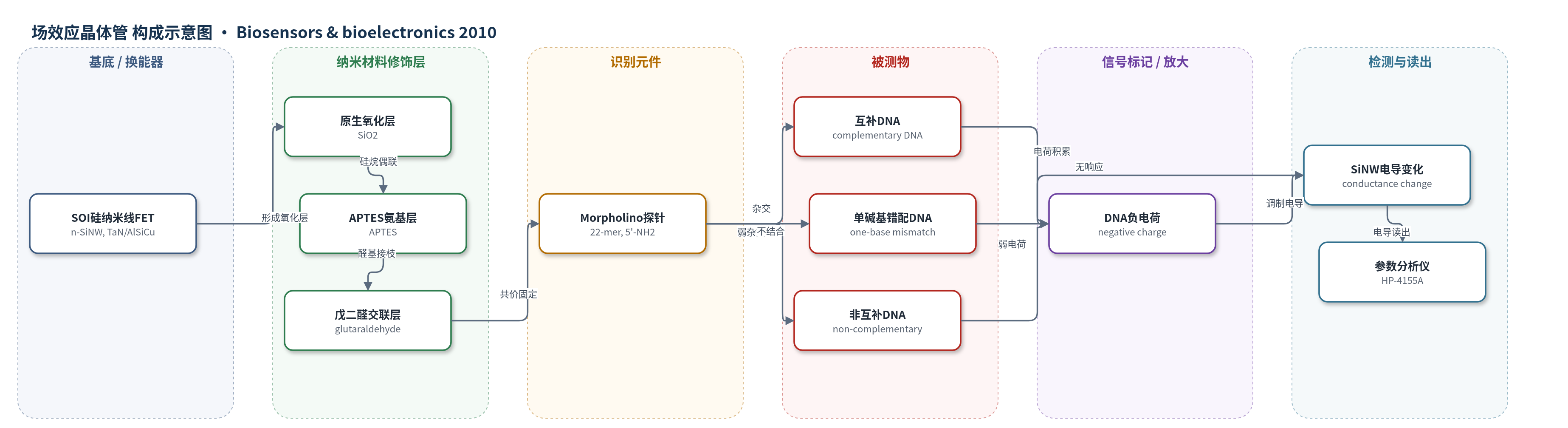
点击图片查看大图 · 依据论文自动绘制
传感器类型
场效应晶体管(FET)生物传感器
检测对象
DNA(互补DNA、单碱基错配DNA、非互补DNA),样品基质为 0.01×SSC 缓冲液
检测原理
该传感器以共价固定的中性 Morpholino 寡聚体作为捕获探针。目标 DNA 与 Morpholino 杂交后,DNA 磷酸骨架的负电荷在 SiNW 表面附近积累;由于 Morpholino 骨架不带电,可避免 DNA–DNA 双链间的静电排斥,并允许在 0.01×SSC 低离子强度缓冲液中进行杂交,从而增大 Debye 长度、降低背景电荷。负电荷改变 n 型 SiNW 表面势,使反型/积累层载流子减少,SiNW 电导随时间下降。完全互补 DNA 产生明显电导下降,单碱基错配 DNA 产生较小但可检测响应,非互补 DNA 几乎无响应。电导变化与 DNA 浓度相关,实现无标记实时检测。
检测灵敏度
LOD: 100 fM;浓度测试范围: 10 fM–1 pM
效应效果
该传感器对完全互补 DNA 选择性良好,非互补 DNA 几乎不引起电导变化,单碱基错配 DNA 可产生较小但可检测响应,显示 SNP 分辨潜力。Morpholino 修饰表面在 20 次杂交/变性循环后荧光强度保持初始值的约 87%,每循环损失约 0.6%,20 次循环变异系数为 5%,表明表面稳定且可再生。无标记实时检测的相对标准偏差为 8.4%。与 DNA 探针修饰 SiNW 相比,Morpholino 探针将有效检测浓度从 100 pM 提升至 100 fM,灵敏度提高约三个数量级。作者认为其可用于基因表达谱分析、疾病诊断和高通量 DNA 检测。
传感器的构成
- 基底/换能器:n 型 SOI 硅纳米线(SiNW)FET 通道,含 700 Å Si 层、1450 Å 埋氧、磷掺杂 n+ 区及 TaN/AlSiCu 欧姆接触,将表面电荷变化转换为电导变化
- 表面氧化层:SiNW 表面原生氧化层(SiO2),提供硅羟基用于 APTES 共价偶联
- 硅烷偶联层:3-氨基丙基三乙氧基硅烷(APTES),在 SiO2 表面形成氨基修饰层
- 交联连接层:戊二醛(glutaraldehyde),双功能醛连接 APTES 氨基与 Morpholino 5′-氨基
- 识别元件:22-mer Morpholino 寡聚体(5′-NH2),中性捕获探针,与目标 DNA 杂交
- 封闭剂:1% 牛血清白蛋白(BSA),荧光验证中封闭未反应醛基,减少非特异结合
- 信号标记物:无标记(label-free),目标 DNA 自身负电荷作为信号源
中文摘要
本文研究了 Morpholino 功能化硅纳米线(SiNW)作为新型基因芯片平台,用于 DNA 的序列特异性无标记检测。作者通过 X 射线光电子能谱(XPS)和荧光显微镜表征了硅表面 Morpholino 的共价接枝及其后续 Morpholino–DNA 杂交过程。结果表明,Morpholino 修饰表面具有对 DNA 的高识别特异性。随后,采用相同方案对 SiNW 生物传感器表面进行 Morpholino 功能化,用于无标记 Morpholino–DNA 杂交检测。实时测量显示,当加入互补 DNA 和突变 DNA 样品时,Morpholino 功能化 SiNW 生物传感器的电导随时间下降。该传感器还能区分完全互补 DNA 与错配 DNA。研究证明,该生物传感器可将 DNA 检测至数百飞摩尔(fM)水平。Morpholino 功能化 SiNW 是一种具有良好选择性的新型无标记直接 DNA 检测传感器,在基因表达研究中具有应用前景。
英文摘要
We investigated Morpholino-functionalized silicon nanowires (SiNWs) as a novel gene chip platform for the sequence-specific label-free detection of DNA. Morpholino attachment and subsequent Morpholino-DNA hybridization on silicon surface was characterized by X-ray photoelectron spectroscopy and fluorescence microscopy. The resultant Morpholino-modified surfaces showed high specificity of recognition for DNA. Subsequently, by using the same protocol, the surface of the SiNW biosensor was functionalized with Morpholino, and this was used for label-free Morpholino-DNA hybridization detection. Real-time measurements of the Morpholino-functionalized SiNW biosensor exhibited a decrease in a time-dependent conductance when complementary and mutant DNA samples were added. Furthermore, identification of fully complementary versus mismatched DNA samples was carried out by the Morpholino-functionalized SiNW biosensor. We demonstrated that DNA detection using the Morpholino-functionalized SiNW biosensor could be carried out to the hundreds of femtomolar range. The Morpholino-functionalized SiNWs show a novel biosensor for label-free and direct detection of DNA with good selectivity, and a promising application in gene expression.