组成图示
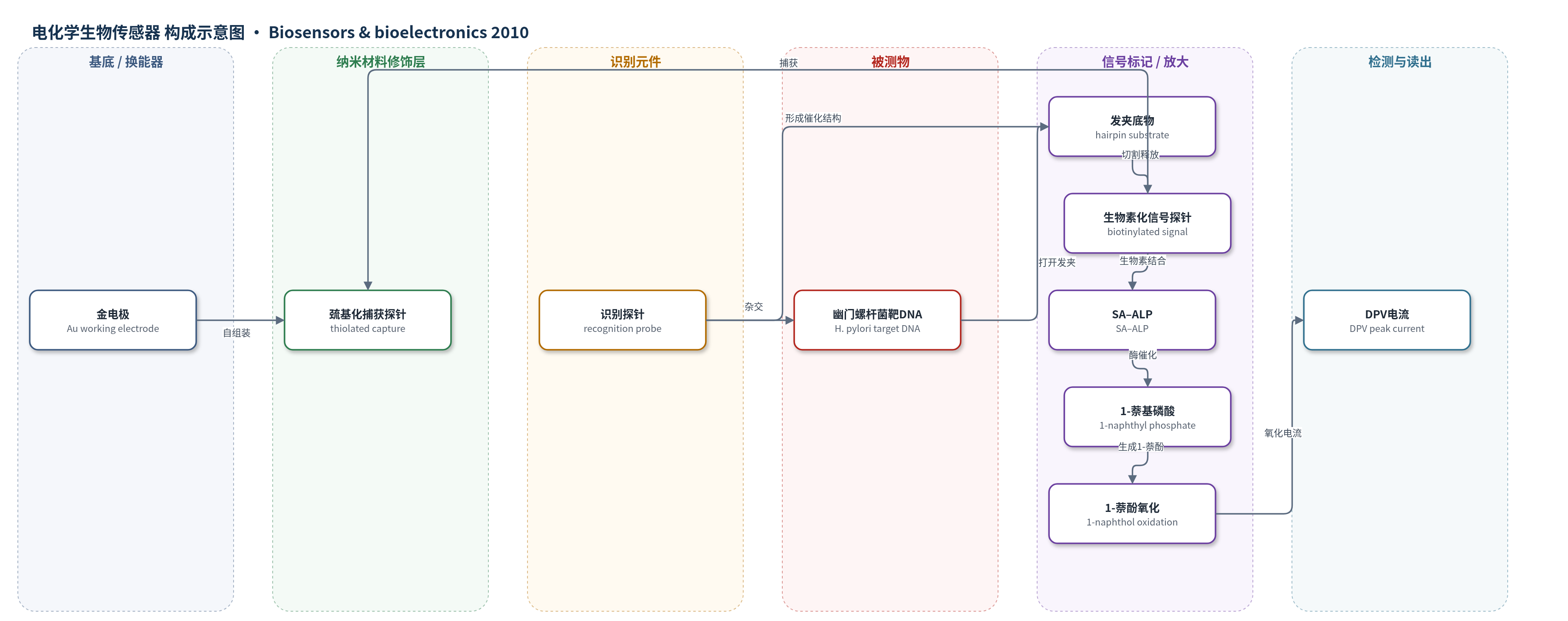
点击图片查看大图 · 依据论文自动绘制
传感器类型
电化学生物传感器
检测对象
幽门螺杆菌(Helicobacter pylori, H. pylori)靶DNA序列(25-mer);样品基质:缓冲液/溶液(未涉及实际临床样品)
检测原理
识别探针含10-23 DNAzyme催化基序,其5′端与靶DNA部分互补。靶DNA加入后,识别探针与靶DNA杂交,使两者末端靠近,促进与发夹底物互补区协同杂交,形成完整DNAzyme结构,其中靶DNA和识别探针分别作为两个结合臂,发夹底物为底物。在Mg2+存在下,DNAzyme催化切割发夹底物中的嘌呤–嘧啶位点,释放生物素化单链信号探针;由于切割后底物亲和力降低,DNAzyme可循环切割多个底物,实现信号放大。信号探针被金电极表面巯基化捕获探针捕获,SA–ALP通过生物素结合,ALP将1-萘基磷酸转化为1-萘酚,DPV检测1-萘酚氧化峰,峰电流随靶DNA浓度增加而增大。
检测灵敏度
LOD: 50 fM;检测范围: 100 fM–1 nM;线性范围: 100 fM–0.1 nM;线性回归方程: y = -43.42x - 0.6209;相关系数: 0.9931
效应效果
传感器对0.1 nM互补靶DNA的DPV峰电流为-4.849 μA,五种单碱基错配、四碱基错配和非互补序列分别为-0.6957、-1.1090、-1.7370、-2.5800、-2.0460、-0.6392、-0.6311 μA,空白-0.39 μA,可区分错配与非互补序列。1 nM靶DNA信号>6.0 μA,约为空白15倍。结果取三次平均,未报告RSD。电极经DMF、热水和冰浴再生,8次循环后0.1 nM峰电流偏移约20%,可重复使用。作者认为方法无需PCR,简便、低成本、低体积,适用于SNP检测、点突变识别和临床诊断。
传感器的构成
- 基底/换能器电极:金电极(Au,2 mm直径),经氧化铝抛光、piranha和电化学活化,作为工作电极。
- 表面修饰层:巯基化捕获探针(thiolated capture probe,CCGTCAATGATCTC-(CH2)6-SH)自组装于金表面,用于捕获切割产生的信号探针。
- 识别元件:识别探针(recognition probe,TTCCAAAGGGCAGTCAGGCTAGCTACAACGACCTATGTGA),含10-23 DNAzyme催化基序,与靶DNA部分互补并参与邻近连接。
- 信号放大底物:生物素化发夹底物(biotinylated hairpin substrate,CCGTCACATAGGraUGAGATCATTGACGG-biotin),被激活的DNAzyme切割,释放生物素化信号探针。
- 信号标记物:链霉亲和素–碱性磷酸酶(SA–ALP),通过生物素–链霉亲和素结合固定于信号探针,并催化底物生成电活性产物。
- 酶底物/电活性产物前体:1-萘基磷酸(1-naphthyl phosphate),经ALP去磷酸化生成1-萘酚(1-naphthol),在DPV中氧化产生电流。
- 反应/检测缓冲:0.5 M Tris–HCl(pH 9.6)含10 mM Mg2+,提供DNAzyme催化辅因子和DPV检测环境;SA–ALP孵育液含1% BSA以降低非特异结合。
中文摘要
本文报道了一种基于邻近依赖性DNA连接反应和DNAzyme放大发夹底物信号的电化学DNA生物传感器,用于简单、灵敏、特异性地检测核酸。长链识别探针含有Mg2+依赖的10-23 DNAzyme催化基序。当靶DNA加入后,其5′端部分与识别探针互补,形成稳定双链;未结合部分作为DNAzyme的一个结合臂,使完整10-23 DNAzyme结构得以形成。该DNAzyme可切割生物素化发夹底物中的嘌呤–嘧啶切割位点,破坏发夹结构并释放两条单链核酸,其中一条带生物素,作为信号探针。巯基化捕获探针固定于金电极表面,可捕获信号探针;随后以链霉亲和素–碱性磷酸酶(SA–ALP)为报告分子,通过生物素–链霉亲和素作用结合。ALP催化1-萘基磷酸去磷酸化生成1-萘酚,用差分脉冲伏安法测定其氧化峰。结果表明,传感器对幽门螺杆菌(H. pylori)互补靶序列在100 fM至1 nM范围内呈灵敏响应,检出限为50 fM,并能区分互补序列与错配序列,具有较高灵敏度和可重复使用性。
英文摘要
This paper describes a novel electrochemical DNA sensor for the simple, sensitive and specific detection of nucleic acids based on proximity-dependent DNA ligation assays with the DNAzyme amplification of hairpin substrate signal. A long DNA strand contains the catalytic motif of Mg(2+)-dependent 10-23 DNAzyme, acting as the recognition probe. When the target DNA was introduced into the system, part of it was complementary to 5'-end of the recognition probe, resulting in the ligation of a stable duplex, the unbinded part of the target DNA was acted as one binding arm for the DNAzyme. This duplex containing a complete 10-23 DNAzyme structure could cleave the purine-pyrimidine cleavage site of the hairpin substrate, which resulted in the fragmentation of the hairpin structure and the release of two single-stranded nucleic acids, one of which was biotinylated and acted as the signal probe. An immobilized thiolated capture probe could bind with the signal probe, using biotin as a tracer in the signal probe, and streptavidin-alkaline phosphatase (SA-ALP) as reporter molecule. The activity of the immobilized enzyme was voltammetrically determined by measuring the amount of 1-naphthol generated after 5 min of enzymatic dephosphorylation of 1-naphthyl phosphate. The results revealed that the sensor showed a sensitive response to complementary target sequences of H. pylori in a concentration range from 100 fM to 1 nM, with a detection limit of 50 fM. In addition, the sensing system could discriminate the complementary sequence from mismatched sequences, with high sensitivity and reusability.