组成图示
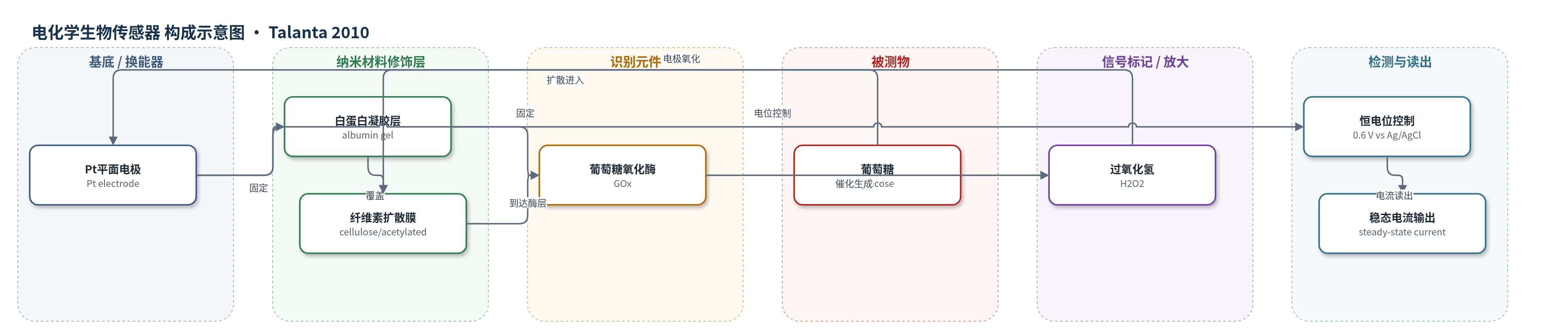
点击图片查看大图 · 依据论文自动绘制
传感器类型
电化学生物传感器
检测对象
葡萄糖(glucose,Glu);样品基质:缓冲溶液(bulk solution),文中亦提及血液
检测原理
葡萄糖从样品溶液扩散穿过纤维素或乙酰化纤维素外膜,进入白蛋白凝胶中的葡萄糖氧化酶(GOx)层。GOx催化葡萄糖氧化为葡萄糖酸,同时生成过氧化氢(H2O2)。H2O2向Pt电极表面扩散,并在0.6 V vs Ag/AgCl发生电化学氧化,产生与H2O2通量成正比的电流。稳态电流由法拉第定律和菲克定律计算,取决于底物浓度、酶动力学参数KM和Vmax以及膜扩散参数。外膜通透性决定传感器工作模式:高通透薄膜下为动力学模式,响应受酶活性影响较大;低通透厚膜下为扩散模式,响应受底物扩散控制,对KM波动更不敏感。pH通过改变GOx活性影响Vmax,并可能引起膜收缩,从而与扩散参数耦合影响响应。
检测灵敏度
原文未报告LOD、线性范围、灵敏度斜率或相关系数。
效应效果
该文以数学模拟评价操作稳定性,未报告RSD、回收率或与ELISA等对比。在允许响应波动不超过5%的条件下,深度扩散模式(厚且高度乙酰化膜)中KM(app.)波动达400%时对响应影响不显著;高通透薄膜下Vmax波动极限约34%,膜厚增加5倍仅提高到19%,膜通透性降低4倍使允许波动提高约10–16%。膜厚从5增至25 μm使KM(app.)允许波动从30.8%增至111.5%;通透性降低4倍可使KM(app.)允许波动提高约3倍。pH通过改变GOx活性影响响应,并与膜扩散参数耦合。模型可预测可靠性并指导膜设计。
传感器的构成
- 换能器电极:Pt平面电极,作为电子转导基底并检测H2O2氧化电流
- 识别/催化层:葡萄糖氧化酶(GOx,Aspergillus niger)固定于白蛋白凝胶层,催化葡萄糖氧化
- 扩散膜:纤维素或乙酰化纤维素膜,控制底物与产物扩散并调节工作模式
- 信号产物:过氧化氢(H2O2),在Pt电极0.6 V vs Ag/AgCl发生氧化产生电流
- 参比电极:Ag/AgCl,用于恒电位控制
中文摘要
本文研究了基于葡萄糖氧化酶的电化学生物传感器在扩散模式和动力学模式下的行为。通过改变传感器外膜的通透性,可以监测其灵敏度与线性响应。作者建立了基于底物酶促转化和扩散过程的数学模型,模拟了膜厚度、扩散系数和pH波动对传感器响应的影响,并评估了不同工作模式下的作用。在允许传感器响应波动不超过5%的条件下,计算了表观米氏常数KM(app.)和最大反应速率Vmax可变化的范围。在深度扩散模式(厚且高度乙酰化膜)下,KM(app.)波动达400%时对传感器响应影响不显著。在扩散模式下,Vmax波动极限约为34%;膜厚度增加5倍仅使波动极限提高到19%;膜通透性降低4倍可使允许波动水平提高约10–16%。本文的创新在于将pH波动与扩散参数波动纳入同一系统,展示二者相互依赖,并作为生物传感器响应可靠性的综合因素。
英文摘要
The behaviour of the electrochemical glucose biosensor based on the glucose oxidase was examined in the diffusion and the kinetic modes of the action. The sensitivity and linearity of the biosensor can be monitored changing the permeability of the outer membrane of the biosensor. The mathematical model based on the enzymatic conversion of the substrate and the diffusion of the substrate was created. The influence of the fluctuations of the membrane thickness, the diffusion coefficients and pH were modelled and their impact was evaluated at different modes of an action of the biosensor. Taking into account that limited acceptable fluctuations of the biosensor response should not exceed 5%, we calculated how K(M(app.)) and V(max) can move to satisfy this requirement. In a deep diffusive mode (thick highly acetylated membrane), the fluctuations of K(M(app.)) up to 400% do not influence significantly the biosensor response. In the diffusion mode of action of the biosensor, the limit of the V(max) fluctuations is on the level of 34%. The increase of the thickness of the membrane 5 times, increases the limit of fluctuations only to 19%. The reduction of the permeability of the membrane 4 times increases the level of limited fluctuations about 10-16%. The novelty of this work is binding into one system the fluctuations of pH and diffusion parameters and demonstrating the interdependence of them as an integrated factor of the reliability of the biosensor response.