组成图示
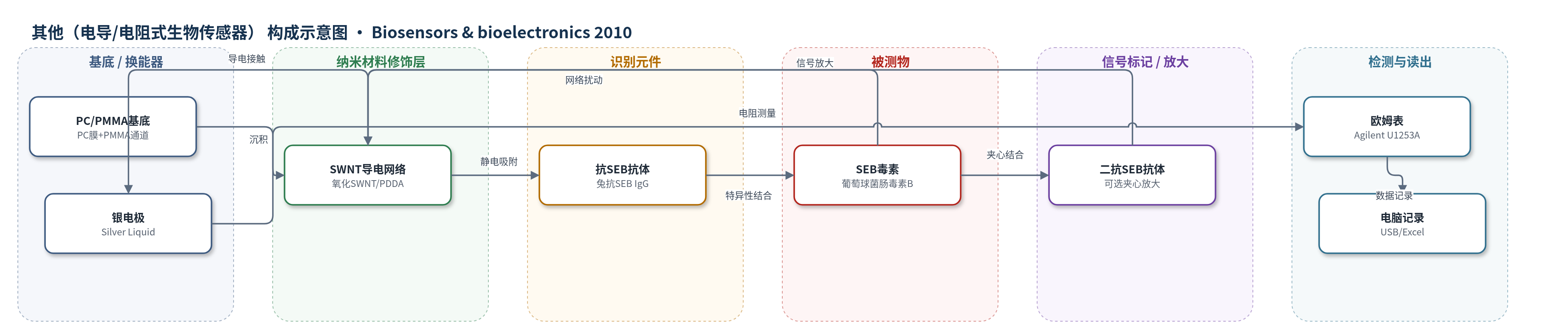
点击图片查看大图 · 依据论文自动绘制
传感器类型
其他(电导/电阻式生物传感器)
检测对象
葡萄球菌肠毒素B(staphylococcal enterotoxin B, SEB);样品基质:缓冲液、牛奶、婴儿食品
检测原理
传感器以处于电渗流阈值附近的SWNTs—抗体网络作为生物半导体。SWNTs端部相互接触形成导电通路,抗体作为连接件促进接触并决定网络连通性。当SEB与抗SEB IgG特异性结合后,抗原—抗体复合物改变SWNTs端部接触状态,破坏部分导电接触,增加电子隧穿距离,使网络电阻升高。电阻变化量R1−R0或信号/基线比S/B随SEB浓度增加而增大,实现无标记定量检测。若加入第二抗SEB IgG,其与捕获的SEB形成夹心结构,进一步扰动SWNTs网络,放大电阻变化。欧姆表连续测量两银电极间电阻,即可实时监测结合过程。
检测灵敏度
LOD: 5 ng/mL (S/B = 2);线性范围: 5–100 ng/mL
效应效果
该传感器对1 μg/mL BSA、溶菌酶和IgG均仅产生低信号,表明对SEB具有良好选择性;100 ng/mL SEB的响应时间约10 s。在缓冲液中检测限为5 ng/mL(S/B=2),线性范围5–100 ng/mL;牛奶中灵敏度较缓冲液低约20%,婴儿食品中低约30%,且无需复杂样品前处理。10 ng/mL SEB五次测量RSD为11.5%。与比色ELISA(1.56 ng/mL)、SWNT增强ELISA(0.1 ng/mL)和ECL免疫传感器(约0.01 ng/mL)相比,本方法灵敏度较低,但无需标记、可实时监测;与SPR直接检测(0.5–10 ng/mL)处于相近范围。作者认为其适合食品安全、临床即时诊断和多分析物BCPU应用。
传感器的构成
- 基底/绝缘层:聚碳酸酯(PC)膜作芯片底部支撑,聚甲基丙烯酸甲酯(PMMA)激光切割形成凹槽与通道,作为绝缘基底和BSC沉积区
- 生物半导体层:经酸氧化、PDDA修饰的单壁碳纳米管(SWNTs)与兔抗SEB IgG静电吸附形成SWNTs—抗体复合物网络,作为导电网络与识别界面
- 识别元件:兔抗SEB亲和纯化IgG,吸附于PDDA修饰SWNTs表面,特异性结合SEB
- 可选信号放大元件:第二抗SEB IgG,用于夹心结合捕获的SEB,进一步扰动SWNTs网络并放大电阻变化
- 电极层:银导电液(Silver Liquid)涂覆于SWNTs—抗体复合物两侧,形成BSC特定电极与公共接地电极,间距约15 mm
- 读出装置:Agilent U1253A/001数字万用表欧姆模式,经USB连接笔记本电脑,连续记录电阻变化
中文摘要
电渗流生物传感是一种新技术,本文首次报道用于实时检测的电渗流生物传感器。该无标记传感器基于单壁碳纳米管(SWNTs)—抗体复合物形成的网络,作为“生物半导体”(BSC)。BSC的电导率与抗体—抗原“连接器”在SWNT网络中促进接触的数量直接相关。BSC通过将预功能化的SWNTs—抗体复合物直接固定在聚甲基丙烯酸甲酯(PMMA)和聚碳酸酯(PC)表面制备,每个BSC经银电极连接至计算机化欧姆表,从而通过电阻变化连续测量抗体—抗原结合等分子相互作用。以抗葡萄球菌肠毒素B(SEB)IgG功能化BSC后,可在湿态芯片上检测低至5 ng/mL的SEB,信号/基线比(S/B)为2。SEB激活芯片迅速,可实现实时信号测量。除直接无标记检测外,还可用二抗对结合在BSC上的靶标进行“标记”,类似免疫夹心间接检测,用于验证或放大信号。BSC在缓冲液和牛奶等复杂基质中检测SEB,展示了电渗流生物传感器用于临床和复杂样品实时无标记多分析物检测的潜力。其组装简单,可在同一芯片上制备多个传感器,形成“生物中央处理单元”(BCPU),用于即时诊断。
英文摘要
Electrical percolation-based biosensing is a new technology. This is the first report of an electrical percolation-based biosensor for real-time detection. The label-free biosensor is based on electrical percolation through a single-walled carbon nanotubes (SWNTs)-antibody complex that forms a network functioning as a "Biological Semiconductor" (BSC). The conductivity of a BSC is directly related to the number of contacts facilitated by the antibody-antigen "connectors" within the SWNT network. BSCs are fabricated by immobilizing a pre-functionalized SWNTs-antibody complex directly on a poly(methyl methacrylate) (PMMA) and polycarbonate (PC) surface. Each BSC is connected via silver electrodes to a computerized ohmmeter, thereby enabling a continuous electronic measurement of molecular interactions (e.g. antibody-antigen binding) via the change in resistance. Using anti-staphylococcal enterotoxin B (SEB) IgG to functionalize the BSC, we demonstrate that the biosensor was able to detect SEB at concentrations as low as 5 ng/mL at a signal to baseline (S/B) ratio of 2. Such measurements were performed on the chip in wet conditions. The actuation of the chip by SEB is immediate, permitting real-time signal measurements. In addition to this "direct" label-free detection mode, a secondary antibody can be used to "label" the target molecule bound to the BSC in a manner analogous to an immunological sandwich "indirect" detection-type assay. Although a secondary antibody is not needed for direct detection, the indirect mode of detection may be useful as an additional measurement to verify or amplify signals from direct detection in clinical, food safety and other critical assays. The BSC was used to measure SEB both in buffer and in milk, a complex matrix, demonstrating the potential of electrical percolation-based biosensors for real-time label-free multi-analyte detection in clinical and complex samples. Assembly of BSCs is simple enough that multiple sensors can be fabricated on the same chip, thereby creating "Biological Central Processing Units (BCPUs)" capable of parallel processing and sorting out information on multiple analytes simultaneously which may be used for complex analysis and for point of care diagnostics.