组成图示
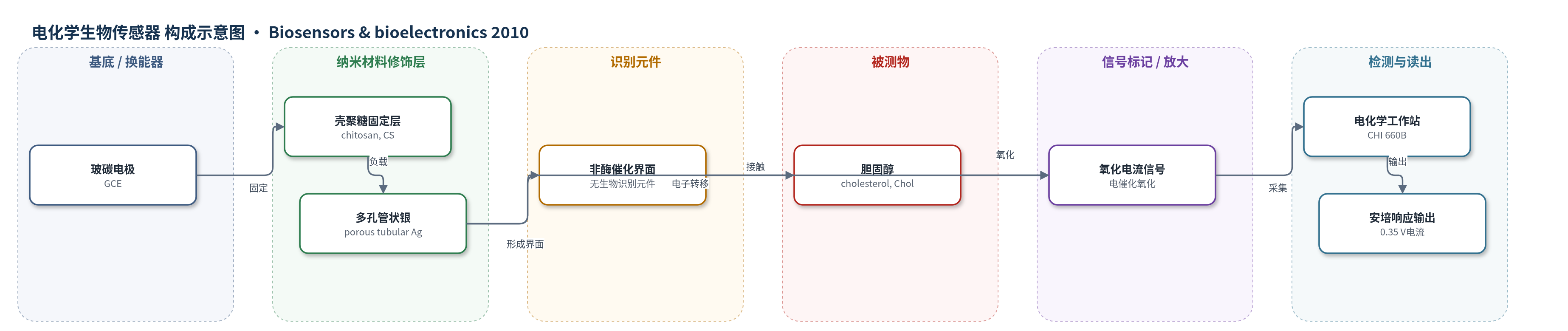
点击图片查看大图 · 依据论文自动绘制
传感器类型
电化学生物传感器
检测对象
胆固醇(cholesterol, Chol);样品基质:血清/血液样品(blood/serum samples),检测于0.1 M NaOH(pH 13)
检测原理
该传感器为非酶型电化学传感器,不含抗体、适配体或酶等生物识别元件。胆固醇在碱性介质中扩散至多孔管状Ag修饰电极表面,在+0.35 V固定电位下发生电催化氧化。多孔管状Ag纳米颗粒具有较大比表面积和孔道结构,可增强胆固醇传质与电子转移,使氧化电流随胆固醇浓度升高而增大。氧化电子经Ag纳米结构传递至GCE,由电化学工作站以安培法记录稳态电流,从而实现定量检测。
检测灵敏度
LOD: 1.8 × 10⁻⁴ M (S/N=3);线性范围: 2.8 × 10⁻⁴ M–3.3 × 10⁻² M;R^2 = 0.9988
效应效果
传感器在20 s内达到95%稳态电流。连续50次测量后保留95.3%初始活性;在0.1 M NaOH中保存60天保留93%,空气中保存保留89%。6个独立制备电极在10 mM胆固醇下RSD为5.1%。10倍葡萄糖、尿酸几乎无干扰,10倍甘油和雌二醇干扰低于6.2%。血液样品加标回收率为95.7%–105.1%(1.0–5.0 mM,五次检测),5个血液样品结果与HPLC一致。其线性范围宽于10–400 mg/dL和5–400 mg/dL的已有胆固醇传感器,检出限低于5 mg/dL,作者认为可用于临床血液胆固醇分析。
传感器的构成
- 基底/换能器:玻碳电极(glassy carbon electrode, GCE),提供电子传导与电化学换能
- 纳米材料修饰层:多孔管状银纳米颗粒(porous tubular Ag nanoparticles, PTAg),提供高比表面积电催化氧化界面
- 固定/分散介质:3%壳聚糖(chitosan, CS)乙酸水溶液,用于分散并固定Ag纳米颗粒
- 识别元件:无(非酶型,不依赖抗体/适配体/酶/DNA探针/MIP/全细胞)
- 信号标记物:无(直接电催化氧化产生电流)
中文摘要
本研究通过先将硫化镉(CdS)预沉积到多孔阳极氧化铝(PAA)模板孔道中,再电沉积银并去除CdS,成功合成多孔管状银(Ag)纳米颗粒。若不使用CdS预沉积,则仅得到实心Ag纳米棒。S2−与Ag(I)的强亲和力使Ag优先沉积在孔壁上形成管状结构。XRD、TEM、FESEM、EDS和氮吸附–脱附等温线表征了该纳米结构。以多孔管状Ag纳米颗粒修饰的玻碳电极(GCE)为工作电极,构建了非酶胆固醇传感器,其对胆固醇氧化的电催化活性明显优于实心Ag纳米棒。在最佳条件下,传感器对胆固醇的线性响应范围为2.8×10⁻⁴ M至3.3×10⁻² M,检出限为1.8×10⁻⁴ M(信噪比3)。该传感器重现性可接受、稳定性良好且干扰较低。据作者所知,这是首个基于Ag纳米颗粒的非酶胆固醇生物传感器,表明多孔管状Ag纳米颗粒为设计制造高效稳定的非酶传感器提供了有前景的平台。
英文摘要
Porous tubular silver (Ag) nanoparticles were successfully synthesized by electrodeposition of Ag into cadmium sulfide (CdS) modified porous anodic alumina (PAA) template and removal of CdS subsequently. Only the solid nanorods were obtained without CdS. The strong affinity between S2- and Ag (I) caused preferential deposition of Ag on the pore walls to form tubular Ag. After removal of CdS, porous tubular Ag nanoparticles were obtained. This novel nanostructure was characterized by XRD, TEM, FESEM, EDS and nitrogen adsorption-desorption isotherms. Using porous tubular Ag nanoparticles modified glassy carbon electrode (GCE) as a working electrode, a good nonenzymatic cholesterol sensor was constructed, which showed markedly improved electrocatalytic activity toward cholesterol oxidation compared to that of solid Ag nanorods. Under optimal detection conditions, the constructed sensor had a linear response range of 2.8 x 10(-4) M to 3.3 x 10(-2) M and the detection limit was 1.8 x 10(-4) M at a signal-to-noise ratio of 3. The biosensor showed an acceptable reproducibility, good stability and low interferences. To the best of our knowledge, it is the first example of a nonenzymatic cholesterol biosensor based on Ag nanoparticles. The experimental results demonstrated that porous tubular Ag nanoparticles provided a promising platform for rational design and fabrication of nonenzymatic cholesterol sensors.