组成图示
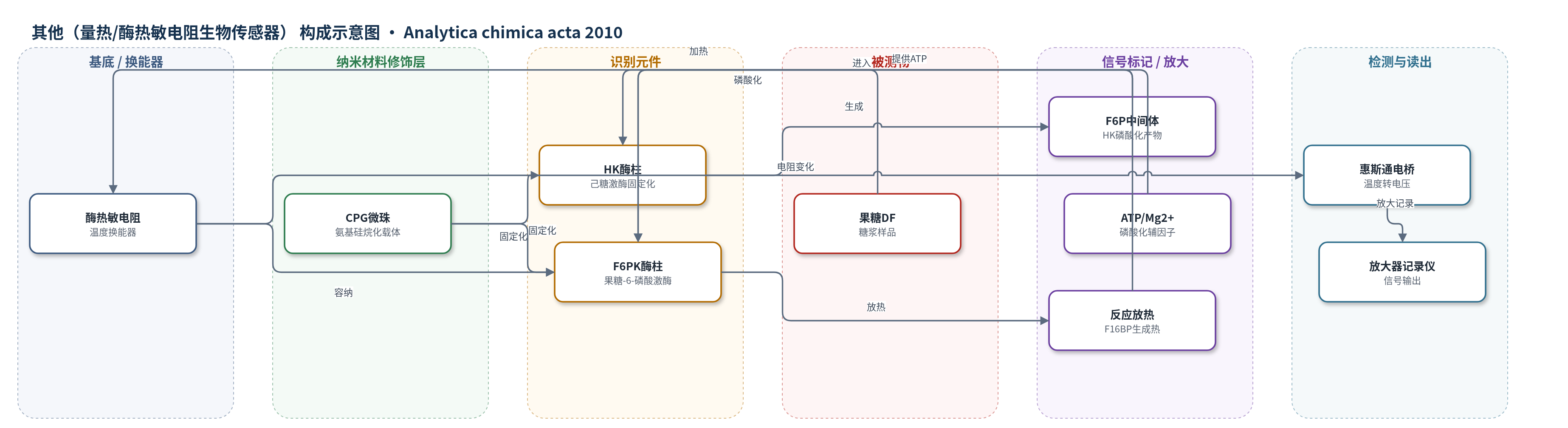
点击图片查看大图 · 依据论文自动绘制
传感器类型
其他(量热/酶热敏电阻生物传感器)
检测对象
d-果糖(d-fructose, DF);样品基质:商业糖浆(稀释后)
检测原理
样品中的d-果糖(DF)先经固定化己糖激酶(HK)柱催化磷酸化,生成果糖-6-磷酸(F6P);HK虽也磷酸化葡萄糖,但后续步骤提供选择性。F6P进入位于酶热敏电阻(ET)内的果糖-6-磷酸激酶(F6PK)柱,在ATP和Mg2+存在下被特异性磷酸化为果糖-1,6-二磷酸(F16BP),该反应放热。ET将微小温度变化转换为Wheatstone电桥电压信号,果糖浓度越高,F6P越多,放热越强,信号越大。系统通过F6P在HK柱中循环两次并补加ATP提高转化效率,恒温铝块降低环境热噪声,从而实现对糖浆中果糖的选择性量热检测。
检测灵敏度
LOD: 0.12 mM;线性范围: 0.5–6.0 mM;灵敏度: 4.69% mM−1 DF;R^2 = 0.99774;14个月后: LOD 0.5 mM,线性范围 1–4 mM,灵敏度 1.31% mM−1 DF,R^2 = 0.99
效应效果
该传感器利用F6PK只磷酸化F6P而不磷酸化G6P的特性,在葡萄糖存在下选择性测定果糖;DF:DG 1:1时信号变化约1%,1:2时无明显变化。25次重复进样1 mM DF的CV<3%。连续操作约20天、每天约30次,3个月内无明显活性损失;6个月约衰减25%,14个月灵敏度降至1.31% mM−1 DF(初始4.69% mM−1 DF)。加标回收率99.8–100.4%;商业糖浆果糖含量为0.5±0.02与1.8±0.06(原文单位标M,按线性范围应为mM)。相比FDH安培传感器,稳定性更好(约3个月对35天),无需去除葡萄糖、无介质、低试剂消耗,约30次/小时,适合食品糖浆常规监测。
传感器的构成
- 换能器:酶热敏电阻(enzyme thermistor, ET),置于30 °C恒温铝块中,检测反应放热引起的温度变化
- 固定化载体:氨基硅烷化控制孔玻璃(aminopropyl-CPG, Trisoperl)微珠,作为酶固定化基底
- 第一酶柱:己糖激酶(hexokinase, HK)固定化CPG柱,位于ET外,将果糖磷酸化为F6P
- 第二酶柱:果糖-6-磷酸激酶(fructose-6-phosphate kinase, F6PK)固定化CPG柱,位于ET内,催化F6P磷酸化并放热
- 交联/封闭层:戊二醛(glutaraldehyde)活化CPG氨基并共价固定酶,乙醇胺(ethanolamine)封闭未反应醛基
- 反应辅因子:ATP(7 mM)与Mg2+(10 mM)在0.1 M Tris-HCl(pH 9.0)载体液中支持磷酸化反应
- 流动注射流路:蠕动泵P1/P2、旋转阀V1/V2、100 μL进样环、PTFE管路和T型接头,实现样品与ATP注入
- 读出系统:Wheatstone电桥、斩波稳幅放大器和记录仪,将温度变化转换为电压信号
中文摘要
本文报道了一种用于真实糖浆样品中果糖测定、高选择性且无干扰的量热生物传感器。该方法基于己糖激酶(hexokinase, HK)将d-果糖磷酸化为果糖-6-磷酸(F6P),再由果糖-6-磷酸激酶(fructose-6-phosphate kinase, F6PK)将F6P转化为果糖-1,6-二磷酸(F16BP);第二步反应释放的热量由酶热敏电阻(enzyme thermistor, ET)监测。该传感器无需预先去除葡萄糖,即可快速、选择性地测定果糖,并采用低成本、无介质的流动注射分析(FIA)量热检测,适合常规果糖分析。作者对pH、离子强度、干扰、操作稳定性和储存寿命进行了优化,获得0.5–6.0 mM的良好线性范围和0.12 mM的检出限。商业糖浆样品及加标样品分析证实了该装置的可靠性;传感器在连续测量三个月内重现性良好,并具有约六个月的实用储存寿命,可用于食品样品中果糖的常规监测。
英文摘要
A highly selective, interference free biosensor for the measurement of fructose in real syrup samples was developed. The assay is based on the phosphorylation of D(-)fructose to fructose-6-phosphate by hexokinase and subsequent conversion of fructose-6-phosphate to fructose-1,6-biphosphate by fructose-6-phosphate-kinase. The heat liberated in the second reaction is monitored using an enzyme thermistor. The major advantages of this biosensor are rapid and selective measurement of fructose without the need to eliminate glucose and inexpensive FIA-based, mediator-free calorimetric measurement suitable for regular fructose analysis. This method was optimised for parameters, such as pH, ionic strength, interference, operational stability and shelf life. Good and reproducible linearity (0.5-6.0 mM) with a detection limit of 0.12 mM was obtained. Fructose determination in commercial syrup samples and spiked samples confirmed the reliability of this set-up and technique. The biosensor gave reproducible results with good overall stability for continuous measurements over a period of three months besides a useful shelf life of six months. The method could be used for routine fructose monitoring in food samples.