组成图示
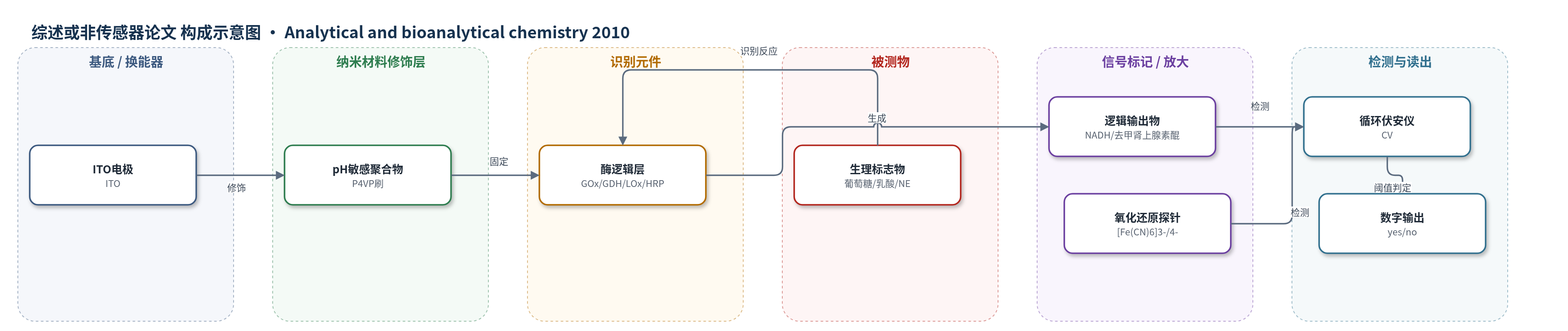
点击图片查看大图 · 依据论文自动绘制
传感器类型
综述或非传感器论文
检测对象
葡萄糖(glucose)、乳酸(lactate)、去甲肾上腺素(norepinephrine, NE)、基质金属蛋白酶2(MMP2)、基质金属蛋白酶7(MMP7);样品基质为生理液体/血液或模拟生理缓冲液
检测原理
该类数字生物传感器以多种生理标志物为输入,酶或生物分子逻辑门按布尔规则处理浓度模式。例如葡萄糖、乳酸、去甲肾上腺素分别经葡萄糖氧化酶/脱氢酶、乳酸氧化酶、辣根过氧化物酶等催化,生成葡萄糖酸、NADH、去甲肾上腺素醌等输出物;输出物改变局部pH或氧化还原状态,使pH敏感聚合物界面在ON/OFF间切换,或使氧化还原探针[Fe(CN)6]3-/4-、NADH、醌类产生可区分电流/吸光度。通过设定阈值将模拟响应数字化为0/1。酶级联、产物积累/循环、纳米材料和电催化层(普鲁士蓝、亚甲蓝)可放大信号。
检测灵敏度
原文未报告LOD、线性范围、灵敏度斜率或相关系数。
效应效果
本文未报道单一器件的LOD、RSD或回收率,因此无直接性能数值。作者强调选择性来自酶对底物的特异性及多标志物逻辑组合,抗干扰需通过Nafion、醋酸纤维素等涂层控制传输并保护酶层;稳定性依赖生物计算层的表面固定与酶微环境优化。文中示例显示,三输入酶逻辑电路可区分正常、创伤性脑损伤和失血性休克:输入0,1,1给出输出1,0,输入1,1,1给出1,1;四输入网络16种组合中仅5种使电化学界面ON。其应用价值在于高保真诊断、医疗预警和闭环感知/执行。
传感器的构成
- 基底/换能器:ITO电极或硅芯片,提供电化学/电容信号读出
- 纳米材料修饰层:金纳米颗粒(Au NPs)包覆pH敏感有机壳,将酶逻辑输出转换为界面电容变化
- 识别/逻辑元件:葡萄糖氧化酶(GOx)、过氧化氢酶(Cat)、葡萄糖脱氢酶(GDH)、醇脱氢酶(ADH)、乳酸氧化酶(LOx)、辣根过氧化物酶(HRP)、酯酶、转化酶、脲酶,构成AND/OR/IDENTITY逻辑门
- 信号标记/输出物:葡萄糖酸、丁酸、氨、NADH、去甲肾上腺素醌,引起pH或氧化还原信号变化
- 电化学探针:[Fe(CN)6]3-/4-,作为扩散型氧化还原探针用于循环伏安读出
- 保护/传输层:Nafion、醋酸纤维素(cellulose acetate),控制底物传输、减少干扰并保护酶层
- 电催化层:普鲁士蓝(Prussian blue)或亚甲蓝(methylene green),用于H2O2或NADH电催化检测
中文摘要
本文综述面向生物分析应用的生物分子逻辑系统,重点讨论设计可数字化运行的生物传感器的前景及基础与实际挑战。此类传感器通过由生物分子系统组成的布尔逻辑网络对多种生化信号进行逻辑处理,最终输出“是/否”响应,从而相比传统单输入或并行传感器件实现更高保真度的生物传感。该方式还可将信号处理与化学执行器直接耦合,形成集成的“智能”感知/执行(生物传感器-生物执行器)系统。与基于单一分析物的常规生物传感器不同,基于生化逻辑系统的器件需要全新的设计与运行思路,并需重视生物计算系统与电子换能器之间的界面。酶逻辑生物传感器的成功部分取决于生物计算试剂层的固定;表面限制可使生物计算层与换能表面接触,并高效组合各逻辑门单元。因此应关注生物计算表面层的组成、制备与固定、系统可扩展性以及输出信号的高效换能。通过处理多种生理标志物的复杂模式,此类多信号数字生物传感器有望深刻影响疾病的快速诊断与治疗,尤其是医疗紧急情况的及时检测、预警及即时治疗干预。从生物技术到国土安全等其他领域也将受益于新型生物计算生物传感器及相应闭环感知/执行操作。
英文摘要
This article reviews biomolecular logic systems for bioanalytical applications, specifically concentrating on the prospects and fundamental and practical challenges of designing digitally operating biosensors logically processing multiple biochemical signals. Such digitally processed information produces a final output in the form of a yes/no response through Boolean logic networks composed of biomolecular systems, and hence leads to a high-fidelity biosensing compared with traditional single (or parallel) sensing devices. It also allows direct coupling of the signal processing with chemical actuators to produce integrated "smart" "sense/act" (biosensor-bioactuator) systems. Unlike common biosensing devices based on a single input (analyte), devices based on biochemical logic systems require a fundamentally new approach for the sensor design and operation and careful attention to the interface of biocomputing systems and electronic transducers. As common in conventional biosensors, the success of the enzyme logic biosensor would depend, in part, on the immobilization of the biocomputing reagent layer. Such surface confinement provides a contact between the biocomputing layer and the transducing surface and combines efficiently the individual logic-gate elements. Particular attention should thus be given to the composition, preparation, and immobilization of the biocomputing surface layer, to the role of the system scalability, and to the efficient transduction of the output signals. By processing complex patterns of multiple physiological markers, such multisignal digital biosensors should have a profound impact upon the rapid diagnosis and treatment of diseases, and particularly upon the timely detection and alert of medical emergencies (along with immediate therapeutic intervention). Other fields ranging from biotechnology to homeland security would benefit from these advances in new biocomputing biosensors and the corresponding closed-loop "add/act" operation.