组成图示
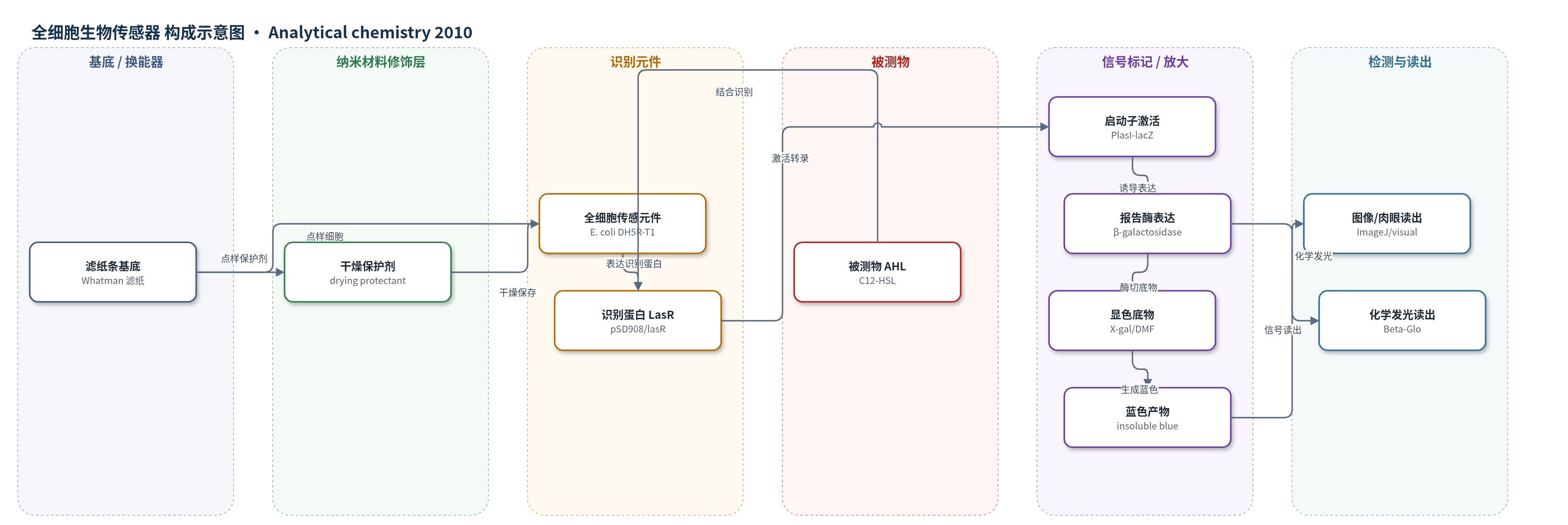
点击图片查看大图 · 依据论文自动绘制
传感器类型
全细胞生物传感器
检测对象
N-酰基高丝氨酸内酯(N-acylhomoserine lactones, AHLs;标准品 C12-HSL);样品基质:人唾液(saliva)、HEPES 缓冲液/LB 肉汤标准体系
检测原理
当样品中存在 AHL 时,AHL 扩散进入固定于滤纸条上的基因工程大肠杆菌,与 LasR 蛋白结合形成 LasR-AHL 复合物。该复合物结合 PlasI 启动子,激活 lacZ 报告基因转录,使细胞表达 β-半乳糖苷酶。随后加入 X-gal 显色底物,β-半乳糖苷酶将其水解为不溶性蓝色吲哚产物,蓝色强度随 AHL 浓度增加而增强,从而实现肉眼半定量或 ImageJ 灰度定量。该体系利用基因转录放大和酶催化显色放大,使低浓度 AHL 产生可见信号。在微孔板优化中,也可用 Beta-Glo 化学发光系统检测 β-半乳糖苷酶活性,获得定量光信号。
检测灵敏度
LOD: 1 × 10^-9 M(微孔板化学发光);LOD: 1 × 10^-8 M(滤纸条比色,90 min 或室温);LOD: 1 × 10^-7 M(滤纸条比色,60 min);响应范围: 1 × 10^-4 M–1 × 10^-9 M(4个数量级)
效应效果
该传感器在微孔板化学发光体系中检测限为 1 × 10^-9 M,响应覆盖 4 个数量级,批内变异系数小于 5%。滤纸条比色法在 90 min 显色后可检测 1 × 10^-8 M AHL,60 min 时剂量依赖检测限为 1 × 10^-7 M,室温条件下仍可达 1 × 10^-8 M。唾液加标曲线与参考曲线重叠且斜率几乎相同,表明无明显基质效应。滤纸条在 4 °C 保存 3 个月后传感能力无明显下降。实际唾液中健康志愿者与克罗恩病患者均检测到不同水平 AHL。该装置无需昂贵仪器和训练人员,便于运输、储存和高通量筛查,可作为临床与环境样品现场监测 AHL 及群体感应干扰物的便携工具。
传感器的构成
- 基底载体:Whatman 通用滤纸条(medium speed, creped, 0.6×4 cm),承载干燥传感细胞并允许样品液体接触。
- 干燥保护层:drying protectant solution(干燥保护剂溶液,按文献方法配制),用于细胞液滴温和干燥并维持细胞活性。
- 全细胞识别元件:基因工程大肠杆菌 E. coli DH5R-T1 全细胞,含质粒 pSD908,作为 AHL 感应与信号转导单元。
- 识别/调控蛋白:LasR(由 lasR 基因编码),与长链 AHL(C8 及以上)结合并启动下游转录。
- 报告基因/信号酶:lacZ 基因编码 β-半乳糖苷酶(β-galactosidase),受 PlasI 启动子调控,AHL 诱导表达。
- 显色底物:X-gal(5-bromo-4-chloro-3-indolyl-β-D-galactopyranoside)溶于 DMF,被 β-半乳糖苷酶水解生成不溶性蓝色产物。
- 复苏/选择介质:LB 肉汤(Luria-Bertani broth)含 100 µg/mL 氨苄西林(ampicillin),用于细胞复苏和质粒维持。
- 缓冲体系:50 mM HEPES buffer(pH 7.0)含 50 mM NaCl、KCl、MgCl2,用于标准溶液与样品稀释。
- 读出方式:肉眼观察蓝色,或数码相机+ImageJ 测量平均灰度;微孔板优化采用 Beta-Glo 化学发光系统。
中文摘要
本文报道了一种新型、低成本、便携的滤纸条全细胞生物传感器,用于半定量检测细菌群体感应信号分子 N-酰基高丝氨酸内酯(AHLs)。AHLs 是革兰氏阴性菌用于细胞间通讯、按群体密度调控生物膜形成和毒力因子表达等基因的关键信号分子。作者首先构建了基于 AHL 介导的群体感应调控系统的全细胞传感体系,以 LasR 蛋白作为识别/调控元件,以 β-半乳糖苷酶作为报告蛋白;随后将传感细菌以液滴干燥方式固定于滤纸条上。加入显色底物 X-gal 后,AHL 诱导的 β-半乳糖苷酶表达可产生肉眼可见的蓝色信号。该纸基传感器可检测低至 1 × 10^-8 M 的 AHL,并成功应用于唾液等生理样品中的 AHL 检测。滤纸条在 4 °C 保存至少 3 个月仍可获得可重复结果。该传感器无需昂贵仪器和受过训练的人员,便于运输和储存,有望作为临床与环境样品现场监测 AHL 的简易经济型便携检测工具。
英文摘要
Herein, we report the development of a novel, inexpensive, and portable filter-paper-based strip biosensor for the detection of bacterial quorum sensing signaling molecules, N-acylhomoserine lactones (AHLs). AHLs are generally employed by Gram-negative bacteria for their cell-cell communication to control expression of specialized genes, such as those involved in biofilm formation and production of virulence factors, in a population-density-dependent manner. First, a bacterial cell-based sensing system employing components of AHL-mediated QS regulatory system as recognition elements and beta-galactosidase as the reporter protein was designed and developed. The bacterial-sensing cells were then liquid-dried on strips of filter paper. beta-Galactosidase as the reporter allows for the visual monitoring of the analyte-induced signal when a colorimetric method of detection is applied. The paper strip biosensor was able to detect low AHL concentrations down to 1 x 10(-8) M. Furthermore, it was successfully applied to the detection of AHLs in physiological samples, such as saliva. The filter-paper-based sensing strips could provide reproducible results upon storage at 4 degrees C for at least 3 months. In conclusion, a filter-paper-based strip biosensor was developed that allows for visual, fast, and convenient detection of AHLs in a dose-dependent manner in a test sample. In addition, it does not require expensive equipment or trained personnel and allows ease of transportation and storage. Therefore, we envision that this biosensor will serve as a simple and economical portable field kit for on-site monitoring of AHL in a variety of clinical and environmental samples.