组成图示
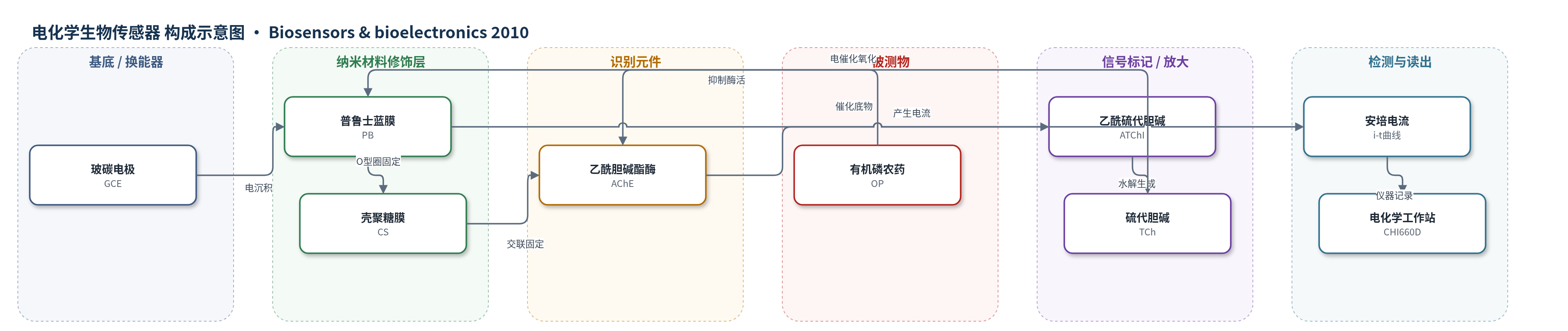
点击图片查看大图 · 依据论文自动绘制
传感器类型
电化学生物传感器
检测对象
有机磷农药(OP pesticides):敌敌畏(dichlorvos)、灭多威(omethoate)、敌百虫(trichlorfon)、辛硫磷(phoxim);样品基质:磷酸盐缓冲液(PBS)标准溶液,适用于农药残留样品
检测原理
传感器采用酶抑制法。AChE固定于壳聚糖膜中,催化底物ATChI水解生成TCh和乙酸;TCh在PB修饰GCE表面发生氧化,产生安培电流。PB具有导电性和电催化作用,可促进TCh电子转移并降低氧化电位,使电流增大。OP农药与AChE活性位点结合,抑制酶催化活性,导致TCh生成减少,氧化电流下降。以无农药时的电流I0和暴露农药后的电流I1计算抑制率I%=(I0-I1)/I0×100%,抑制率随农药浓度升高而增大,并与浓度对数呈线性关系。壳聚糖膜可负载大量酶,PB与酶膜协同放大信号,从而提高灵敏度。
检测灵敏度
LOD: 2.5 ng/L (dichlorvos), 15 ng/L (omethoate), 5 ng/L (trichlorfon), 10 ng/L (phoxim);线性范围: 10 ng/L–10 μg/L (dichlorvos), 50 ng/L–10 μg/L (omethoate), 30 ng/L–5 μg/L (trichlorfon), 50 ng/L–10 μg/L (phoxim);灵敏度斜率: 32.3 (dichlorvos), 22.015 (omethoate), 23.514 (trichlorfon), 21.624 (phoxim);回归方程: I = 32.3 lgc − 10.9 (dichlorvos), I = 22.015 lgc + 6.5147 (omethoate), I = 23.514 lgc + 9.5466 (trichlorfon), I = 21.624 lgc + 0.0087 (phoxim);相关系数: 0.9968 (dichlorvos), 0.9931 (omethoate), 0.9871 (trichlorfon), 0.9947 (phoxim)
效应效果
传感器对四种有机磷农药均表现出低检出限,且对不同农药灵敏度不同,说明对OP农药具有选择性响应;原文未报告其他干扰物抗干扰数据。方法重现性良好,批内RSD为4.8%,批间RSD为3.5%;四种农药的RSD分别小于4.1%、5.1%、5.3%和4.3%。稳定性方面,被500 ng/L敌敌畏抑制的传感器在PBS中浸泡20 min后可恢复95.1%原始活性,PBS本身即可作为再激活试剂,较TMB-4或2-PAM更简单可靠。作者认为该传感器灵敏度高、操作简便、成本低、可更换酶膜,适合OP农药残留痕量检测。原文未报告实际样品加标回收率,也未与ELISA、HPLC或qPCR等方法直接对比。
传感器的构成
- 基底电极:玻碳电极(GCE),导电基底与安培换能器
- 修饰层:普鲁士蓝(PB)膜,电沉积于GCE表面,增强电子转移并电催化TCh氧化
- 载体膜:壳聚糖(CS)膜,负载AChE,提供生物相容微环境并可更换
- 识别元件:乙酰胆碱酯酶(AChE),催化ATChI水解,被OP农药抑制
- 交联固定剂:戊二醛(GA),交联固定AChE于CS膜
- 封闭稳定剂:牛血清白蛋白(BSA),与AChE共固定,稳定酶并减少非特异结合
- 机械固定件:O型圈,将CS酶膜固定于PB/GCE表面
- 底物/信号前体:碘化乙酰硫代胆碱(ATChI),AChE催化生成TCh,TCh氧化产生安培电流
中文摘要
本研究开发了一种基于普鲁士蓝(PB)修饰玻碳电极(GCE)的乙酰胆碱酯酶(AChE)生物传感器,用于有机磷(OP)农药检测。传感器采用双层膜结构:先在GCE表面电沉积PB膜以增强电子转移和电催化能力,再用O型圈将壳聚糖酶膜快速固定于PB/GCE表面。壳聚糖膜通过戊二醛交联固定AChE,作为可更换载体,可负载大量酶并保持酶活性。AChE催化底物碘化乙酰硫代胆碱(ATChI)水解生成硫代胆碱(TCh),TCh在电极上氧化产生安培电流;OP农药抑制AChE活性后电流下降,抑制率与农药浓度相关。研究优化了磷酸盐缓冲液pH、ATChI浓度和农药孵育时间。最优条件下,敌敌畏、灭多威、敌百虫和辛硫磷的线性范围分别为0.01–10、0.05–10、0.03–5和0.05–10 μg/L,检出限分别为2.5、15、5和10 ng/L。传感器重现性和稳定性良好,适用于OP农药残留痕量检测。
英文摘要
In this study, a novel acetylcholinesterase (AChE) biosensor was developed based on dual-layer membranes (chitosan membrane and prussian blue membrane) modifying glassy carbon electrode (GCE). A chitosan membrane was used for immobilizing AChE through glutaraldehyde cross-linking attachment to recognize pesticides selectively. A prussian blue (PB) membrane was electrodeposited on the surface of GCE to enhance electron transfer. Before the detection, the chitosan enzyme membrane was quickly fixed on the surface of PB/GCE with O-ring to prepare an amperometric AChE-PB/GCE sensor for organophosphorus (OP) pesticides. The electrochemical behaviour of AChE-PB/GCE was studied, and the results showed that the chitosan membrane as carrier can absorb a large amount of enzyme, and PB has a significant synergistic effect towards enzymatic catalysis. As a result of these two important enhancement factors, the proposed biosensor exhibited extreme sensitivity to OP pesticides compared to the other kinds of AChE biosensor. The influences of phosphate buffer pH, substrate concentration, incubation time of pesticide on the response of the fabricated biosensor were investigated. Under optimum conditions, the inhibition rates of these pesticides were proportional to their concentrations in the range of 0.01-10 microg l(-1), 0.05-10 microg l(-1), 0.03-5 microg l(-1), and 0.05-10 microg l(-1), respectively. The detection limits were found to be 2.5 ng l(-1) for dichlorvos, 15 ng l(-1) for omethoate, 5 ng l(-1) for trichlorfon and 10 ng l(-1) for phoxim. Moreover, the biosensor exhibited good reproducibility and stability, and it was suitable for trace detection of OP pesticide residue.