组成图示
点击图片查看大图 · 依据论文自动绘制
传感器类型
综述或非传感器论文
检测对象
目标DNA寡核苷酸(target DNA oligonucleotide,18mer/9mer),样品基质为磷酸盐缓冲液(0.63 mol L−1 sodium phosphate,pH 7.0)
检测原理
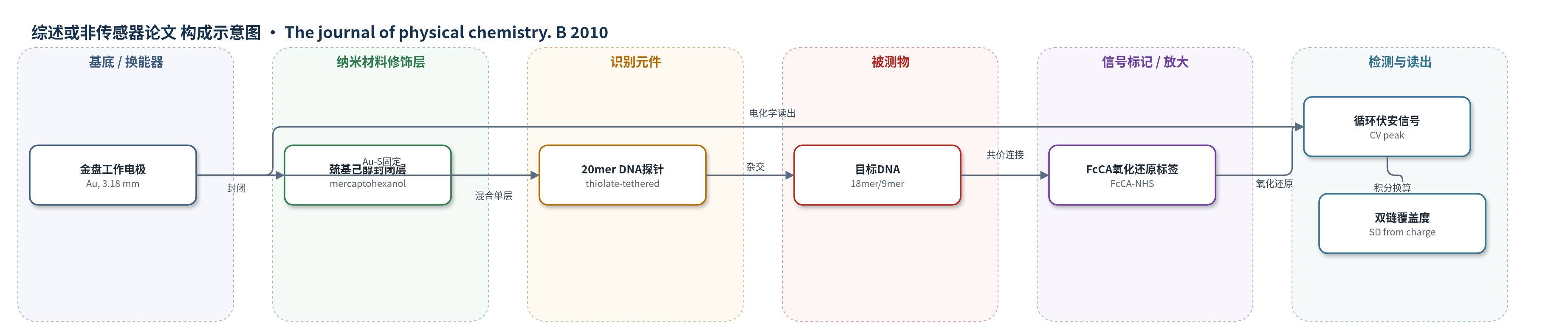
金表面硫醇端接的20mer DNA探针与溶液中互补目标DNA发生序列特异性杂交,形成表面双链。目标DNA在5′端经胺基连接FcCA氧化还原标签,杂交后标签靠近金电极。循环伏安法扫描时,FcCA在约0–0.65 V区间发生氧化还原,峰面积或积分电荷与表面双链覆盖度SD成正比,从而反映目标浓度。界面中探针层负电荷会排斥带负电目标进入,盐离子通过Debye屏蔽降低该惩罚;探针-探针相互作用和双链堆积约束会改变杂交自由能与可用位点。高覆盖、高盐下空间拥挤使杂交产率对目标浓度增加不敏感。
检测灵敏度
未报告
效应效果
实验在10 nM–3 µM目标浓度、约0.012–1 mol L−1磷酸盐缓冲液范围内测量杂交等温线。当表面DNA体积分数Φ低于约0.25时,扩展模型及VP/HBZ模型能较好再现盐浓度与探针覆盖度趋势,低盐条件下尤佳;当Φ接近0.3、高缓冲强度与高密度探针膜时,杂交产率对目标浓度增加不敏感,模型均不能解释,作者归因于堆积约束。测量数小时中探针损失可达12%,平衡时间最长约2.5 h。研究未报告RSD、回收率或与ELISA/qPCR对比,但为DNA微阵列和生物传感器界面杂交设计提供条件边界。
传感器的构成
- 基底/换能器电极:3.18 mm 金盘工作电极(Au),提供导电基底与自组装界面。
- 识别元件:20mer 硫醇端接 DNA 探针(5′NH2-(CH2)6-PO3-TTT TAA ATT CTG CAA GTG AT-PO3-(CH2)6-S-Au 3′),通过 Au-S 键固定于金表面并序列特异性结合目标。
- 封闭剂:1 mmol L−1 巯基己醇(mercaptohexanol)在 0.33 mol L−1 pH 7.0 磷酸钾缓冲液中,封闭金表面非特异性吸附。
- 信号标记物:目标 5′ 胺连接 N-羟基琥珀酰亚胺基二茂铁羧酸(FcCA-NHS)氧化还原标签,杂交后提供 Fc 氧化还原峰。
- 检测读出:循环伏安法(CV)/旋转圆盘电极与 CH440A 工作站,通过 FcCA 峰面积/电荷计算双链覆盖度。
中文摘要
表面杂交检测的设计与解释受界面环境复杂影响,其动力学和热力学行为常偏离溶液体系,根源在于杂交链在表面经历额外相互作用。本文针对端接单链寡核苷酸探针与尺寸相近的单链溶液目标分子之间的表面杂交平衡进行分析,比较了Vainrub与Pettitt模型、Halperin、Buhot与Zhulina模型,以及进一步纳入类似溶液盐依赖性的探针-目标二聚化项的扩展模型,并考察盐浓度和探针覆盖度的影响。结果表明,当表面DNA体积分数低于约0.25时,模型与实验总体吻合;但当DNA体积分数接近0.3,即高缓冲强度和密集接枝膜条件下,杂交受到强烈抑制,杂交产率对分析物浓度增加不再敏感,尽管仍有大量探针可结合目标。作者将该现象归因于堆积约束,并指出其出现位置显著低于理想六方堆积预测的最大覆盖。研究通过界定不同杂交行为条件,为DNA微阵列和生物传感器应用提供基础认识。
英文摘要
The design and interpretation of surface hybridization assays is complicated by poorly understood aspects of the interfacial environment that cause both kinetic and thermodynamic behaviors to deviate from those in solution. The origins of these differences lie in the additional interactions experienced by hybridizing strands at the surface. In this report, an analysis of surface hybridization equilibria is provided for end-tethered, single-stranded oligonucleotide "probes" hybridizing with similarly sized, single-stranded solution "target" molecules. Theoretical models by Vainrub and Pettitt (Phys. Rev. E 2002, 66, 041905) and by Halperin, Buhot, and Zhulina (Biophys. J. 2004, 86, 718), and an "extended" model that in addition includes a solution-like salt dependence of probe-target dimerization, are compared to experiments as a function of salt concentration and probe coverage. Good agreement with experiment is observed when the DNA volume fraction at the surface remains below approximately 0.25. None of the models, however, can account for strong suppression of hybridization when the volume fraction of DNA approaches 0.3, realizable in the limit of high buffer strength and densely tethered films. Under these conditions, hybridization yields become insensitive to increases in analyte concentration even though many probes remain available to bind targets. These observations are attributed to the onset of packing constraints which, interestingly, become limiting significantly below maximum DNA coverages estimated from ideally efficient hexagonal packing. By delineating conditions under which specific hybridization behaviors are observed, the results advance fundamental knowledge in support of DNA microarray and biosensor applications.