组成图示
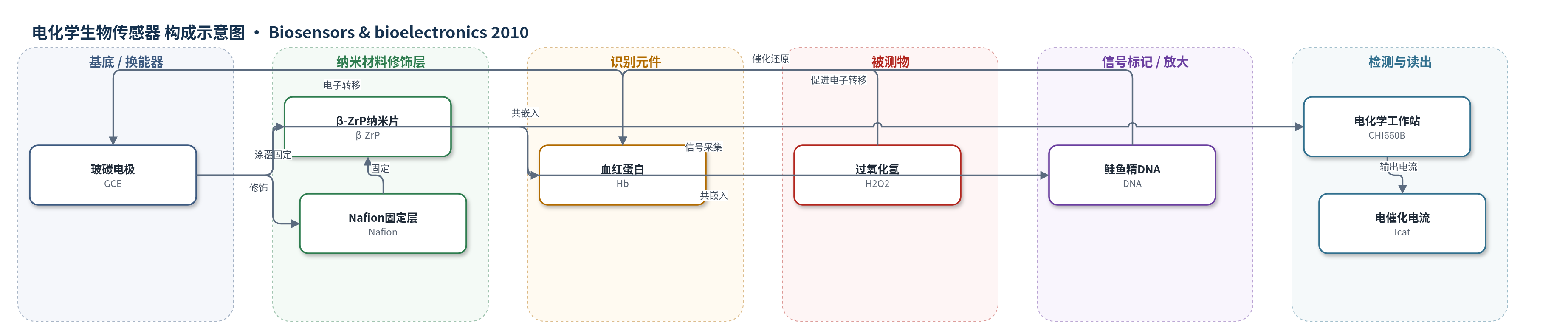
点击图片查看大图 · 依据论文自动绘制
传感器类型
电化学生物传感器
检测对象
过氧化氢(H2O2);样品基质:磷酸盐缓冲液(PBS, pH 7.0)及 CH3CN:PBS=3:1 混合液
检测原理
该传感器基于血红蛋白(Hb)的直接电子转移(DET)和类过氧化物酶电催化。β-磷酸锆(β-ZrP)经剥离后,在 pH 5.5 下与带正电 Hb 和带负电 DNA 共嵌入层间,形成 DNA/Hb/β-ZrP 复合材料。Hb 的血红素中心可催化 H2O2 还原,电子经共嵌入 DNA 的电荷迁移通道和 β-ZrP 层间界面传递至玻碳电极,使循环伏安阴极峰电流随 H2O2 浓度增加而增大。DNA 的共嵌入改善 Hb 与电极间的电子通信,提高电催化电流;β-ZrP 层状结构保护 Hb 构象并增强热稳定性和有机溶剂耐受性。检测信号为电催化还原电流 Icat,在低浓度范围内与 H2O2 浓度呈线性关系。
检测灵敏度
LOD: 4.28 × 10⁻⁷ M;线性范围: 7.28 × 10⁻⁷ to 9.71 × 10⁻⁵ M;灵敏度: 0.79 A M−1 cm−2;相关系数: 0.999;线性方程: y = 0.056x + 0.091 μA (n = 15)
效应效果
与 Hb/β-ZrP 电极相比,DNA/Hb/β-ZrP 电极对 H2O2 的电催化电流更高,线性斜率由 0.026 μA μM−1 提高到 0.056 μA μM−1,表明共嵌入 DNA 显著增强 Hb 电催化活性。KappM 为 458 μM,小于文献中 Hb/Mb 嵌入层状铌酸盐、Au-ZrP、硅藻土膜等体系,说明对 H2O2 亲和力较高。7 个独立电极在 29.1 μM H2O2 下 RSD 为 3.89%;储存 5 天和 10 天后保留电流分别为 98.1% 和 94.7%。85 °C 处理 15 min 后电流仅下降约 5%;在 CH3CN:PBS=3:1 中仍线性(y = 0.039x + 0.55 μA,R = 0.997,7.28×10−6–9.71×10⁻⁵ M)。作者认为该材料可用于构建第三代电化学 H2O2 生物传感器。
传感器的构成
- 基底/换能器电极:玻碳电极(GCE),提供电子转移界面并承载修饰层
- 纳米材料修饰层:剥离-重组 β-磷酸锆(β-ZrP)纳米片,提供可膨胀层间空间并保护嵌入生物分子
- 生物催化识别元件:血红蛋白(Hb),具有过氧化物酶样活性,催化 H2O2 还原并发生直接电子转移
- 共嵌入电子转移促进元件:鲑鱼精 DNA(约 2000 bp),带负电,与 Hb 共嵌入并促进 Hb 直接电子转移
- 固定/封闭层:0.5% Nafion,滴涂固定 DNA/Hb/β-ZrP 复合材料并防止脱落
中文摘要
本文报道了一种新型无中介体电化学生物传感器。在 pH 5.5 条件下,采用剥离-组装法将带负电的鲑鱼精 DNA 和带正电的血红蛋白(Hb)共嵌入层状 β-磷酸锆(β-ZrP)的层间空间,形成 DNA/Hb/β-ZrP 复合材料。X 射线衍射和场发射扫描电镜表明重组复合材料具有特征层状结构;红外光谱和圆二色谱证实 Hb 与 DNA 共存,且嵌入 Hb 的蛋白质构象得到较好保留。DNA 与 Hb 的共嵌入促进了 Hb 的直接电子转移。由于 β-ZrP 宿主与共嵌入 DNA 客体的协同作用,DNA/Hb/β-ZrP 修饰电极对 H2O2 表现出良好的电催化响应,灵敏度为 0.79 A M−1 cm−2,在 7.28×10⁻⁷–9.71×10⁻⁵ M 线性范围内检出限为 4.28×10⁻⁷ M。此外,复合材料中 Hb 的电催化活性在 85 °C 高温或乙腈(CH3CN)有机溶剂存在下仍能保留,可能归因于 β-ZrP 纳米片的保护作用。
英文摘要
A novel mediator-free biosensor was constructed by the co-intercalation of negatively charged DNA and positively charged hemoglobin (Hb) in the interlayer galleries of layered alpha-zirconium phosphate (alpha-ZrP) with the delamination-assembly procedure at pH 5.5. X-ray diffraction and field-emission scanning electron microscopy results revealed the featured layered structure for the re-assembled DNA/Hb/alpha-ZrP composite. Infrared spectroscopy and circular dichroism results confirmed the coexistence of Hb and DNA in the composite and the considerably retained protein conformation of intercalated Hb. The direct electron transfer of Hb was facilitated by the co-intercalation of DNA and Hb. Because of the synergistic effect of alpha-ZrP host and co-intercalated DNA guest, the DNA/Hb/alpha-ZrP modified electrode exhibited good electrocatalytic response to H(2)O(2) with higher sensitivity of 0.79 A M(-1) cm(-2) and lower detection of 4.28x10(-7) M in the linear range of 7.28x10(-7) to 9.71x10(-5) M. Furthermore, the electrocatalytic activity of Hb in the DNA/Hb/alpha-ZrP composite retained at high temperature (85 degrees C) or in the presence of organic solvent (CH(3)CN), which could be the protection of alpha-ZrP nanosheets.