组成图示
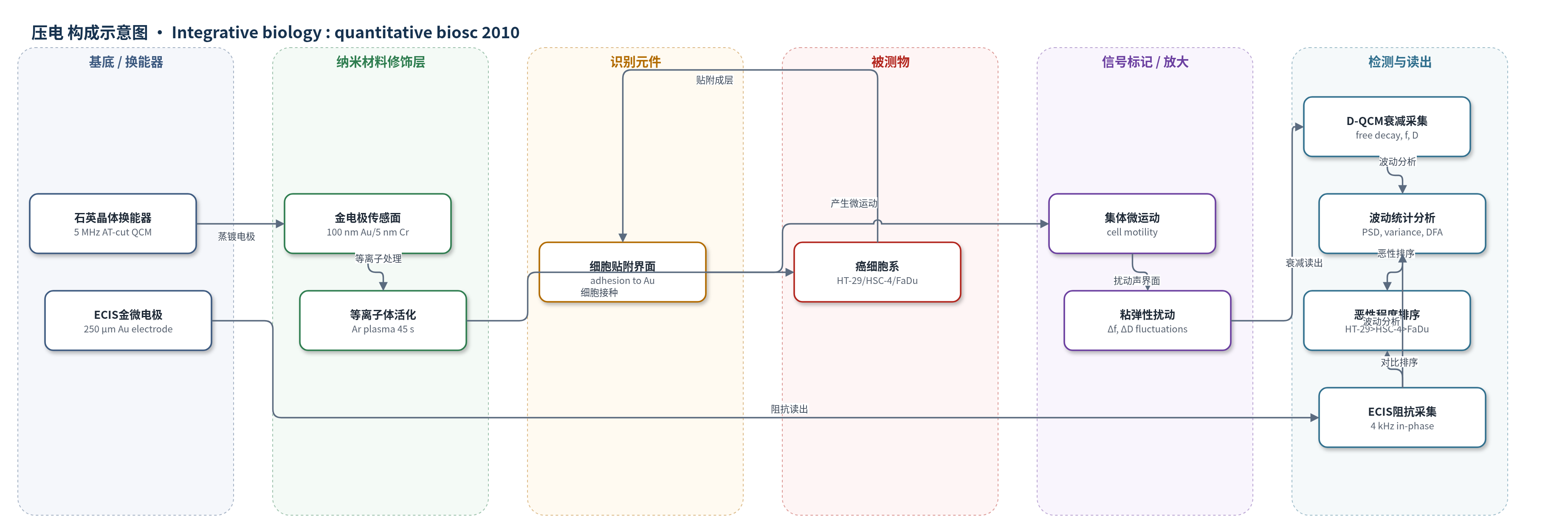
点击图片查看大图 · 依据论文自动绘制
传感器类型
压电(QCM)生物传感器
检测对象
人癌细胞系(human cancer cell lines,HT-29、HSC-4、FaDu)的集体微运动/转移潜能;样品基质:贴壁细胞单层于 HEPES–HCO3− 缓冲培养液中
检测原理
该传感器以 5 MHz AT-cut 石英晶体为厚度剪切模式换能器。信号发生器驱动晶体后周期性断开,A/D 卡采集自由衰减,拟合阻尼正弦得到共振频率 f 与衰减常数 δ(能量耗散 D)。癌细胞贴附在金电极上形成粘弹性负载,使 f 下降、D 上升;细胞集体微运动伴随粘附斑形成/解离、细胞高度和粘弹性变化,引起 f、D 的时间波动。对去趋势时间序列做 FFT,计算功率谱密度斜率、归一化方差和 DFA 指数,用以表征长记忆随机运动。恶性程度越高,方差与 PSD 斜率通常越大。ECIS 分支则通过 4 kHz 交流阻抗监测细胞-基底界面阻抗波动。
检测灵敏度
原文未报告 LOD、线性范围、灵敏度斜率或相关系数。
效应效果
控制实验表明甘油-水混合液可模拟粘弹性负载但波动较小,0.5% 戊二醛固定后波动消失,证明信号来自活细胞。三种细胞系 n=3。Boyden 迁移/侵袭计数为 HT-29 400±160/30±8、HSC-4 204±24/29±8、FaDu 118±30/12±2 细胞/视野。QCM 归一化方差为 33.1±6.2、24.8±7.6、9.6±5.2,PSD 斜率为 -1.8±0.4、-1.5±0.5、-0.6±0.5,重现 HT-29>HSC-4≈FaDu 趋势;ECIS 方差为 167±39、1793±4、1002±29,未能确认该趋势。作者认为 QCM 方差分析可无标记、非侵入、实时评估转移潜能。
传感器的构成
- 换能器基底:5 MHz AT-cut 石英晶体,厚度剪切模式压电换能器,提供共振频率与阻尼读出
- 电极/传感界面:热蒸发 100 nm Au 圆形电极(0.2 cm²),下垫 5 nm Cr 粘附层,作为细胞贴附与声耦合界面
- 表面活化层:氩等离子体处理 45 s,灭菌并亲水化,促进细胞直接贴壁,无外加识别分子
- 培养腔体:特制 Teflon 腔体与 O-ring 密封,容纳 1.5 mL 培养基,维持 37 °C、5% CO2 细胞培养
- 识别/被测层:贴壁人癌细胞系 HT-29、HSC-4、FaDu 单层,作为全细胞识别与动态信号源
- 介质/缓冲层:HEPES–HCO3− 缓冲培养基,维持细胞活性并传递声/电扰动
- 读出电子学:自制 D-QCM 信号发生器、运算放大器、A/D 卡,采集自由衰减并拟合 f 与 D
- ECIS 电极阵列:Applied Biophysics 8W1E 金微电极(250 μm)与大面积对电极,4 kHz 交流阻抗读出
中文摘要
早期判断癌细胞的转移潜能是肿瘤成功治疗的关键。除分子基因组学和蛋白质组学诊断外,体外生物传感器可快速、选择性检测肿瘤细胞侵袭特性。本文比较了基于 Boyden 小室的经典迁移与侵袭实验,以及一种以石英晶体微天平(QCM)为核心的实时电声生物传感器。该传感器通过测量贴壁细胞引起振荡石英晶体共振频率和阻尼的变化,监测细胞附着、铺展及材料性质改变;同时可检测细胞体微妙波动,作为微运动指标。作者对三种人癌细胞系(HT-29、HSC-4、FaDu)的 QCM 微运动读数与电细胞-基底阻抗传感(ECIS)进行比较,发现共振频率波动呈现与细胞恶性程度相关的集体随机运动,并表现出区别于热运动的长记忆随机噪声。
英文摘要
Early determination of the metastatic potential of cancer cells is a crucial step for successful oncological treatment. Besides the remarkable progress in molecular genomics- or proteomics-based diagnostics, there is a great demand for in vitro biosensor devices that allow rapid and selective detection of the invasive properties of tumor cells. Here, the classical cancer cell motility in vitro assays for migration and invasion relying on Boyden chambers are compared to a real-time biosensor that analyzes the dynamic properties of adherent cells electro-acoustically with a time resolution on the order of seconds. The sensor relies on the well-established quartz crystal microbalance technique (QCM) that measures the shift in resonance frequency and damping of an oscillating quartz crystal when adsorption, desorption or changes in material properties close to the quartz surface occur. In addition, the QCM is capable of detecting the rather subtle fluctuations of the cell bodies as an indicator for their micromotility. QCM-based micromotility readings of three different cancer cell lines (HT-29, HSC-4, FaDu) are compared with the well-known electrical cell-substrate impedance sensing (ECIS) revealing collective stochastic motion that corresponds to the malignancy of the cells.