组成图示
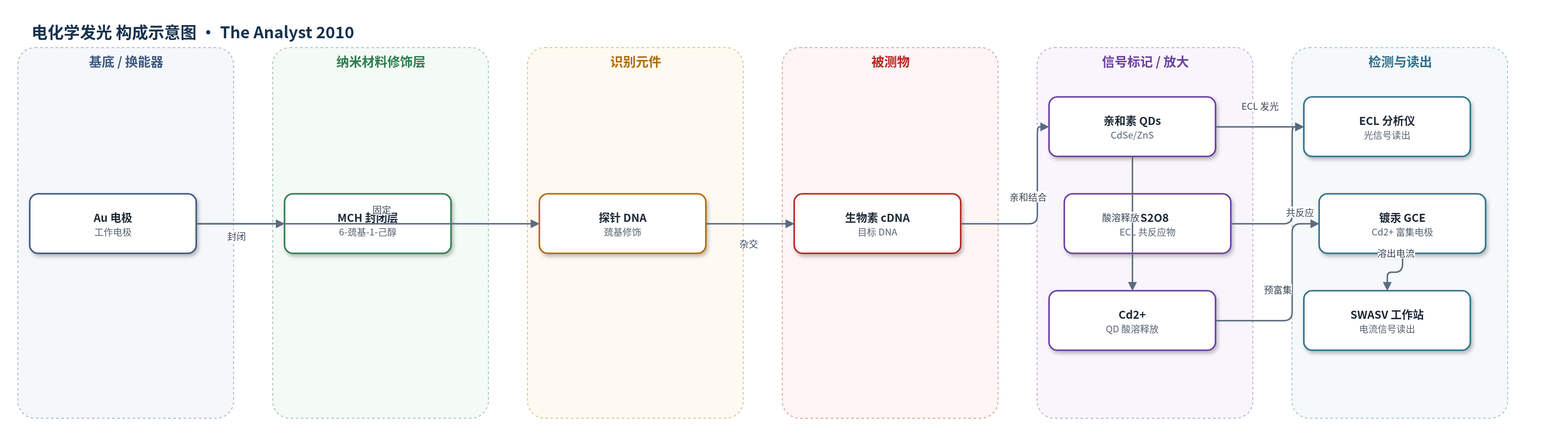
点击图片查看大图 · 依据论文自动绘制
传感器类型
电化学发光(ECL)生物传感器
检测对象
互补 DNA 寡核苷酸(cDNA oligonucleotides);样品基质:PBS+ 缓冲液中的 DNA 寡核苷酸溶液
检测原理
巯基探针 DNA 通过 Au–S 键固定于 Au 电极,cDNA 杂交形成 ds-DNA,使界面负电荷增加,EIS/CV 显示电子转移阻力增大。生物素修饰 cDNA 与亲和素-QDs 经生物素–亲和素高亲和结合,QD 数量随 cDNA 浓度增加。ECL 模式下,QD 在阴极电位被还原,与 K2S2O8 共反应物反应产生光子,ECL 强度正比于结合 QD 量,即 cDNA 浓度。SWASV 模式下,HNO3 溶解结合 QD 释放 Cd2+,Cd2+ 在镀汞 GCE 上预富集后阳极溶出,溶出峰电流随 cDNA 浓度对数线性增加。该策略以 QD 作为多重信号标记,实现双模检测。
检测灵敏度
ECL:LOD: 10 pM(摘要);LOD: 1.5 nM(结果);线性范围: 5 nM–5000 nM;回归方程: y = 1765 + 4115 lgx (x: nmol L−1);R^2 = 0.9943。SWASV:LOD: 50 pM(摘要);LOD: 15 nM(结果);线性范围: 50 nM–5 mM;回归方程: y = −24.17 + 23.94 lgx (x: nmol L−1);R^2 = 0.9739。
效应效果
该传感器对序列特异性识别良好:在 5 μM 条件下,单碱基错配和非互补 DNA 的 ECL 信号均显著低于互补 DNA,表明具有较高选择性。重现性方面,三个独立制备传感器检测 500 nM cDNA,ECL 和 ASV 的变异系数分别为 8.46% 和 7.25%,说明制备精度可接受。作者指出 ECL 检测限低于 SPRi(10 nM)和 QCM(250 nM),可与三(2,2'-联吡啶)钌(II)标记方法相当;SWASV 结果优于已报道的电化学阻抗 DNA 传感器。与 SWASV 相比,ECL 具有更宽线性范围和更低检测浓度。文中未报告实际样品加标回收率,但作者主张该双模态策略可用于分子诊断中的序列特异性 DNA 检测。
传感器的构成
- 基底/换能器电极:Au 电极,固定巯基探针 DNA 并作为 ECL/CV/EIS 工作电极;SWASV 另用镀汞 GCE 检测 Cd2+
- 识别元件:巯基修饰探针 DNA(probe DNA),经 Au–S 键自组装固定,与 cDNA 杂交
- 封闭层:6-巯基-1-己醇(MCH),去除非特异吸附 DNA 并封闭 Au 表面
- 目标识别结合层:生物素修饰 cDNA(biotin-cDNA),与探针杂交形成 ds-DNA,提供生物素位点
- 信号标记层:亲和素修饰量子点(avidin-QDs,CdSe/ZnS),经生物素–亲和素结合,产生 ECL 和 Cd 溶出信号
- 封闭剂:牛血清白蛋白(BSA),封闭 QD 表面活性位点,降低非特异结合
- ECL 共反应物:过硫酸钾(K2S2O8),与电还原 QD 反应生成 ECL 光子
- 缓冲/电解质:PBS+(含 MgCl2)与 KCl,维持 DNA 杂交和 ECL 反应环境
- SWASV 溶出介质:HNO3、0.1 mol L−1 醋酸缓冲液(pH 4.6)与 10 ppm Hg(II),溶解 QD 并用于 Cd2+ 预富集/溶出
中文摘要
本文报道了一种以量子点(QDs)作为标记物用于 DNA 检测的简便方法。首先将巯基修饰的探针 DNA 固定于预处理金电极表面,随后将互补 DNA(cDNA)寡核苷酸与固定化探针杂交,最后在生物素修饰 cDNA 存在下使亲和素修饰 QDs 结合到生物传感器上。传感器制备过程用电化学阻抗谱(EIS)和循环伏安法(CV)监测。与传统三明治结构不同,QDs 通过生物素–亲和素体系直接结合到目标 DNA 上。通过观察 ECL 信号以及测定 QDs 中镉组分,分别用电致发光(ECL)和方波阳极溶出伏安法(SWASV)检测 DNA 杂交事件。SWASV 信号在 50 nM–5 μM 范围内随 cDNA 浓度对数线性增加,最低可检测浓度为 50 pM;ECL 具有更宽线性范围 5 nM–5 μM 和更低检测限 10 pM,表明 ECL 检测可与传统电化学方法相当。此外,该生物传感器对不同序列目标 DNA 寡核苷酸具有较高选择性。
英文摘要
Simple and convenient assays with quantum dots (QDs) as the labels for DNA detection are developed. The probe DNA modified with thiol was first immobilized on a pretreated Au electrode, and then the complementary DNA (cDNA) oligonucleotides were hybridized with the immobilized probes by immersing the probe-modified Au electrode into the cDNA oligonucleotide solution. Finally, the avidin-modified QDs were bound to the biosensor in the presence of biotin-modified cDNA. The fabrication process for the biosensor was monitored by electrochemical impedance spectroscopy (EIS) and cyclic voltammetry (CV). Different from the traditional sandwich-structure strategy, the QDs bind to the target DNA directly via the biotin-avidin-system. By observing the ECL signal and determination of the cadmium component in QDs, the DNA hybridization event was detected by ECL and square wave anodic stripping voltammetric technique (SWASV) respectively. For SWASV detection, the signal linearly increased with the increase of the logarithm of the cDNA concentration over the range of 50 nM-5 microM. The minimum detectable concentration is 50 pM. For ECL, it showed wider linearity range over 5 nM-5 microM and lower detectable concentration of 10 pM. This indicated that the ECL assay could be comparable to the conventional electrochemical assay. Furthermore, this biosensor possesses high selectivity over different sequences of target DNA oligonucleotides.