组成图示
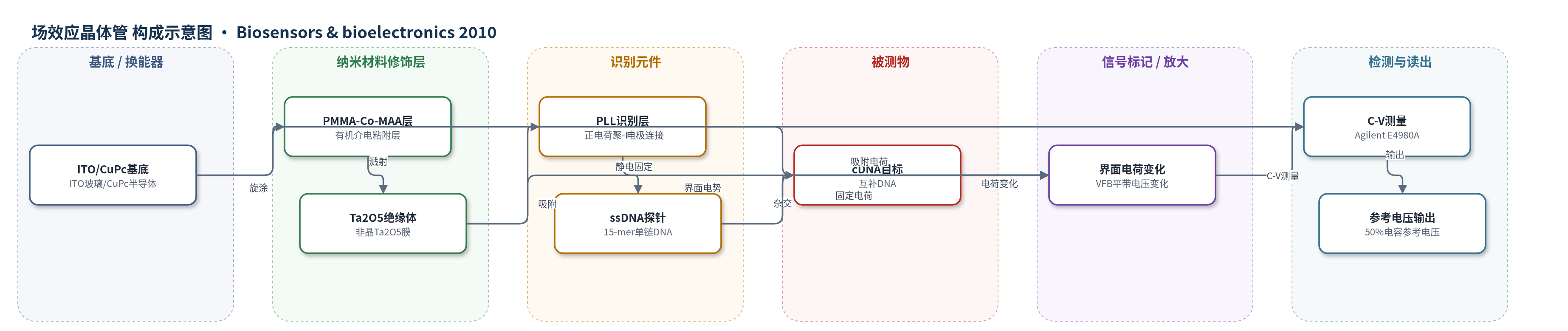
点击图片查看大图 · 依据论文自动绘制
传感器类型
场效应晶体管(FET)生物传感器
检测对象
互补DNA(complementary DNA, cDNA),样品基质:0.5× PBS缓冲液;pH(氢离子活度),样品基质:pH 2–12缓冲液
检测原理
OEIS器件由ITO/CuPc/PMMA-Co-MAA/Ta2O5构成,无金属栅。Ta2O5表面基团电离或带电生物分子结合改变绝缘体-电解质界面表面电势ψ0,根据平带电压公式VFB = Eref - ψ0 - (φsol - φSi)/q - (Qss+Qox)/Cox,ψ0变化导致VFB沿电压轴平移。PLL正电荷吸附使VFB左移/降低,ssDNA负电荷固定使VFB右移/升高;cDNA与ssDNA杂交后引入负电荷,使VFB进一步升高。在0.5× PBS中Debye屏蔽长度约1 nm,可覆盖PLL-DNA层,因此界面电荷变化有效调制CuPc半导体通道电容。通过C-V曲线在50%归一化电容处读取参考电压,随cDNA浓度对数线性增加。
检测灵敏度
pH: 线性范围: pH 2–12;平均灵敏度: 44.1 mV/pH;相关系数 = 0.977。cDNA: LOD: 1 μM;线性范围: 10^-7–5 × 10^-5 M;相关系数 = 0.953。
效应效果
OEIS器件对互补DNA具有特异性,非互补DNA在10^-7–5×10^-5 M范围内无明显响应。PMMA-Co-MAA界面层显著提高稳定性:无该层时Ta2O5薄膜在PBS中3次测量后易脱落,含该层时20次测量未见降解。实验数据为至少3次测量的均值±SEM,并在3个不同器件上验证。pH灵敏度44.1 mV/pH,低于硅基EIS的57 mV/pH;DNA检出限1 μM,低于硅纳米线FET的数十纳摩尔水平,但作者认为可通过优化ssDNA固定密度和缓冲液离子强度提高。器件制备简便、成本低、具柔性,适合一次性生物传感器。
传感器的构成
- 基底/换能器电极:ITO玻璃(indium tin oxide, ITO),作为器件基底与电极。
- 有机半导体层:CuPc(copper phthalocyanine)100 nm热蒸镀p型有机半导体,作为场效应通道/换能层。
- 有机介电/界面粘附层:PMMA-Co-MAA(poly(methyl methacrylate-co-methacrylic acid))旋涂三次并100°C烘烤,改善Ta2O5与CuPc粘附。
- 无机介电/离子敏感膜:Ta2O5(tantalum pentoxide)250 nm非晶薄膜,作为绝缘体/离子敏感膜,表面基团电离或带电分子结合改变界面电势。
- 识别元件:PLL(poly-l-lysine)1 wt%正电荷多肽,静电吸附ssDNA。
- 识别探针:ssDNA(single-stranded DNA probe,15-mer 5′-GATGATGAGAAGAAC-3′)100 μM固定,与cDNA杂交。
- 封装/保护:epoxy-type resin环氧树脂封装,防止漏电流,接触面积25 mm2。
中文摘要
本研究构建了首个基于电解质-绝缘体-半导体(OEIS)结构的有机场效应传感器,并将其应用于pH和DNA检测。绝缘体-电解质界面表面电势的变化,源于绝缘体表面基团电离状态改变或带电分子结合到绝缘体表面,会改变OEIS传感器的平带电压(VFB)。pH传感实验表明,OEIS传感器输出信号在pH 2–12范围内随pH线性变化,平均灵敏度为44.1 mV/pH。生物传感实验中,正电荷聚-L-赖氨酸(PLL)吸附于绝缘体表面使VFB降低;随后负电荷单链DNA探针(ssDNA)通过静电作用结合使VFB升高。进一步地,固定ssDNA的OEIS器件成功用于DNA杂交检测。互补DNA(cDNA)检出限低至1 μM,OEIS生物传感器输出信号在10^-7–5×10^-5 M范围内随cDNA浓度对数线性增加。OEIS器件制备简便、成本低廉,有望作为可一次性使用且灵敏的生物传感器。
英文摘要
In this study, we have constructed the first organic field effect sensor based on an electrolyte-insulator-semiconductor structure (OEIS) and applied this novel device to pH and DNA sensing. Variations in the insulator-electrolyte surface potential, which originate from either the change of the ionization states of the insulator surface groups or the binding of charged molecules to the insulator surface, modify the flat band voltage (V(FB)) of the OEIS sensor. The pH sensing experiments of OEIS sensor showed that the output signal linearly depended on pH solution in the range from pH 2 to pH 12, and an average sensitivity of 44.1 mV/pH was obtained. In the biosensing experiments, the absorption of positively charged poly-L-lysine on the insulator surface resulted in the reduction of the V(FB) value, whereas the subsequent binding of negatively charged single-stranded DNA probe (ssDNA) via electrostatic interaction increased the V(FB) value. Furthermore, the ssDNA-immobilized OEIS device was successfully used for the detection of DNA hybridization. The detection limit of complementary DNA was as low as 1 microM, and the output signal of OEIS biosensor linearly increased with the logarithm of complementary DNA concentration in the range from 5x10(-5) to 10(-7) M. The easy and inexpensive fabrication of the OEIS device allows to be served as a potentially disposable and sensitive biosensor.