组成图示
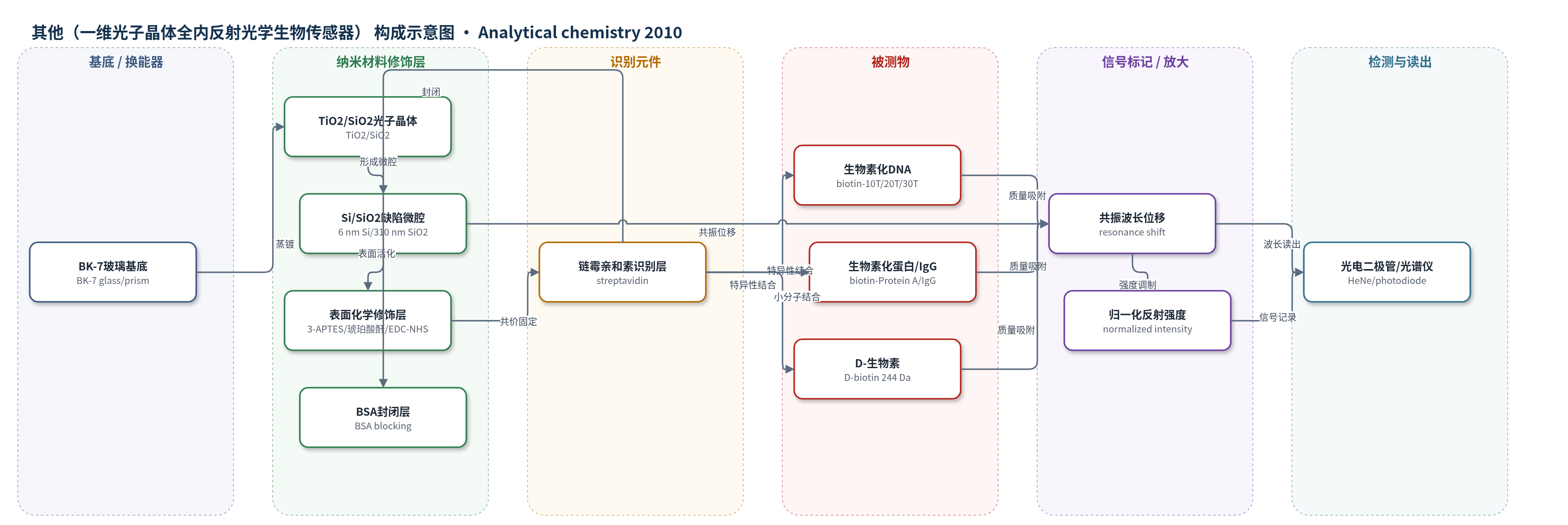
点击图片查看大图 · 依据论文自动绘制
传感器类型
其他(一维光子晶体全内反射光学生物传感器)
检测对象
D-生物素(D-biotin)、生物素化DNA寡核苷酸(biotin-10T/20T/30T)、生物素化蛋白A(biotin-Protein A)、生物素化牛血清白蛋白(biotin-BSA)、生物素化免疫球蛋白G(biotin-IgG)、DNA寡核苷酸(20A/20C)、免疫球蛋白G(IgG);样品基质:PBS缓冲液
检测原理
该传感器采用一维光子晶体全内反射(PC-TIR)结构,缺陷层形成中等Q值Fabry-Perot共振。链霉亲和素共价固定于SiO2缺陷层表面,生物素化分析物或D-生物素与链霉亲和素特异性结合后,传感表面质量与有效折射率发生变化,改变缺陷层共振条件,使共振波长发生位移。由于共振峰较窄,结合引起的微小折射率/厚度变化可转换为较大的波长位移;再用632.8 nm HeNe激光在共振最陡处监测信号与参考通道反射强度比,将波长位移转换为归一化强度变化,从而提高信噪比。信号随结合分析物质量或浓度增加而增大,直至表面位点饱和。
检测灵敏度
LOD(体相折射率): 1 × 10^-8 RIU;灵敏度: 1840 nm/RIU;分辨率: 1.6 × 10^-5 nm;基线噪声: 8 × 10^-6;斜率: 0.25 ± 0.01、0.45 ± 0.02、0.66 ± 0.04(biotin-20T、biotin-Protein A、biotin-BSA结合位移对链霉亲和素吸附位移)
效应效果
非特异性结合未检出。1 µM D-生物素位移0.053 nm,接近理论值0.056 nm,信噪比3300;1 nM biotin-20T位移0.033 nm,信噪比2000。总位移0.641 nm与先前0.68 nm接近,重现性良好。与Biacore X SPR相比,1 mM D-生物素在SA芯片上无可检测结合,且占据后biotin-IgG响应仅85 RU,远低于新芯片1915 RU;PC-TIR可高分辨检测小分子。体相检测限1 × 10^-8 RIU,较SPR约10^-6 RIU高两个数量级。作者认为其适用于小分子及多层相互作用实时检测。
传感器的构成
- 基底/换能器:BK-7玻璃基底与BK-7耦合棱镜,承载一维光子晶体并实现全内反射
- 光子晶体高折射率层:107 nm TiO2,与SiO2交替形成一维光子带隙
- 光子晶体低折射率层:330 nm SiO2,与TiO2交替形成光子带隙
- 缺陷微腔层:6 nm Si吸收层与310 nm SiO2层,形成Fabry-Perot缺陷态并增强表面电场
- 表面化学修饰层:3-APTES硅烷化、琥珀酸酐羧基化、EDC/NHS活化,将SiO2表面转为可共价偶联基团
- 识别元件:链霉亲和素(streptavidin),共价固定于SiO2表面,提供生物素结合位点
- 封闭剂:BSA牛血清白蛋白,封闭非特异性结合位点并稳定基线
- 样品流道:PDMS双通道微流控池,分隔信号区与参考区并输送PBS/分析物
- 光学读出:HeNe激光(632.8 nm)、光电二极管、数据采集卡/光谱仪,监测反射强度比或共振波长位移
中文摘要
实时测量特异性生物分子相互作用对生物研究至关重要。虽然已发展多种无标记生物分子结合监测技术,但测量极小分子结合动力学、检测低浓度分析物或低亲和力相互作用仍具挑战。本研究报道了一种高灵敏度光子晶体生物传感器,用于无标记、实时生物分子结合分析。作者以标准链霉亲和素-生物素体系表征该传感器性能,优化了链霉亲和素在二氧化硅传感表面固定化的表面功能化方法,并实时检测了分子量跨越3个数量级的生物素化分析物分子,包括极小分子(<250 Da)、DNA寡核苷酸、蛋白质和抗体(>150 000 Da),均获得高信噪比。研究还记录了传感器对低质量吸附及多层分子相互作用的高效检测能力。作者认为,该光子晶体生物传感器将在高灵敏度生物分子结合测量方面提供新能力。
英文摘要
Real-time measurement of specific biomolecular interactions is critical to many areas of biological research. A number of label-free techniques for directly monitoring biomolecular binding have been developed, but it is still challenging to measure the binding kinetics of very small molecules, to detect low concentrations of analyte molecules, or to detect low affinity interactions. In this study, we report the development of a highly sensitive photonic crystal biosensor for label-free, real-time biomolecular binding analysis. We characterize the performance of this biosensor using a standard streptavidin-biotin binding system. Optimization of the surface functionalization methods for streptavidin immobilization on the silica sensing surface is presented, and the specific binding of biotinylated analyte molecules ranging over 3 orders of magnitude in molecular weight, including very small molecules (<250 Da), DNA oligonucleotides, proteins, and antibodies (>150 000 Da), are detected in real time with a high signal-to-noise ratio. Finally, we document the sensor efficiency for low mass adsorption, as well as multilayered molecular interactions. By all important metrics for sensitivity, we anticipate this photonic crystal biosensor will provide new capabilities for highly sensitive measurements of biomolecular binding.