组成图示
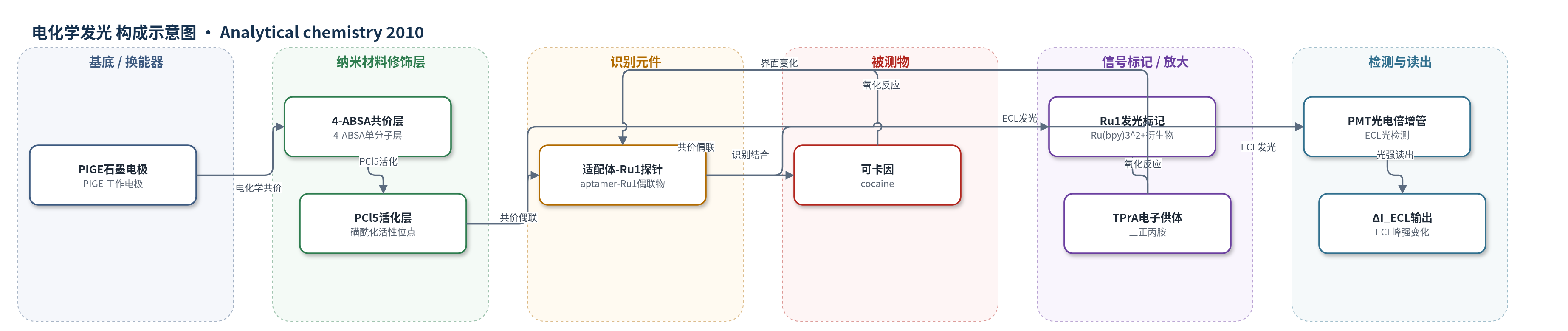
点击图片查看大图 · 依据论文自动绘制
传感器类型
电化学发光(ECL)生物传感器
检测对象
三正丙胺(TPrA)、甲氧氯普胺(MCP)、可卡因(cocaine);样品基质:0.10 M PBS(pH 7.40)缓冲溶液,可卡因检测在0.10 M TPrA-0.10 M PBS中进行
检测原理
该ECL传感器以PIGE/4-ABSA为共价界面,将Ru1或aptamer-Ru1固定于电极。检测时在0.10 M PBS中加入三正丙胺(TPrA)作为电子供体,施加阳极电位(如+1.35 V vs Ag/AgCl)使TPrA氧化为自由基阳离子,后者与Ru(bpy)3^2+发生电子转移生成激发态Ru(bpy)3^2+*,退激发射ECL光。化学传感器中TPrA或MCP作为共反应物/分析物,其浓度越高,界面ECL越强。可卡因生物传感器中,可卡因嵌入适配体并改变aptamer-Ru1界面状态,使ECL峰强发生变化,以ΔI_ECL=I-I0为分析信号;低浓度下ΔI随可卡因浓度增大,高浓度趋于饱和,符合Langmuir等温吸附。
检测灵敏度
LOD: 30 nM (TPrA, S/N=3)、2.0 nM (MCP, S/N=3)、10 pM (cocaine, S/N≥3);线性范围: 70 nM–5.0 µM (TPrA)、5.0 nM–0.50 µM (MCP);Langmuir线性化斜率: 1.59×10^-3;R^2 = 0.994
效应效果
双共价偶联使PIGE/4-ABSA-Ru1在0–1.50 V循环中稳定,50 nM TPrA下90次循环RSD为2.1%,200 nM MCP下45次循环RSD为2.6%;其ECL强度约为静电吸附型的1.7倍,Ru1表面覆盖度为1.2×10^-10 mol/cm2。可卡因ECL-AB传感器对0.50 nM海洛因和咖啡因的干扰响应变化<5.0%,选择性良好;连续再生7次RSD为2.8%,信号恢复约95%;4 ℃存储21天和30天后ECL恢复率分别为96.8%和92.3%。其10 pM检出限比交流伏安法和光学适配体可卡因传感器低4–6个数量级,比此前硫醇金电极ECL传感器低约2个数量级。
传感器的构成
- 工作电极基底:石蜡浸渍石墨电极(PIGE),提供导电换能表面,直径6.0 mm、有效面积98.9 mm2
- 共价修饰层:4-氨基苯磺酸(4-ABSA)单分子层,经电化学氧化与PIGE形成C-N共价键,提供磺酸基团
- 活化修饰层:经五氯化磷(PCl5)处理的4-ABSA磺酰化层,提供与氨基共价偶联的活性位点
- 发光标记:含氨基Ru(bpy)3^2+衍生物Ru1,作为ECL发光中心,通过氨基与磺酰化4-ABSA共价连接
- 识别元件:30-mer可卡因适配体(cocaine aptamer),序列5′-NH2-(CH2)6-GAC AAG GAA AAT CCT TCA ATG AAG TGG GTC-(CH2)6-HPO4--3′,特异性识别可卡因
- 适配体-发光偶联物:aptamer-Ru1,适配体3′磷酸基经咪唑/EDC活化与Ru1氨基共价连接,兼具识别与ECL信号
- 电子供体:三正丙胺(TPrA),在阳极电位氧化生成自由基,与Ru(bpy)3^2+反应产生激发态ECL
中文摘要
本文报道了一种双共价偶联法,用于制备高灵敏、可重复使用的电化学发光(ECL)化学传感器和基于适配体的ECL生物传感器。传感器以石蜡浸渍石墨电极(PIGE)为基底,先经电化学氧化在其表面共价构建4-氨基苯磺酸(4-ABSA)单分子层,再用五氯化磷(PCl5)活化磺酸基团,随后将含氨基的Ru(bpy)3^2+衍生物Ru1或可卡因适配体-Ru1探针共价偶联到电极表面。以三正丙胺(TPrA)和甲氧氯普胺(MCP)为模型分析物评价化学传感器,检出限分别为30 nM和2.0 nM,循环伏安稳定性RSD分别为2.1%(90次)和2.6%(45次)。ECL适配体生物传感器对可卡因的检出限为10 pM,对海洛因和咖啡因具有良好选择性,比交流伏安法和光学适配体传感器低4–6个数量级。该传感器可重复使用(RSD 2.8%,n=7),21天存储后ECL恢复率为96.8%,并测得可卡因-适配体结合常数为4.6±0.3×10^9 M^-1。
英文摘要
A double covalent coupling method for the fabrication of a highly sensitive and reusable electrogenerated chemiluminescence (ECL) chemical sensor for the detection of tertiary amines and ECL aptamer-based (ECL-AB) biosensor for the detection of cocaine is reported. The ECL sensors were constructed by covalent coupling of amino-containing Ru(bpy)(3)(2+) derivatives (Ru1, Ru(bpy)(3)(2+) = tris(2,2'-bipyridyl)ruthenium(II)) or cocaine aptamer-Ru1 to the surface of a paraffin-impregnated graphite electrode that had been covalently modified with a monolayer of 4-aminobenzene sulfonic acid via electrochemical oxidations. ECL performance of the newly developed chemical sensors was evaluated using tri-n-propylamine (TPrA) and metoclopramide (MCP) as model analytes. The sensors exhibited excellent sensitivity, stability, and reproducibility with a detection limit of 30 nM for TPrA and 2.0 nM for MCP, and relative standard deviations (RSDs) of 2.1% over 90 cyclic potential cycles (0 to 1.50 V vs Ag/AgCl) and 2.6% over 45 cycles (0.60 to +1.30 V vs Ag/AgCl) at 400 mV/s for 50 nM TPrA and 200 nM MCP, respectively. For the ECL-AB biosensor, it showed an extremely low detection limit of 10 pM for cocaine, and offered a good selectivity toward cocaine, heroin, and caffeine. This detection limit was about 4-6 orders of magnitude lower than that reported on the basis of alternating current (AC) voltammetry and optical aptamer-based cocaine biosensors. Additionally, the ECL-AB biosensor was highly reusable (RSD = 2.8%, n = 7) and possessed long-term storage stability (96.8% initial ECL recovery over 21 days storage). A binding constant of 4.6 +/- 0.3 x 10(9) M(-1) between cocaine and its aptamer was estimated using an ECL based Langmuir isotherm approach. Wide ranging applications of the presently reported strategy in fabricating various chemical sensors or biosensors are expected.