组成图示
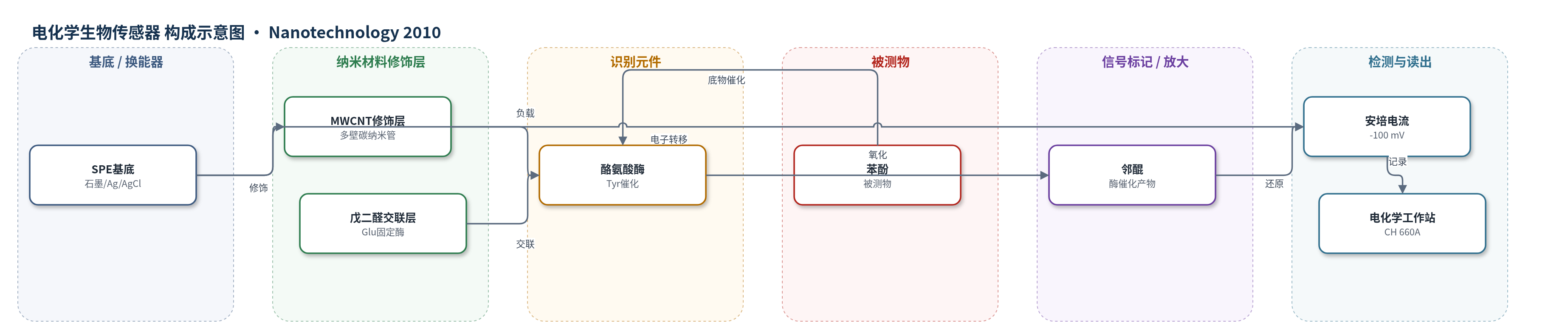
点击图片查看大图 · 依据论文自动绘制
传感器类型
电化学生物传感器
检测对象
苯酚(phenol);样品基质:PBS缓冲液、海水(seawater)
检测原理
苯酚作为底物进入由MWCNT/Tyr/Glu修饰的SPE工作电极表面。酪氨酸酶在分子氧存在下催化苯酚发生邻位羟基化及邻二酚氧化,生成邻醌。邻醌在-100 mV工作电位下于电极表面被还原为邻二酚,产生与苯酚浓度相关的阴极电流。MWCNT提高电极比表面积、导电性和电子转移速率,戊二醛交联固定酶并维持其构象与活性。流注入系统以3 mL/min流速输送样品,使酶促反应与电化学还原快速完成,安培信号随苯酚浓度增加而增大。
检测灵敏度
LOD: 0.14 μM;线性范围: 0.05–1 μM;灵敏度: 52.5 nA μM−1;相关系数: 0.99
效应效果
酪氨酸酶提供对酚类底物的选择性。在-100 mV、pH 6.5、流速3 mL/min、进样10 s条件下,响应时间约15 s。对10 μM苯酚连续测定10次、3重复的RSD为5.8%;室温连续FIA使用两周内RSD约5%,保留约95%酶活性,一个月RSD升至25%。PBS加标回收率为94%、98%、90%,海水加标回收率为74%、99%、98%。检出限低于EPA限值约500倍,作者认为其适合海水污染自动监测,并可扩展至其他酶传感器。
传感器的构成
- 基底/换能器电极:聚酯基底上的丝网印刷电极(SPE),石墨工作电极与 Ag/AgCl 参比/对电极,提供电化学换能
- 纳米材料修饰层:经硝酸氧化/热处理的多壁碳纳米管(MWCNT,1 mg/mL THF)滴涂于工作电极,提高导电性、比表面积和电子转移
- 识别元件:蘑菇酪氨酸酶(Tyr)滴涂于 MWCNT 层,催化苯酚氧化
- 交联固定层:5% 戊二醛(Glu)滴涂于酶层,交联固定 Tyr,保持构象并防止泄漏
中文摘要
本文设计了一种用于苯酚检测的稳定且高灵敏的电化学生物传感器,并将其应用于流注入分析系统。该传感器以丝网印刷电极为基底,工作电极表面修饰多壁碳纳米管,并负载酪氨酸酶,再用戊二醛交联固定。所提出的碳纳米管基质制备简单、成本低,能为酶提供良好的包埋环境,且使酶具有快速响应,响应时间约15 s。作者系统研究了工作电位、测量溶液pH、响应时间、检出限、线性范围和灵敏度等参数。苯酚检出限为0.14 μM。该传感器在室温下连续流注入测量中保持活性,两周内响应稳定,相对标准偏差约5%。该传感器已用于海水样品中苯酚检测,有望作为海水污染自动监测的替代方案,并可扩展到其他酶生物传感器应用。
英文摘要
A stable and sensitive biosensor for phenol detection based on a screen printed electrode modified with tyrosinase, multiwall carbon nanotubes and glutaraldehyde is designed and applied in a flow injection analytical system. The proposed carbon nanotube matrix is easy to prepare and ensures a very good entrapment environment for the enzyme, being simpler and cheaper than other reported strategies. In addition, the proposed matrix allows for a very fast operation of the enzyme, that leads to a response time of 15 s. Several parameters such as the working potential, pH of the measuring solution, biosensor response time, detection limit, linear range of response and sensitivity are studied. The obtained detection limit for phenol was 0.14 x 10(-6) M. The biosensor keeps its activity during continuous FIA measurements at room temperature, showing a stable response (RSD 5%) within a two week working period at room temperature. The developed biosensor is being applied for phenol detection in seawater samples and seems to be a promising alternative for automatic control of seawater contamination. The developed detection system can be extended to other enzyme biosensors with interest for several other applications.