组成图示
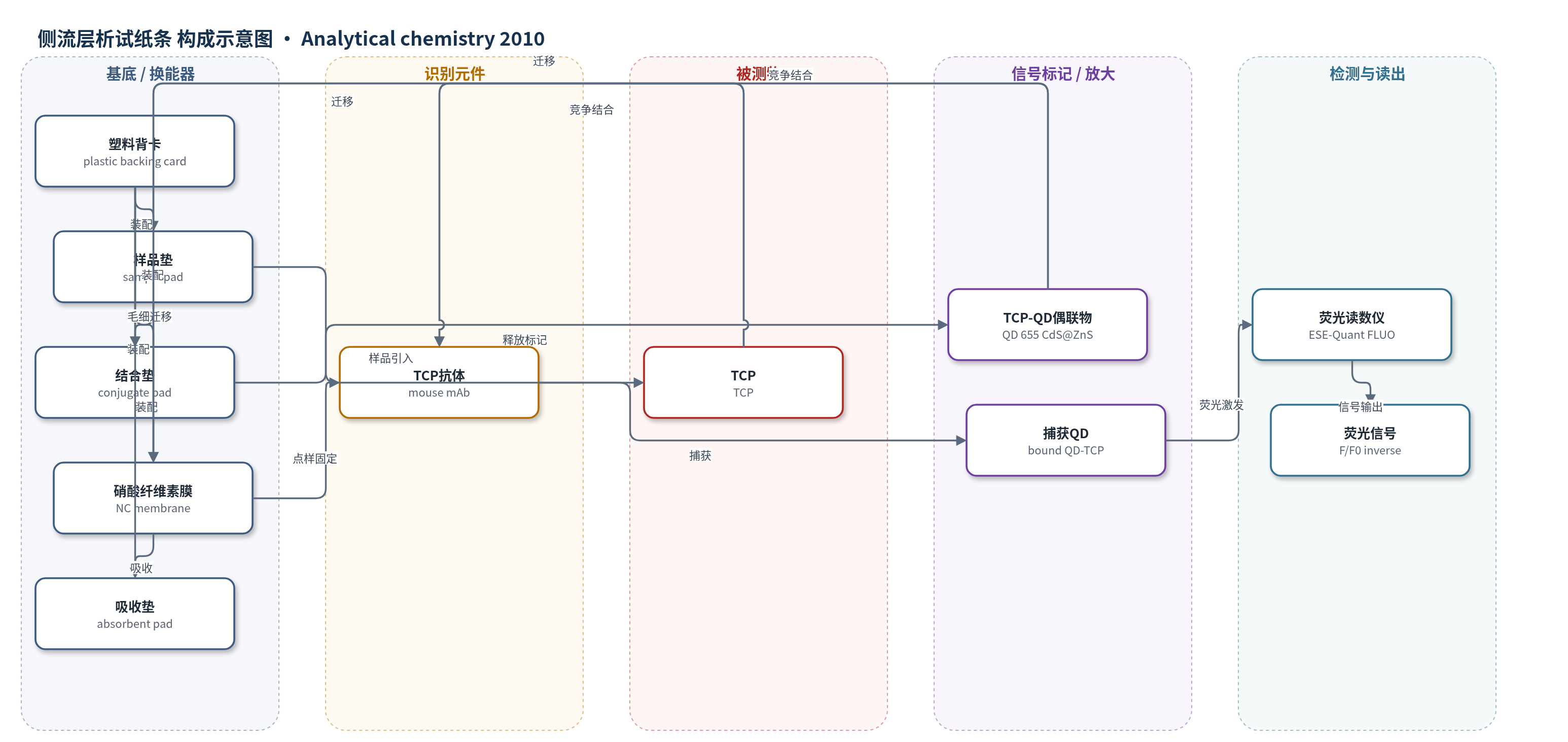
点击图片查看大图 · 依据论文自动绘制
传感器类型
侧流层析试纸条
检测对象
3,5,6-三氯吡啶醇(TCP, 3,5,6-trichloropyridinol);样品基质:大鼠血浆(10倍稀释)、PBS标准溶液
检测原理
该传感器采用竞争免疫层析原理。样品加入样品垫后,在毛细作用下沿试纸条迁移,样品中的TCP与结合垫中固定量的TCP-QD偶联物混合并共同迁移至检测区。检测区硝酸纤维素膜上固定有限量小鼠单克隆TCP抗体,TCP与TCP-QD竞争结合抗体。无TCP时,TCP-QD充分结合,检测区荧光强;样品中TCP浓度越高,结合到抗体的TCP-QD越少,荧光信号越低。QD 655(CdS@ZnS)作为高亮度、抗光漂白荧光标记,每个QD约连接30个TCP,提高信号强度。便携式读数仪激发并记录检测区荧光,以F/F0对TCP浓度作标准曲线,实现定量检测。
检测灵敏度
LOD: 1.0 ng/mL;线性范围: 1–50 ng/mL;灵敏度斜率: -50.76(Y=90.68-50.76 lg X);R = 0.9935;校准范围: 1–1000 ng/mL
效应效果
该传感器15 min完成检测,快速便携且可定量。特异性实验中,TCP-QD与TCP抗体组合信号显著高于BSA或无TCP的QD对照,说明识别主要来自抗体特异性结合。抗体活性在4 ℃密封保存下可维持6个月。0和10 ng/mL TCP的RSD分别为6.3%和12.9%。大鼠血浆10倍稀释加标实验中,1–50 ng/mL回收率为77.0%–130.4%,平均102.0%。其检出限与商业TCP RaPID Assay Kit相当,作者认为可用于现场和即时医疗(POC)中氯吡若斯暴露生物标志物TCP的筛查与定量。
传感器的构成
- 支撑基底:塑料粘附背卡(plastic adhesive backing card),承载样品垫、结合垫、硝酸纤维素膜和吸收垫并固定试纸条
- 样品垫:玻璃纤维样品垫(sample application pad),接收50 μL样品并启动毛细迁移
- 结合垫:玻璃纤维结合垫(conjugation pad),预涂PBS/BSA/蔗糖/Tween-20缓冲液并点样TCP-QD偶联物,作为竞争标记物
- 信号标记物:QD 655(CdS@ZnS)与羧基化TCP(HTCP)经EDC/NHS偶联形成的TCP-QD,约30个TCP/QD,提供荧光信号
- 检测膜:硝酸纤维素膜(nitrocellulose membrane),检测区点样1 mg/mL小鼠单克隆TCP抗体(mouse monoclonal TCP antibody),捕获TCP-QD
- 识别元件:小鼠单克隆TCP抗体(mouse monoclonal TCP antibody),特异性识别TCP并介导竞争结合
- 封闭层:1%酪蛋白(casein)封闭硝酸纤维素膜,减少QD非特异结合并提高QD迁移
- 吸收垫:吸收垫(absorbent pad),吸收多余液体并维持层析流动
- 读数换能器:便携式试纸条荧光读数仪(ESE-Quant FLUO),激发并记录检测区QD荧光
中文摘要
本研究报道了一种新型便携式荧光生物传感器,将免疫层析试纸条检测(ITSA)、量子点(QD)标记和试纸条读数仪相结合,用于有机磷农药代谢物的简单、快速、灵敏生物监测。该传感器基于试纸条上的竞争免疫反应:样品中的分析物与固定量的QD偶联类似物竞争结合检测区抗体,被捕获的QD作为荧光信号载体进行读出。作者以3,5,6-三氯吡啶醇(TCP)为模型分析物,合成并用X射线光电子能谱(XPS)和荧光光谱表征了QD-TCP偶联物,优化了QD修饰TCP用量和免疫反应时间等参数。最优条件下,传感器具有较宽动态范围,可在15 min内检测最低1.0 ng/mL的TCP标准品,并成功用于大鼠血浆中TCP加标检测,平均回收率为102.0%。结果表明,该传感器为TCP检测提供了快速、临床准确且定量的工具,在现场和即时医疗(POC)代谢物生物标志物筛查中具有应用前景。
英文摘要
A novel and portable fluorescent sensor that integrates an immunochromatographic test strip assay (ITSA) with a quantum dot (QD) label and a test strip reader was described in this study for simple, rapid, and sensitive biomonitoring of an organophosphorus pesticide metabolite. The principle of this sensor is based on a competitive immunoreaction that was performed on an immunochromatographic test strip, where analytes compete with competitors (QD-conjugated analogs) to bind to antibodies on a test zone. Captured QDs serve as signal vehicles for fluorescent readout. In this work, 3,5,6-trichloropyridinol (TCP) is used as a model analyte to demonstrate the performance of the immunosensor. QD-TCP conjugates were synthesized and characterized with X-ray photoelectron spectroscopy (XPS) and fluorescence spectroscopy. Some parameters (e.g., the amount of QD-modified TCP and immunoreaction time) that govern sensitivity and reproducibility of ITSA were optimized. Under optimal conditions, the sensor has a wide dynamic range and is capable of detecting a minimum 1.0 ng/mL TCP standard analyte in 15 min. The sensor has been successfully applied for detection of TCP spiked in rat plasma with average recovery of 102.0%. Results demonstrate that this sensor provides a rapid, clinically accurate, and quantitative tool for TCP detection and shows great promise for in-field and point-of-care (POC) quantitative testing and screening for metabolite biomarkers, e.g., TCP, for humans exposed to pesticides.