组成图示
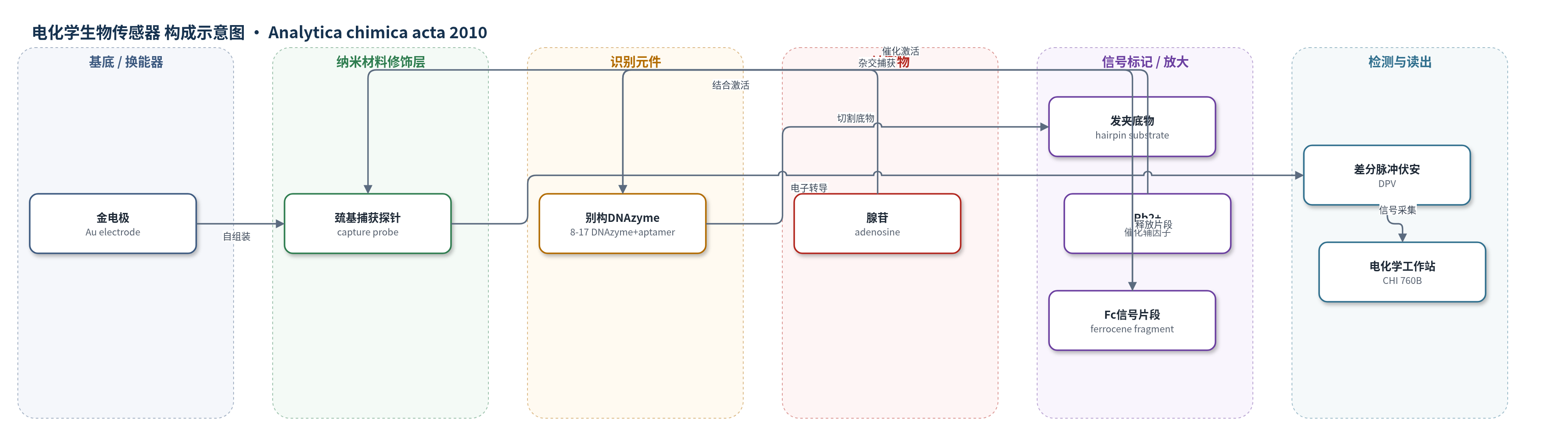
点击图片查看大图 · 依据论文自动绘制
传感器类型
电化学生物传感器
检测对象
腺苷(adenosine),样品基质为人血清(10倍稀释)及缓冲液
检测原理
腺苷与别构DNAzyme中的腺苷适配体结合,诱导适配体构象变化,通过链置换使5碱基抑制段从8-17 DNAzyme催化核心解离,DNAzyme由失活发夹态转变为活性构象。活性DNAzyme结合含核糖腺苷(ra)的发夹底物,在Pb2+存在下催化ra位点水解,将底物切割为两条单链片段。由于DNAzyme可多次周转切割多个底物,产生大量带二茂铁(Fc)标记的信号片段。Fc片段与金电极表面巯基化捕获探针杂交,使Fc氧化还原基团靠近电极,DPV/CV产生法拉第电流。腺苷浓度越高,释放并被捕获的Fc片段越多,峰电流越大。
检测灵敏度
LOD: 5 nM (S/N = 3);线性范围: 5 nM–2000 nM;线性方程: y = 141.7146 log x − 78.7772(y为峰电流 nA,x为腺苷浓度 nM);R = 0.994
效应效果
该传感器对腺苷具有良好选择性:2000 nM腺苷DPV峰电流为401.4 nA,而1 mM胞苷、鸟苷、尿苷分别仅36.85、22.81、37.91 nA,与空白21.63 nA同量级;突变DNAzyme或适配体的对照在100 nM腺苷下峰电流仅16.73和21.86 nA,说明识别与催化均必要。在人血清10倍稀释样品中加标10、100、1000 nM,回收率分别为91.2–94.3%、95.2–107.1%、98.7–108.2%,RSD为3.1%、7.5%、6.2%(n=5)。作者认为其灵敏度与宽线性范围优于光学DNAzyme传感器,可用于临床腺苷检测。
传感器的构成
- 工作电极:金电极(Au electrode,2 mm直径),作为换能器与电子转导基底。
- 自组装捕获层:巯基化捕获探针(thiolated capture probe,ATGGACCCAGACG-(CH2)6-SH),通过Au-S键固定于金表面,捕获Fc信号片段。
- 识别元件:腺苷适配体(adenosine aptamer,32碱基),识别腺苷并触发构象变化。
- 催化元件:8-17 DNAzyme,在Pb2+存在下催化核糖腺苷(ra)位点水解。
- 构象调控元件:5碱基抑制段(inhibitory segment),无腺苷时结合DNAzyme催化核心使其失活。
- 催化辅因子:Pb2+,激活8-17 DNAzyme切割活性。
- 底物/信号前体:发夹底物(hairpin substrate,NH2-CGTCTGGGTCCATraGATCAAACAGACG),被切割后释放信号片段。
- 信号标记物:二茂铁(ferrocene, Fc)标记片段,作为电化学氧化还原信号探针。
- 检测介质:Tris-acetate/NaCl缓冲液(50 mM Tris-acetate,0.3 M NaCl,pH 8.2)及PBS/NaClO4/NaCl,维持反应与电化学检测。
中文摘要
本文报道一种基于适配酶的电化学生物传感器,用于检测腺苷。通过在8-17 DNAzyme上连接含32碱基腺苷适配体的抑制剂寡核苷酸链,调节适配酶活性。无腺苷时,DNAzyme因与抑制剂链结合而不能形成合适催化结构;腺苷结合适配体后,抑制剂链从DNAzyme序列解离,使DNAzyme打开并结合发夹底物,在Pb2+存在下诱导DNAzyme活性,切割底物核糖核苷酸位点。切割产生两条单链产物,其中一条带二茂铁(Fc)标记,作为信号探针。修饰在金电极上的巯基化探针可捕获信号探针,使Fc靠近电极表面,观察到法拉第电流。该传感器动态范围为5 nM至2000 nM,检出限为5 nM,具有高灵敏度和良好选择性,有望用于临床检测腺苷。
英文摘要
In this work, an aptazyme-based electrochemical biosensor for the detection of adenosine is reported. Aptazyme activity was modulated by appending an "inhibitor" oligonucleotide strand containing a 32-base adenosine aptamer to the 8-17 DNAzyme. In the absence of adenosine, the DNAzyme could not form appropriate catalytic structure due to the binding with the inhibitor strand. Upon adenosine binding to the aptamer, the inhibitor strand was dissociated from the DNAzyme sequence. This allowed the DNAzyme to open and bind with the hairpin substrate, and DNAzyme activity was thereby induced, cleaving the substrate at its ribonucleotide site in the presence of Pb(2+). Cleavage of the substrate yields two single-stranded products, one of which was ferrocene-tagged and acted as the signal probe. The thiolated probe modified on the gold electrode could capture the signal probe. As a result, the ferrocene (Fc) moiety was brought in close proximity to the electrode surface and the Faradaic current was observed. This electrochemical biosensor was proved to have a wide dynamic range from 5 nM to 2000 nM with a detection limit of 5 nM. The fabricated sensor is shown to exhibit high sensitivity and desirable selectivity, which might be promising for the rational construction of aptazyme-based biosensors and the determination of adenosine in clinical examination.