组成图示
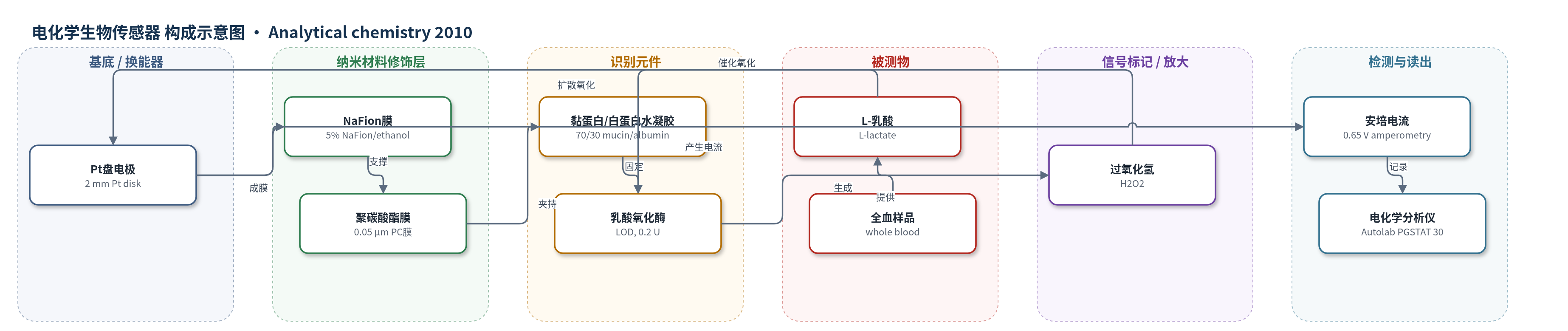
点击图片查看大图 · 依据论文自动绘制
传感器类型
电化学生物传感器
检测对象
L-乳酸(L-lactate);样品基质:全血(whole blood)及pH 7.0磷酸盐缓冲液
检测原理
该传感器以乳酸氧化酶(LOD)为识别元件。L-乳酸进入黏蛋白/白蛋白水凝胶后被LOD催化氧化为丙酮酸,LOD还原态被溶解氧再氧化并生成H2O2。H2O2为中性分子,可穿过带负电的NaFion膜到达Pt电极表面,在0.65 V下发生电化学氧化:H2O2→O2+2H++2e-,产生与乳酸浓度成正比的安培电流。NaFion膜排斥抗坏血酸、尿酸等带负电干扰物,从而降低干扰;聚碳酸酯膜和水凝胶基质固定酶并提高稳定性。信号大小取决于乳酸催化生成H2O2的速率及H2O2在电极上的氧化电流。
检测灵敏度
LOD: 0.8 µM;线性范围: 2至约1000 µM;灵敏度: (0.537 ± 0.007) mA M-1;5个月后线性范围: 2至800 µM;5个月后灵敏度: (0.51 ± 0.03) mA M-1
效应效果
5% NaFion/乙醇膜使100 µM抗坏血酸稳态电流降至(1.7±0.2) nA,较无膜降低超过96%;H2O2信号仅降低约15%,选择性提高。传感器5个月内灵敏度保持(0.51±0.03) mA M-1,线性上限降至0.8 mM;一年后灵敏度约为初始30%,NaFion膜使操作稳定性提高5倍以上。全血加标100 µM乳酸回收率为(89±6)%,未加标全血乳酸约(0.77±0.01) mM,符合健康人基础水平。论文未报告与ELISA、HPLC或qPCR的直接对比,作者认为其适合未处理全血中乳酸的快速直接检测,可每日或每周校准。
传感器的构成
- 工作电极:2 mm直径Pt盘电极(CH Instruments),作为换能器催化H2O2氧化并输出安培电流
- 抗干扰膜:5%(v/v)NaFion/乙醇溶液干燥成膜,排斥抗坏血酸等负电干扰物,允许中性H2O2通过
- 支撑限域膜:0.05 µm孔径聚碳酸酯(polycarbonate)膜,夹持酶基质并机械固定
- 酶固定基质:70/30质量比黏蛋白/白蛋白(mucin/albumin)水凝胶,负载LOD并维持酶活性
- 识别元件:乳酸氧化酶(LOD,0.2 U),催化L-乳酸氧化为丙酮酸并生成H2O2
- 交联剂:戊二醛(glutaraldehyde),交联黏蛋白/白蛋白基质以固定LOD
中文摘要
本文报道了一种用于乳酸定量检测的安培法生物传感器。该传感器仅需0.2 U乳酸氧化酶(LOD),将其固定在黏蛋白/白蛋白(mucin/albumin)水凝胶基质中;在铂(Pt)电极表面覆盖磺化氟聚合物膜(NaFion),可显著降低抗坏血酸等带负电干扰物的信号,使其接近不可检出。作者系统考察了不同浓度NaFion膜对H2O2和抗坏血酸电化学氧化的影响,发现5%(v/v)NaFion/乙醇膜在保持H2O2响应损失约15%的同时,可将抗坏血酸信号降低96%。在pH 7.0磷酸盐缓冲液中,催化电流与乳酸浓度在2至约1000 µM范围内呈线性关系,检出限为0.8 µM。传感器灵敏度为(0.537±0.007) mA M-1,5个月内基本保持不变,线性上限降至0.8 mM;全血加标100 µM乳酸的回收率为(89±6)%,表明其适用于未处理全血中乳酸的直接检测。
英文摘要
An amperometric sensor for lactate quantification is presented. The developed biosensor requires only 0.2 U of lactate oxidase, which is immobilized in a mucin/albumin hydrogel matrix. By protecting the platinum surface with a Nafion membrane, typical interference related to negatively charged species such as ascorbic acid has been minimized to practically undetectable levels. Electrochemical properties associated with the Nafion membrane are assessed as a function of Nafion concentration. In a phosphate buffer solution of pH 7.0, linear dependence of the catalytic current upon lactate bulk concentration was obtained between 2 and approximately 1000 microM. A detection limit of 0.8 microM can be calculated considering 3 times the standard deviation of the blank signal divided by the sensitivity of the sensor. The lactate biosensor presents remarkable operational stability and sensitivity (0.537 +/- 0.007) mA.M(-1), where the error is the standard deviation of the slope calculated from the linear regression of the calibration curve of a fresh biosensor. In this regard, the sensor keeps practically the same sensitivity for 5 months, while the linear range decreases until an upper value of 0.8 mM is reached. Assays performed with whole blood samples spiked with 100 microM lactate gave (89 +/- 6)% of recovery.