组成图示
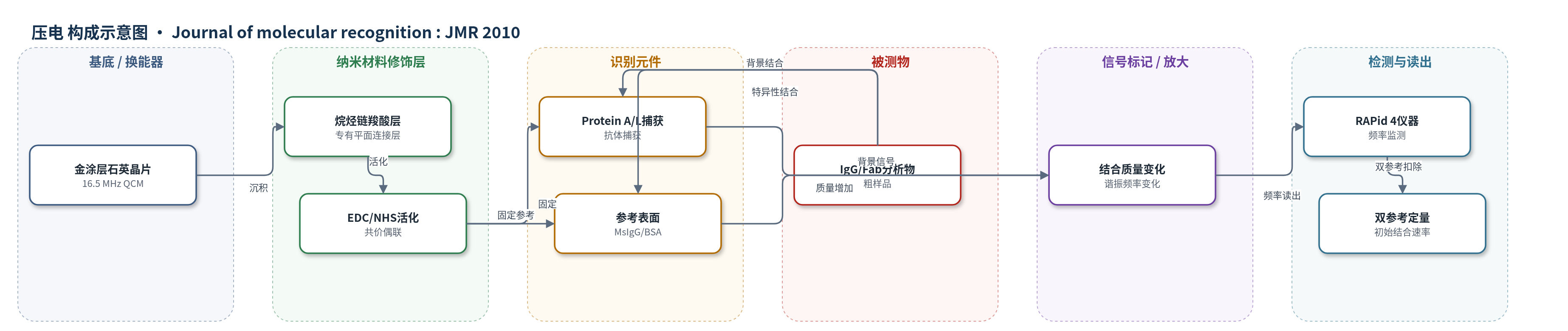
点击图片查看大图 · 依据论文自动绘制
传感器类型
压电(QCM)生物传感器
检测对象
小鼠免疫球蛋白 G(mouse IgG, MsIgG)、人免疫球蛋白 G(human IgG)、抗体 Fab 片段(Fab fragment);样品基质:LB 培养基、DMEM 含 10% FCS 细胞培养上清、人血清(10–75%)、周质提取物等粗样品。
检测原理
RAP 基于高频石英晶体微天平(QCM)原理:金涂层石英晶片表面经烷烃链羧酸连接层、EDC/NHS 活化后共价固定 Protein A、Protein L 或抗体作为识别元件。当样品中的 IgG 或 Fab 片段与表面捕获元件结合时,界面质量增加,使 16.5 MHz 谐振器的谐振频率发生可测变化。RAP 对折射率变化不敏感,因此可在未稀释培养基、血清等复杂基质中直接检测;样品粘度变化引起的 bulk shift 通过并行参考通道(MsIgG 或 BSA)和空白缓冲液进行双参考扣除。结合初期频率变化速率(Hz/s)与待测物浓度近似成正比,用已知浓度标准建立标准曲线,即可从初始结合速率定量未知样品浓度。
检测灵敏度
测量范围: 100–0.2 mg/ml(Fab,DMEM 含 10% FCS);动态范围: 3-log dynamic range
效应效果
Protein A 表面在 240 次连续注射中初始结合速率为 10.3±0.6 Hz/s(RSD 5.8%),结合水平为 249.7±7.3 Hz(RSD 2.9%),至少可稳定使用 1000 次注射后再校准。Protein L 表面 252 次注射初始结合速率为 1.3±0.1 Hz/s(RSD 9.4%),至少 1000 次注射后 RSD 不超过 10%。人 IgG 在含 10%、25%、50% 和 75% 人血清中结合信号与缓冲液几乎无差异,显示抗血清干扰能力。Fab 在 DMEM 含 10% FCS 中可在 100–0.2 mg/ml 范围检测。作者认为 RAP 可免纯化直接分析细胞培养上清、表达培养基和周质提取物,适用于生物药开发、免疫原性研究和生产质量控制。
传感器的构成
- 基底/换能器:金涂层石英晶片(gold-coated quartz wafer),16.5 MHz 谐振器,无应力安装于亚克力盒,提供压电换能与频率读出
- 表面连接层:专有平面紧凑烷烃链连接层,以羧酸基团终止,提供蛋白固定表面
- 活化/偶联层:EDC/NHS 活化羧基形成 NHS 酯,用于共价固定蛋白
- 识别/捕获元件:Protein A、Protein L 或抗体(RaM-Fc、MsIgG、IgG Fab 片段)固定于表面,捕获 IgG/Fab 或作为结合配体
- 参考通道:非特异 MsIgG 或 BSA 表面,用于双参考扣除背景
- 封闭剂:乙醇胺(ethanolamine)封闭未反应 NHS 酯/羧基,减少非特异结合
- 读出系统:RAPid 4 仪器与 RAP Workbench 软件,监测谐振频率变化并计算初始结合速率
中文摘要
检测蛋白–蛋白识别的分子基础是理解蛋白功能的关键,因为蛋白与其他蛋白形成特异性复合物的能力支撑着大多数细胞过程。标记方法存在局限,如标记会改变结合动力学、难以检测生化活性,并增加检测开发步骤,因此推动了无标记检测格式的发展。尽管光学系统主导无标记生物传感器市场,电化学、压电和声学器件是功能相似且成本显著更低的替代方案。声学生物传感器已用于无标记检测从界面化学、脂质膜、小分子到完整细胞的广泛分析物。共振声学分析(RAP)技术可提供无标记、实时的生物分子相互作用分析,是优化重组蛋白开发与生产流程的高效手段。RAP 只测量物理结合事件,对折射率和颜色变化不敏感,因此可在未稀释的粗样品和复杂样品(如细胞培养基或周质提取物)中直接测量,无需密集校准。该优势简化实验设计,避免对有限材料进行昂贵且耗时的纯化,同时提供高信息量,从而降低成本并提高通量与信息密度,使过程优化与控制更有效。
英文摘要
Detecting the molecular basis of protein-protein recognition is an essential element in understanding protein function because their ability to form specific complexes with other proteins underlies most cellular processes. The use of labels has limitations, such as changes to the binding kinetics due to the alterations in structure and function that occur with label addition, difficulty in detecting biochemical activities and the need for additional steps in assay development. These issues have driven the development of label-free formats for identifying the full range of biochemical activities. Although optical-based systems dominate the label-free biosensor market, electrochemical, piezoelectric and acoustic devices represent similar but significantly less expensive alternatives. Acoustic biosensors have been employed in the label-free detection of an incredibly broad range of analytes, from interfacial chemistries and lipid membranes, to small molecules and whole cells. Resonant acoustic profiling (RAP) technology offers label-free, real-time analysis of biomolecular interactions and offers an efficient way to optimize the development and production process of recombinant proteins. RAP measures only the physical binding events and is insensitive to refractive index and colour changes. This enables direct measurement in undiluted crude and complex samples, such as cell culture media or periplasmic extracts, without intensive assay calibration. This advantage simplifies experimental design and eliminates expensive time-consuming purification of often limited material, while delivering high content information. In this respect RAP technology reduces costs and increases the throughput and the density of information to optimize and control the processes more effectively.